Why Structure Matters More Than Repetition
Many pet owners assume that training success comes down to doing more - more repetitions, more commands, more time. Behavioral science tells a different story. What actually drives learning is the structure of practice: how sessions are timed, how cues are delivered, and how consistently reinforcement follows the behavior you want.
Operant conditioning - the learning process underlying most animal training - depends on clear, immediate connections between behavior and consequence. When those connections are muddled by inconsistent timing or unpredictable cues, even a motivated pet struggles to form reliable habits. A well-structured routine removes that guesswork. For a deeper look at how different animals learn, see how dogs, cats, rabbits, and birds learn differently.
Designing Sessions Your Pet Can Actually Succeed In
The most common training mistake isn't choosing the wrong technique - it's choosing the wrong session length. Fatigue and frustration degrade learning rapidly. For most dogs and cats, sessions of three to five minutes repeated two or three times a day outperform a single 20-minute block. Small animals like rabbits and birds often do best with even shorter bursts of one to two minutes.
Start every session at a level where your pet can succeed immediately - this builds engagement and keeps motivation high. End on a successful repetition, not a failed one. If your pet starts showing stress signals - yawning, lip-licking, turning away, or repeated errors - that's your cue to stop. Reading your pet's body language during sessions helps you catch these signals before frustration takes hold.
Timing, Consistency, and the Reinforcement Window
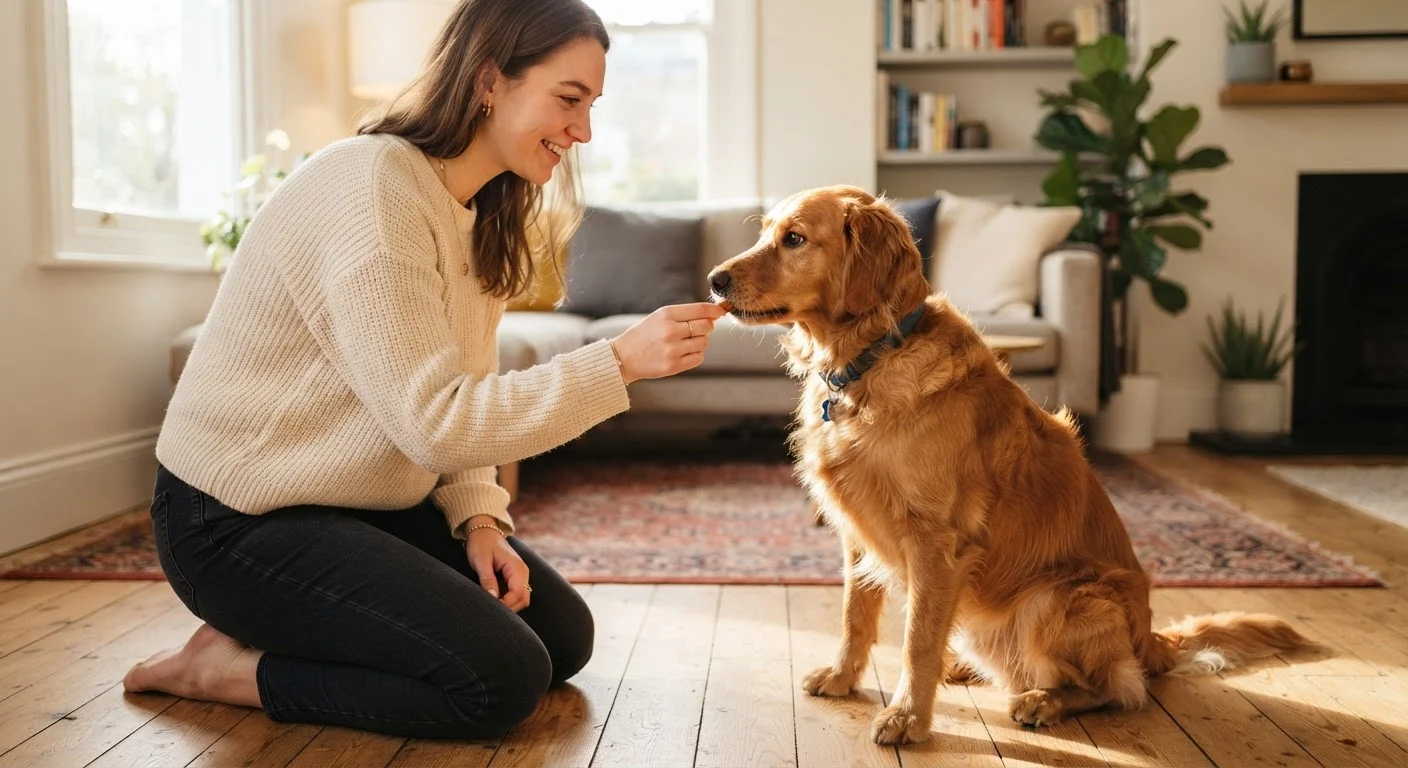
Reward timing is one of the most critical variables in any training program. Research in animal learning consistently shows that reinforcement delivered within one to two seconds of the target behavior produces faster, more durable learning than delayed rewards. This is why marker training tools - whether a clicker or a short verbal cue like "yes" - are so effective: they bridge the gap between the moment the behavior occurs and the moment the treat arrives. Learn more about the differences in clicker versus verbal marker training.
Consistency matters just as much. Use the same word, tone, and hand signal for each cue every single time. Pets don't generalize language the way humans do - a sit cue whispered softly and a sit cue said firmly can register as two entirely different signals. Establish your cue vocabulary early and stick to it across all family members who interact with the pet.
Generalization Takes Intentional Practice
A behavior learned in one room or context isn't automatically understood everywhere. Once your pet performs a cue reliably at home, begin practicing it in slightly different locations, with mild distractions present. Gradually increase difficulty as reliability improves. This process - called generalization - is what produces a pet that responds in real-world situations, not just in a quiet training setup.
Fitting Training Into Real Daily Life
Training doesn't require dedicated blocks of time carved out of a busy schedule. Some of the most effective practice happens in everyday moments: asking for a sit before a meal, a down-stay while you prepare food, or a recall before opening a door. These real-life repetitions reinforce behavior in varied contexts, which is essential for generalization - meaning your pet performs the behavior reliably in different locations and situations, not just in one spot at home.
Anchoring training to existing routines dramatically improves consistency. If your dog already expects breakfast at 7 a.m., a brief two-minute session just before feeding becomes a natural part of the morning. Predictable daily schedules reduce stress and make pets more receptive to learning. If you're still setting up the foundations of your pet's environment and management tools, the pre-training preparation checklist is a useful starting point.