
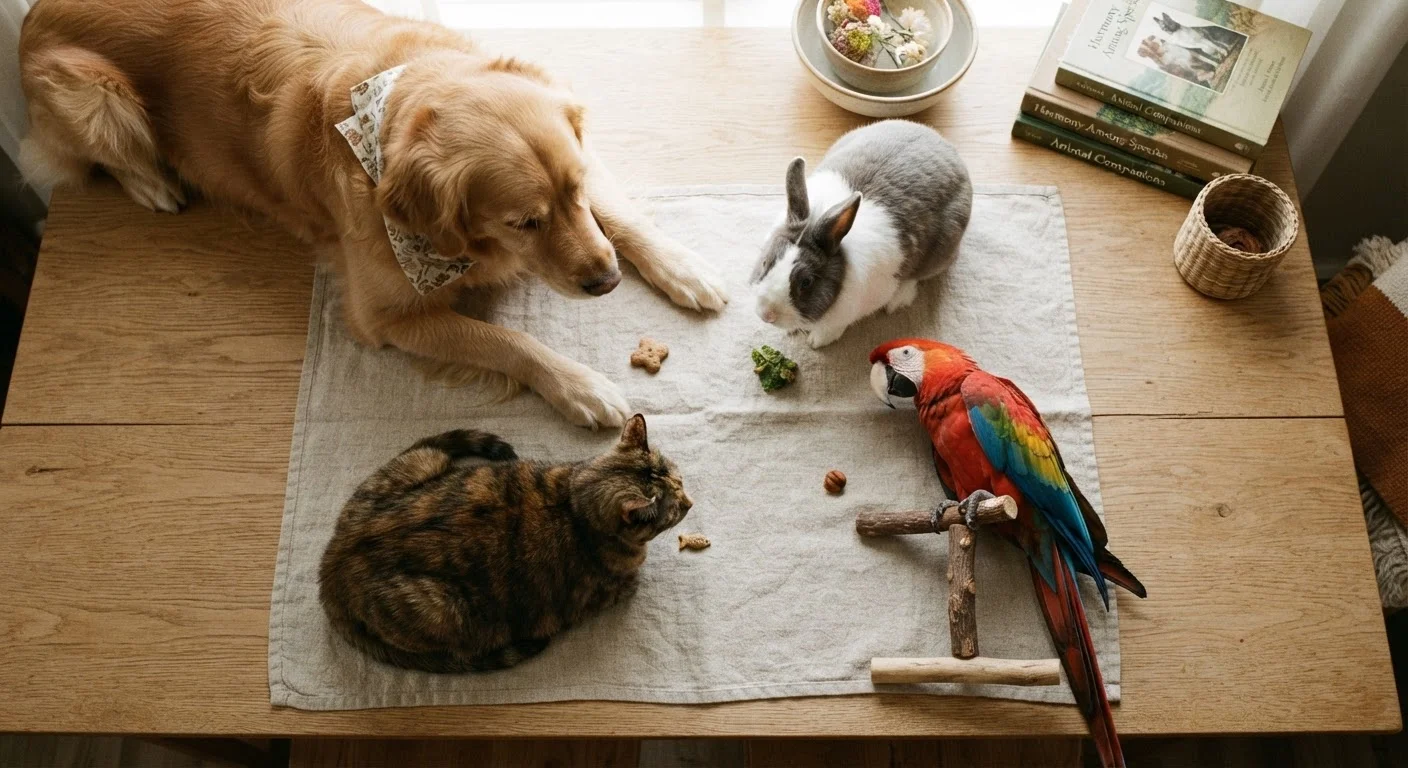
Why One-Size Training Fails Across Species
Most popular pet training advice is built around dogs - and for good reason. Dogs have co-evolved with humans for tens of thousands of years, developing remarkable sensitivity to human gestures, eye contact, and social approval. But that evolutionary history also means dog-centric advice can seriously mislead owners of cats, rabbits, or birds who expect the same social engagement.
The core principles of learning science - operant and classical conditioning - apply to all vertebrates. What differs profoundly between species is what motivates them, how they perceive the world through their senses, and what their natural social structures look like. A rabbit is a prey animal whose nervous system is tuned for threat detection, not performance. A parrot is a highly intelligent, flock-oriented animal that needs cognitive challenge alongside reinforcement. Understanding these differences isn't just interesting biology - it's the foundation of effective, humane training. See how positive reinforcement works across species for a deeper look at the conditioning principles that underpin all of these approaches.
Dogs: Social learners driven by relationship
Dogs are exceptionally tuned to human social signals. Research published in animal cognition journals consistently shows that dogs follow human pointing gestures, interpret gaze direction, and respond to emotional tone in ways that no other domesticated species reliably matches. This means eye contact, body language, and your own enthusiasm are genuine training tools - not just nice extras.
Food rewards are highly effective, but many dogs also work enthusiastically for play, praise, or access to a favorite activity. The key is identifying your individual dog's reinforcement hierarchy - what they want most in a given moment - and using that strategically. Avoid long, repetitive drills; dogs disengage when tasks feel rote. End every session on a success, and vary the exercises to keep motivation high. Because dogs read social cues so readily, accidental reinforcement (rewarding unwanted behavior with attention) is also a common pitfall to manage deliberately.
Dogs read human social cues so precisely that your own body language is a training tool in itself.
Cats: Independent operators who train on their own terms
Cats are not simply small, uncooperative dogs. As solitary hunters, they have little evolutionary history of deferring to social hierarchies or seeking group approval. This means social praise rarely motivates them, and training sessions must be initiated when the cat is already in an alert, relaxed state - not when they are sleepy or overstimulated.
Clicker training works well with cats precisely because it provides a clear, immediate signal that a reward is coming, removing ambiguity. Food rewards - especially high-value options like small pieces of cooked chicken or commercial treats - are typically the most reliable currency. Keep sessions to two or three minutes maximum. Cats that disengage should never be pushed; ending the session and trying again later is always the right call. Many cats also respond well to target training (touching a stick or hand with their nose), which can be a gateway to more complex behaviors like jumping through hoops or navigating agility courses.
Cats train on their own schedule - pushing a disengaged cat never produces learning, only avoidance.
Rabbits: Prey animals that learn through safety and gentleness
Rabbits are fundamentally different from dogs and cats in one critical way: as prey animals, their default stress response is freezing, fleeing, or hiding - not engaging with a potential threat. Any training approach that involves pressure, looming body postures, loud sounds, or sudden movements can trigger a fear state that makes learning impossible and can cause chronic stress.
Effective rabbit training begins with trust-building. Sit on the floor at the rabbit's level and allow them to approach you. Once your rabbit is comfortable in your presence, food-based reinforcement (small pieces of leafy greens, herbs, or approved commercial treats) can teach recall, litter habits, and even simple agility behaviors. Rabbits have a keen sense of smell and sharp hearing, so use these sensory strengths: a consistent verbal cue combined with a specific scent or sound marker can become a reliable signal. Progress will feel slower than with dogs - celebrate small steps and never interpret a lack of response as stubbornness. For broader guidance on everyday rabbit care and housing, foundational husbandry is always the first pillar.
Rabbit training starts with earning trust at ground level - fear responses shut down all learning pathways.
Parrots and pet birds: Cognitive athletes that need mental challenge
Parrots - and many other pet bird species - are among the most cognitively sophisticated animals kept as companions. Species such as African greys, cockatoos, and Amazon parrots have demonstrated problem-solving, tool use, and vocal learning at levels that rival great apes in some research contexts. This cognitive depth is a significant asset in training, but it also means that birds who are understimulated, ignored, or trained through aversive methods can develop behavioral problems including feather-destructive behavior, aggression, or excessive vocalization.
Positive reinforcement using food (small pieces of preferred fruit, a favored seed, or a nutritional treat) works well, but variety matters enormously. A bird that receives the same reward in the same sequence across sessions will quickly lose motivation. Rotate reinforcers, introduce novel behaviors regularly, and incorporate foraging-based rewards - hiding food inside a puzzle toy as part of the session - to tap into natural behavior. Birds are also acutely sensitive to your emotional state; a tense or frustrated trainer will produce a tense or defensive bird. Keep energy calm and sessions brief: three to five minutes is typically optimal.
Birds are cognitively sophisticated enough that repetitive, unvaried training sessions will bore them into disengagement.
Cross-species principle: Timing and reinforcement schedules matter for all
Regardless of species, the timing of reinforcement is the single most critical mechanical skill in training. A reward delivered even two or three seconds after the desired behavior loses much of its communicative power, because the animal has moved on to other actions in the interval. This is why clicker training (using a distinct sound as a precise marker, then delivering food) has become a foundational tool across species - it bridges the gap between behavior and reward with scientific precision.
Reinforcement schedules - how often and how predictably rewards are delivered - also shape behavior durability. Initially, rewarding every correct response (continuous reinforcement) builds the behavior fastest. Once established, shifting to variable reinforcement, where rewards come unpredictably, makes behaviors more resistant to fading. This principle applies equally to a dog learning to sit, a rabbit learning to recall, and a parrot learning to step up. Understanding how animal behavior science debunks common training myths can help owners sidestep outdated approaches that slow progress for every species.
Precise timing of reinforcement is the one mechanical skill that elevates training quality across every species.
Applying Species Knowledge to Your Daily Practice
The most important shift an owner can make is moving from a correction-based mindset to a curiosity-based one. Ask what your specific animal finds genuinely rewarding - not what you think they should want. Ask how their senses filter the environment, and design your cues accordingly. A cat trained with a clicker needs the click to be paired with food precisely and immediately; a rabbit trained in short, gentle sessions needs the room to feel safe before learning can happen at all.
Match your session length to the species
Dogs can often sustain focused training for ten to fifteen minutes, especially when tasks are varied. Cats, rabbits, and most birds hit their engagement ceiling much sooner - two to five minutes per session is a practical target. Multiple short sessions spread across the day consistently outperform a single long one, and they help you catch your pet at the moments when they are naturally most alert and food-motivated.
For all species, short sessions - two to five minutes, repeated several times a day - outperform marathon training blocks. Building a consistent daily training routine is one of the highest-leverage things any owner can do, regardless of which animal they share their home with. And if you encounter unfamiliar terminology in training resources, a plain-language training glossary can help you decode the concepts quickly.
This article is for general informational and educational purposes only and does not constitute professional veterinary or behavioral advice. Consult a qualified veterinary behaviorist or certified animal trainer for guidance tailored to your individual pet.