
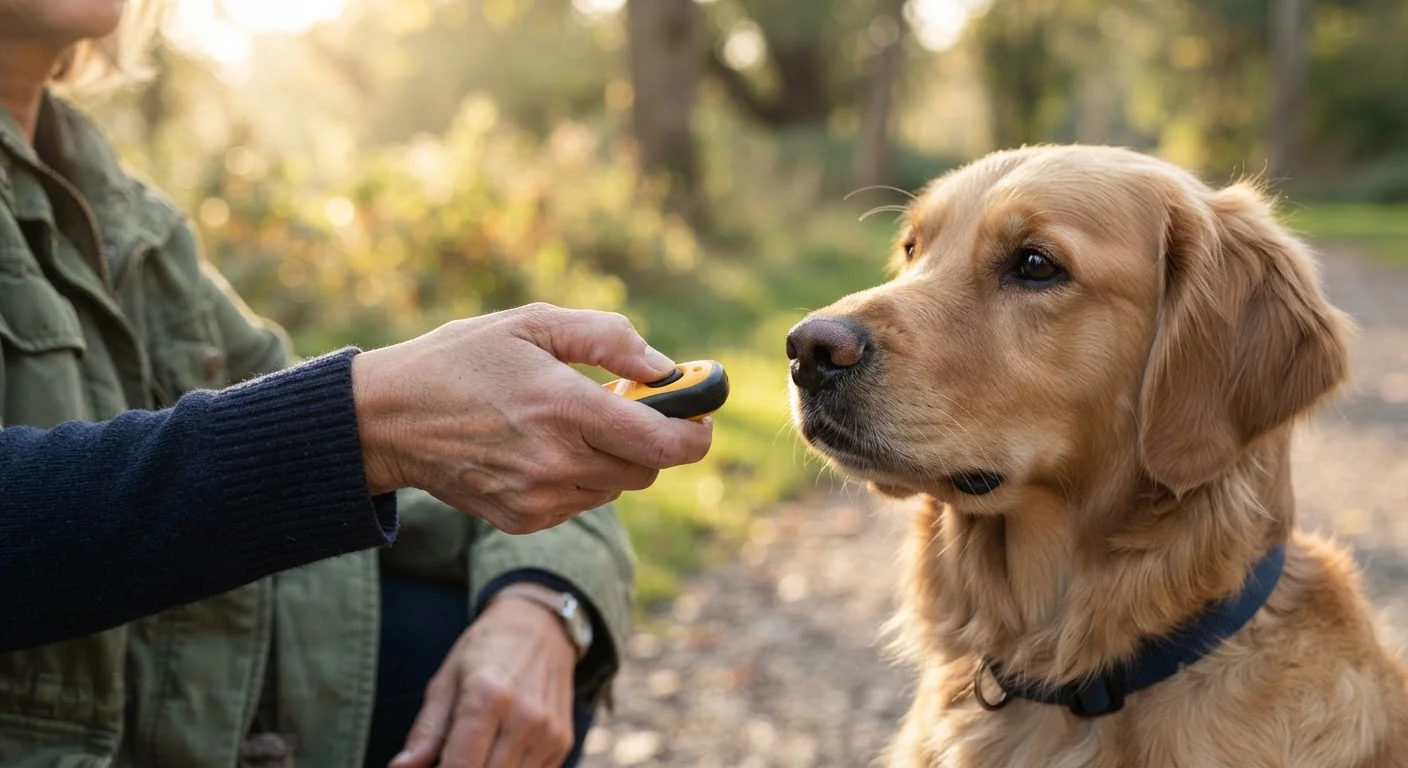
What Both Methods Share: The Conditioned Reinforcer
Before comparing the two, it helps to understand what both clicker and verbal marker training have in common. Each method relies on a conditioned reinforcer - a previously neutral signal that acquires meaning through repeated pairing with something the animal values, such as food or play. When the marker sounds, the animal learns it predicts a reward is coming.
This process draws directly from operant conditioning, specifically the principle of marking behavior at the moment it occurs. Because rewards take a second or two to deliver, the marker bridges the gap between the behavior and the payoff. Positive reinforcement is the engine driving both approaches - the marker simply tells the animal, with precision, exactly what earned it.
Before starting either approach, it is worth reviewing key training terms like reinforcement schedules and shaping so you understand the framework you are working within.
| Criterion | Clicker Training | Verbal Marker Training |
|---|---|---|
| Signal consistency | Identical every time | Varies with tone and mood |
| Equipment required | Yes - handheld clicker | None |
| Ease for beginners | Moderate - requires coordination | High - no extra tool to manage |
| Best for shaping complex behaviors | Very effective | Effective with practice |
| Works across species | Widely documented | Most common in dogs and cats |
| Hands-free use | No | Yes |
| Risk of emotional bleed | Very low | Moderate - voice carries emotion |
The Case for Clicker Training
A clicker produces a short, mechanically consistent sound - the same pitch, volume, and duration every single time. That acoustic uniformity is its primary advantage. Unlike a human voice, which shifts in tone depending on mood, excitement, or fatigue, the click sounds identical whether you are calm or thrilled. Animals, particularly dogs, respond to the emotional quality of sounds, and a neutral, predictable signal may be processed more cleanly as information rather than as an emotional cue.
Clickers are especially well suited to shaping - a training technique in which you reward successive approximations of a final behavior. Because shaping requires rapid, precise marking of very small behavioral steps, the click's distinctiveness gives it an edge. Professional trainers working across species, from dogs to marine mammals to parrots, have long relied on clicker-based systems for this reason. See how training approaches differ across species in our guide to training dogs, cats, rabbits, and birds.
< 1-2 sec
Optimal marker-to-behavior window
Animal learning research consistently indicates that markers delivered within one to two seconds of a behavior produce the strongest association between signal and action.
10-20×
Recommended marker loading repetitions
Most applied behavior analysts recommend pairing a new marker with reward at least 10 to 20 times in a distraction-free environment before using it in active training.
The main limitation is portability of attention: you must have a clicker in hand, which can be awkward during leash walks, when managing multiple pets, or in spontaneous real-life situations.
The Case for Verbal Marker Training
A verbal marker - most commonly the word yes or good - works on the same conditioned reinforcer principle. Through consistent pairing with rewards, the word becomes a reliable signal of incoming reinforcement. The obvious advantage is availability: your voice is always with you.
This accessibility makes verbal markers particularly effective once the marker is well established. During a walk when you catch your dog choosing to check in with you rather than lunge at a squirrel, you can mark that moment instantly without fumbling for a device. The verbal marker also integrates more naturally into the flow of daily life, which matters for building a consistent training routine.
The challenge is vocal consistency. Tone, timing, and enthusiasm can vary, especially for beginners. Some trainers mitigate this by practicing delivering their marker word in a flat, uniform tone rather than an excited one, which preserves its informational clarity. For animals attuned to human emotion - many dogs especially - an overly enthusiastic verbal marker can trigger excitement that disrupts the very behavior you intended to reward.
Paying attention to how your pet responds moment-to-moment also matters. Learning to read engagement signals and stress cues helps you adjust your timing and delivery in real time. Our guide on reading your pet's body language during training covers what to look for.
Choosing - or Combining - Both
Neither method is universally superior. The right choice depends on your training goals, your animal's sensitivity, and your own consistency as a handler. Some trainers use a clicker for formal training sessions where precision matters and switch to a verbal marker for real-world reinforcement throughout the day - getting the benefits of both.
What matters most in either case is timing. Research in animal learning consistently shows that markers landing more than one to two seconds after a behavior lose effectiveness because the animal cannot reliably connect the signal to what it just did. Practice the mechanical habit of marking first, then reaching for the reward.
A Note on Multi-Pet Households
If you are training more than one animal at the same time, verbal markers can cause confusion - one pet hears the cue intended for another. In multi-pet sessions, clickers are generally easier to direct at the intended animal, especially when combined with physical targeting or station training. Always set each animal up for success by separating sessions when introducing a new behavior.
Whichever marker you choose, load it thoroughly before expecting results: pair the signal with a high-value reward at least 10 to 20 times in a low-distraction setting before using it to mark complex behavior. Both methods reward patient, methodical owners equally.