
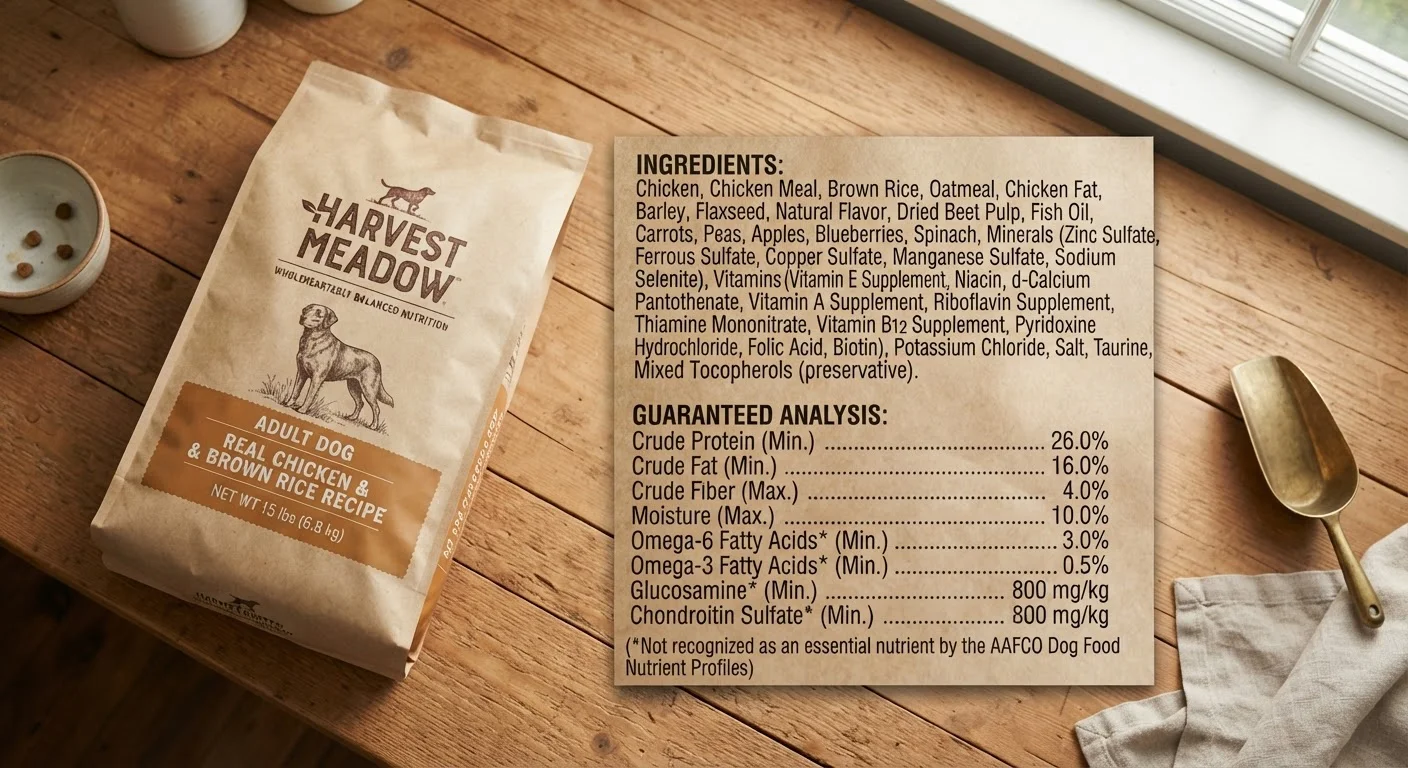
How Pet Food Labels Are Legally Structured
Pet food sold in the United States is regulated by a combination of federal and state authorities, with most states adopting the model regulations developed by the Association of American Feed Control Officials (AAFCO). These rules dictate exactly what must appear on packaging and in what form - so every label you pick up follows the same underlying framework.
Every compliant label includes five core elements: a product name and species designation, a net weight statement, a manufacturer's name and address, a guaranteed analysis panel, and an ingredient list. The AAFCO nutritional adequacy statement - often called the "complete and balanced" statement - is also required for foods intended as a primary diet. That statement tells you whether a food meets established nutrient profiles through formulation or through actual feeding trials, a distinction worth understanding. For a broader walkthrough of each label section, see our guide to reading a pet food label without getting lost in the fine print.
Decoding the Ingredient List
Ingredients are listed in descending order by pre-cooking weight, which means the first few items make up the largest portion of the recipe by mass before processing. A named protein source - such as chicken, salmon, or beef - appearing first is generally a positive sign, but it doesn't automatically guarantee a high protein content in the finished product, because raw meat contains substantial moisture that evaporates during manufacturing.
Watch for the practice sometimes called ingredient splitting: a manufacturer may list several forms of the same base ingredient separately (for example, ground corn, corn gluten meal, and corn bran) so that each appears lower on the list individually, even though corn collectively represents a large proportion of the diet. The same principle applies to human nutrition labels - our guide on what ingredient list order and terminology reveal explains this technique in detail.
Terminology matters, too. "Chicken meal" is a concentrated, rendered protein source with moisture already removed and is not inferior to whole chicken in protein density. "Poultry by-product meal," by contrast, refers to rendered animal parts excluding muscle meat - legally defined and nutritionally variable. "Meat and bone meal" without a named species is a less specific designation. None of these are automatically harmful, but specificity gives you more information to work with.
Guaranteed Analysis (GA)
The panel on a pet food label listing minimum or maximum percentages of key nutrients including crude protein, crude fat, crude fiber, and moisture. It reflects as-fed nutrient content, not dry matter content.
AAFCO
The Association of American Feed Control Officials, a non-governmental organization that develops model regulations for pet food labeling and nutrient profiles adopted by most U.S. states.
Dry Matter Basis
A method of comparing nutrient levels across pet foods by mathematically removing moisture from the equation, enabling fair comparison between wet and dry formats.
Ingredient Splitting
A labeling practice where a single ingredient source is listed under multiple names or forms, causing each to appear lower on the ingredient list than the ingredient's total contribution would suggest.
Crude Protein
A laboratory measurement of protein content based on nitrogen levels in the food. The term 'crude' refers to the measurement method, not the quality of the protein source.
Meal (as in Chicken Meal)
A rendered, moisture-removed concentrate of an animal protein source. Because moisture has already been extracted, meal is protein-dense and not nutritionally inferior to whole fresh meat by weight after cooking.
Reading the Guaranteed Analysis Panel
The guaranteed analysis (GA) panel lists minimum or maximum percentages for four core nutrients: crude protein (minimum), crude fat (minimum), crude fiber (maximum), and moisture (maximum). Some labels voluntarily add guarantees for ash, omega fatty acids, or specific minerals.
One important limitation: the GA reports as-fed percentages, meaning the numbers reflect the food as it comes out of the bag or can, moisture included. Comparing a canned food's crude protein (often 8-12%) directly to a dry kibble's (often 25-32%) is misleading because canned food typically contains 75-82% moisture. To compare foods on equal footing, nutritionists use a dry matter basis calculation: divide the as-fed nutrient percentage by the dry matter percentage (100 minus moisture %) to get a moisture-free comparison. For a side-by-side look at how wet and dry formats differ nutritionally, see our breakdown of wet food vs. dry food differences.
"Crude" in these labels refers to the measurement method, not quality - crude protein is measured by nitrogen content, which is why exotic, non-protein nitrogen sources can technically inflate the number without adding nutritional value.
Dry Matter Basis: A Quick Example
If a canned food lists 10% crude protein and 78% moisture, its dry matter protein is roughly 45% (10 ÷ 22 × 100). A kibble with 30% crude protein and 10% moisture yields about 33% dry matter protein. This calculation gives you a meaningful comparison across formats rather than an apples-to-oranges reading of the as-fed panel.
Common Label Claims and What They Actually Mean
Marketing language on the front of the bag is largely unregulated in the same way ingredient lists are, so understanding a few AAFCO-backed naming conventions helps separate meaningful claims from promotional language.
- The "95% rule": If a product is named "Chicken for Dogs," at least 95% of the total product weight (excluding water added for processing) must be that named ingredient.
- The "25% or dinner rule": Words like "dinner," "entrée," "platter," or "formula" signal that the named ingredient makes up 25-94% of the product.
- The "with" rule: "Dog Food with Chicken" requires only 3% of the named ingredient.
- The "flavor" rule: A "Chicken Flavor" product must contain enough of the ingredient to be detectable but has no minimum percentage requirement.
Claims like "natural" and "organic" are separately defined. "Natural" under AAFCO means no chemically synthesized ingredients, with limited exceptions. "Organic" requires USDA certification of ingredients. Neither term is a guarantee of nutritional completeness or overall diet quality.
Feeding your pet well also means feeding appropriate amounts - label feeding guides are starting points, not precise prescriptions. Our article on why overfeeding harms your pet's health puts portion context into practice. For any questions about your specific pet's dietary needs, consult your veterinarian, particularly for animals with health conditions, life stage changes, or food sensitivities.
This article is for general informational purposes only and is not a substitute for professional veterinary nutritional advice. Always consult a licensed veterinarian regarding your pet's individual dietary needs.