Why Ingredient Lists Follow a Specific Structure
In the United States, the Food and Drug Administration (FDA) requires that food manufacturers list every ingredient in descending order of predominance by weight. That means the first ingredient contributes the most to the product's total weight, and the last contributes the least. This single rule is the most useful lens you can apply when scanning a label.
For example, if a loaf of bread lists enriched flour first and whole wheat flour fourth, the product contains substantially more refined flour than whole grain - regardless of what the front of the package claims. Understanding this framework lets you look past marketing language and evaluate what's actually inside.
This article walks you through the practical steps for reading an ingredient list accurately. For a broader look at the numbers alongside these ingredients, see what the Nutrition Facts panel is telling you.
What you will need
Step-by-Step: How to Read an Ingredient List
Follow these steps each time you examine a packaged food label. With practice, the process takes only a few seconds per product.
Locate the ingredient list
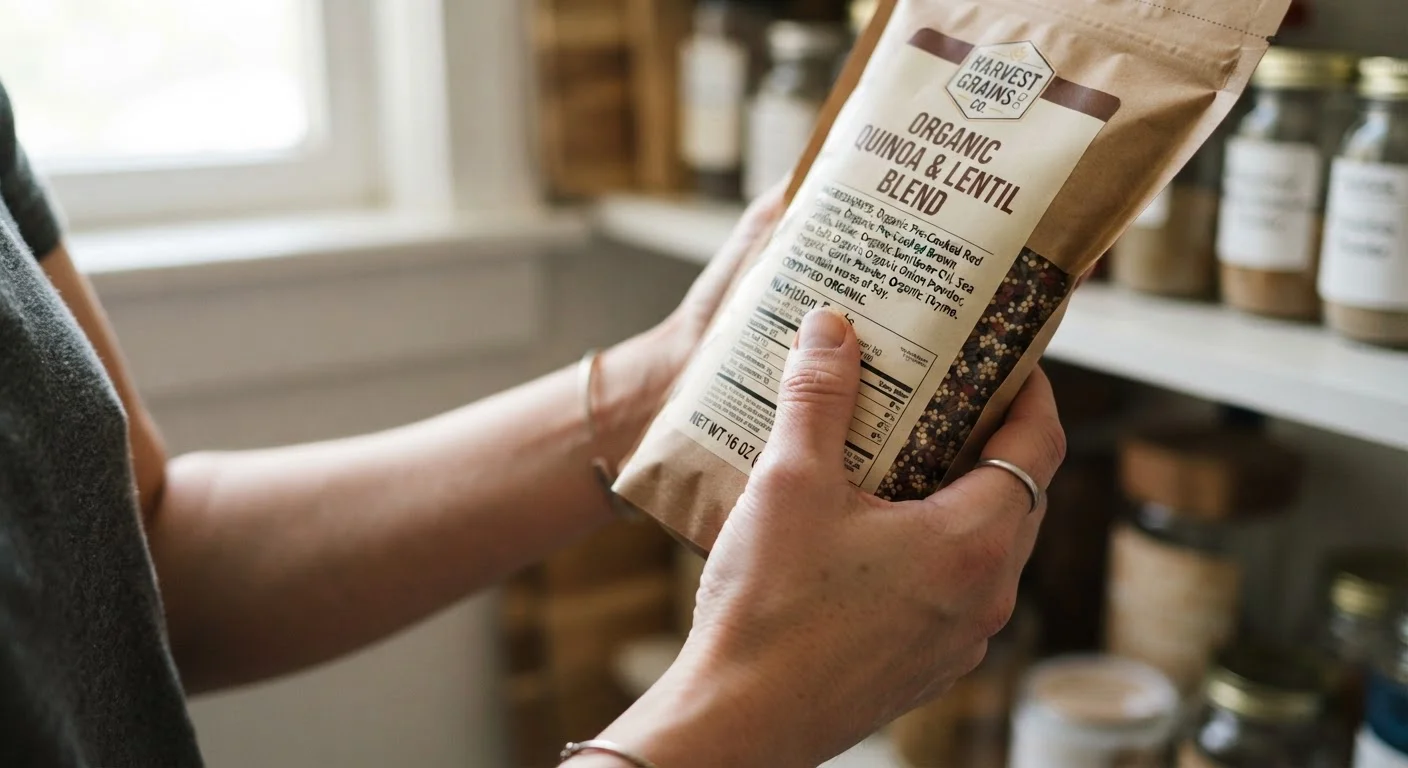
Find the ingredient list on the package - typically on the back or side panel, often near or below the Nutrition Facts label. On very small packages, it may appear on the bottom. Federal regulations require it to be present and legible on virtually all packaged foods sold in the US.
Read the first three to five ingredients closely
Because ingredients are listed by descending weight, the opening entries represent the bulk of what you're eating. Pay attention to whether the first ingredient is a whole food (e.g., whole oats, skim milk) or a refined or processed one (e.g., enriched wheat flour, sugar). The top three to five entries alone tell you a great deal about the product's character.
Scan for repeated versions of the same ingredient
Manufacturers sometimes list multiple forms of the same substance - particularly sugars and sodium compounds - at different positions in the list. Each individual entry may appear minor, but cumulatively they can represent a substantial portion of the product. Scan the full list and mentally group aliases before drawing conclusions.
Check parenthetical sub-ingredient lists
Any compound ingredient must declare its own components in parentheses. Read these nested entries the same way you read the main list - by descending weight within that sub-component. This is where less obvious additives, flavor enhancers, or processing aids often appear.
Note allergen disclosures
The FDA requires that the eight major allergens - milk, eggs, fish, shellfish, tree nuts, peanuts, wheat, and soybeans - be declared either within the ingredient list itself or in a separate Contains: statement immediately following it. Sesame was added as a ninth major allergen with requirements phased in starting in 2023. Cross-check both locations if you or someone you cook for has a food allergy.
Cross-reference with the Nutrition Facts panel
The ingredient list tells you what is present; the Nutrition Facts panel tells you how much - in grams, milligrams, and as a percentage of Daily Value. Use them together. A product might list a whole grain first but still deliver high sodium or saturated fat levels that the ingredient list alone wouldn't reveal.
Decoding Terminology and Common Aliases
Ingredient lists use technical, chemical, or trade names that often obscure familiar substances. Three categories are especially worth knowing.
Sugar Aliases
Added sugars appear under dozens of names: high-fructose corn syrup, cane juice, dextrose, maltose, agave nectar, fruit juice concentrate, and many others. When several of these appear at different positions in the list, their combined contribution may be significant even if no single entry ranks first. For a deeper explanation of why added sugars are tracked separately from naturally occurring ones, see the science behind added sugar.
Sodium Aliases
Sodium hides behind names like monosodium glutamate (MSG), sodium bicarbonate, sodium nitrate, disodium phosphate, and sodium benzoate. The Nutrition Facts panel reports total sodium in milligrams, but the ingredient list tells you which forms are present.
Fat Aliases
Oils appear under their source names - palm kernel oil, hydrogenated soybean oil, interesterified fats. The word hydrogenated signals partial or full processing that changes the fat's structure, a distinction worth noting.
Length Alone Doesn't Tell the Story
A long ingredient list isn't automatically a red flag. Some minimally processed foods - like a multigrain trail mix - legitimately contain many ingredients. Conversely, a short list can include highly refined components. Focus on what the ingredients are and where they appear, not just how many there are.
What Sub-Ingredient Lists and Label Claims Mean
When a recipe-style ingredient - such as a sauce, seasoning blend, or breading - is included in a product, manufacturers must disclose its own components in parentheses immediately after. For instance: Seasoning (salt, garlic powder, paprika, yeast extract). These nested lists can be dense, but they follow the same weight-descending rule within themselves.
Front-of-package claims like natural, made with real fruit, or multigrain are not regulated in the same rigorous way as the ingredient list itself. Always cross-reference a front label claim with the actual ingredient list before accepting it at face value. Multigrain, for instance, only means more than one grain type is present - not that any of them are whole grains.
The same principles apply when reading labels for your pets. If you'd like to practice these skills on animal nutrition labels, our guide on reading a pet food label covers the parallel structure used in that category.
This article is for general informational and educational purposes only and does not constitute medical or dietary advice. Consult a registered dietitian or qualified healthcare professional for guidance specific to your health needs.