
Why Pet Food Labels Are Worth Understanding
Pet food is one of the most routine purchases pet owners make, yet the label - a regulated, information-rich document - often goes unread beyond the marketing copy on the front of the package. Understanding what each section is legally required to contain, and what it actually means, puts you in a better position to ask informed questions and make sound everyday care decisions for your animal.
In the United States, pet food labeling is governed at the federal level by the Food and Drug Administration (FDA) and at the state level by regulations modeled on AAFCO guidelines. This means most commercial pet foods sold in the US must meet a defined set of labeling requirements - and knowing how to read those requirements is a skill any pet owner can develop.
What you will need
The steps below walk through each major label section in the order you are likely to encounter it, explaining what it is required to show and what it genuinely tells you about the food inside.
Labels Are Not a Substitute for Veterinary Guidance
While learning to read pet food labels is a valuable skill, it cannot replace a conversation with your veterinarian. Nutrient needs vary significantly by species, breed, age, health status, and activity level. Always consult your vet before making major dietary changes, especially for pets with chronic health conditions.
What the Label Sections Tell You - Step by Step
Find the Product Name and Descriptor
Start at the top: the product name is more regulated than it looks. The Association of American Feed Control Officials (AAFCO) - the body that sets model pet food regulations adopted by most US states - has naming rules that directly reflect how much of a named ingredient is actually present.
- "Beef Dog Food" or "Salmon Cat Food" (no qualifier): The named ingredient must make up at least 95% of the total product weight, excluding water.
- "Dinner," "Entrée," "Formula," or "Platter": The named ingredient must be at least 25% of the product.
- "With Beef" or "With Salmon": Only 3% of that ingredient is required.
- "Beef Flavor": No minimum percentage - just enough to be detectable.
This hierarchy means a "Chicken Dinner" and a "Chicken Formula" can look similar on a shelf but contain very different proportions of chicken.
Locate the AAFCO Nutritional Adequacy Statement
This is arguably the most important sentence on the label. It tells you whether the food is designed to meet your pet's complete nutritional needs - and how that claim was validated.
Look for language such as: "[Product name] is formulated to meet the nutritional levels established by the AAFCO [Dog/Cat] Food Nutrient Profiles for [life stage]."
Two types of substantiation exist:
- Formulated to meet AAFCO nutrient profiles: The recipe was calculated to hit minimum nutrient levels on paper. This is the more common claim.
- Animal feeding tests using AAFCO procedures: The food was fed to live animals under controlled conditions. This provides more real-world validation but is less common due to cost.
Also note the life stage listed: "All life stages," "Adult maintenance," "Growth" (puppies/kittens), or "Senior." A food labeled for adult maintenance is not formulated to support a growing puppy or a pregnant animal.
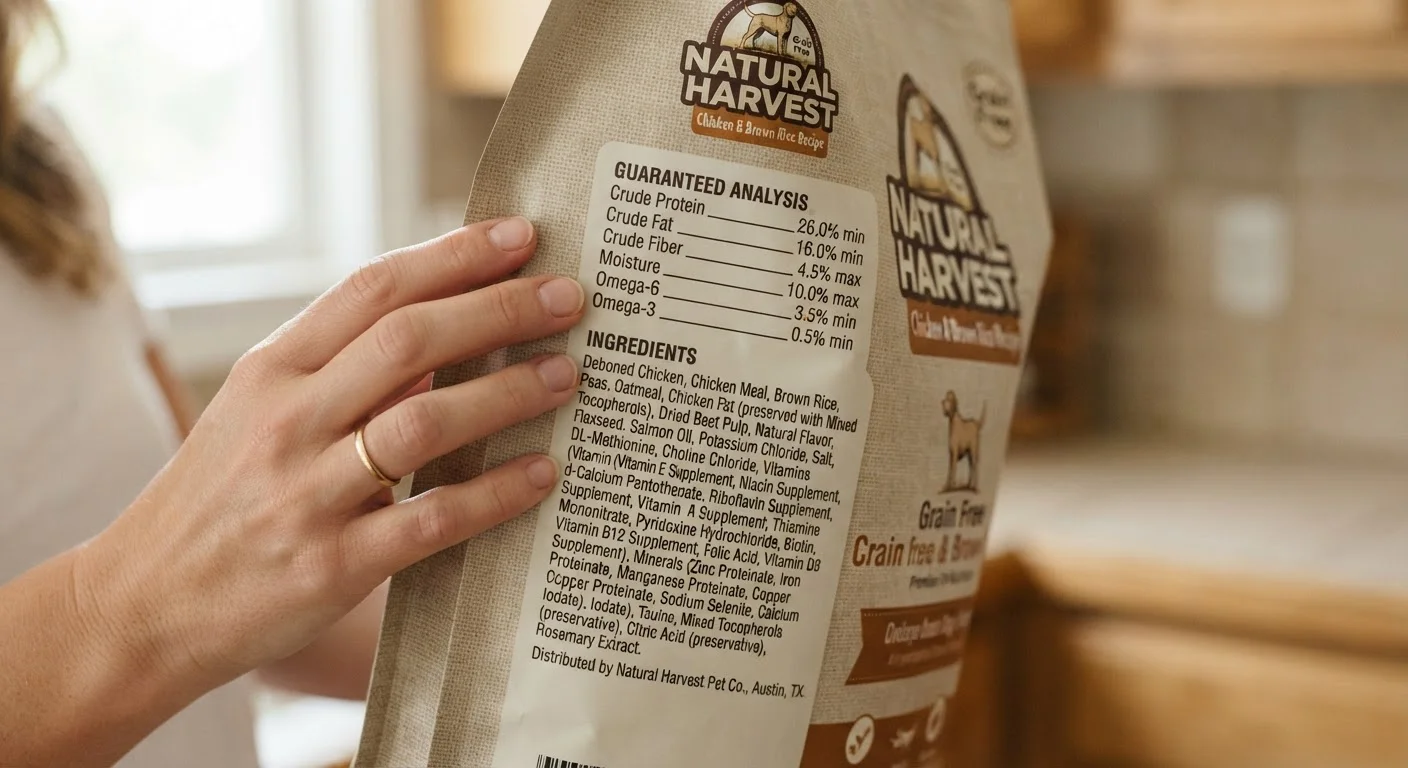
Read the Ingredient List Carefully
Ingredients are listed in descending order by weight before cooking or processing. This means a fresh meat listed first may shrink considerably after moisture is removed during manufacturing - a concept called ingredient splitting and moisture influence.
Key things to look for:
- Named protein sources: "Chicken," "lamb meal," or "salmon" are more specific and traceable than generic terms like "meat" or "poultry."
- Ingredient splitting: A manufacturer can divide one ingredient (e.g., corn) into several sub-forms (corn flour, corn gluten meal, ground corn) so each appears lower on the list individually.
- "Meal" ingredients: "Chicken meal" is a concentrated, dried form of chicken - it actually delivers more protein per pound than fresh chicken listed first, because moisture has already been removed.
For a deeper dive into how ingredient order and terminology work, see our guide to reading ingredient lists.
Interpret the Guaranteed Analysis Panel
The guaranteed analysis is a small table listing minimum and maximum percentages of key nutrients. AAFCO requires four values at minimum:
- Crude protein (minimum %)
- Crude fat (minimum %)
- Crude fiber (maximum %)
- Moisture (maximum %)
The word "crude" refers to the laboratory measurement method, not quality. "Crude protein," for instance, measures nitrogen content - it does not tell you how digestible that protein is or what source it comes from.
These are not exact amounts - they are guarantees that the nutrient level will be at least (or no more than) the stated value. Some manufacturers voluntarily list additional nutrients like taurine, omega fatty acids, or specific minerals.
Check the Feeding Guidelines - Then Calibrate with Your Vet
Feeding guidelines appear as a chart or range suggesting how much to feed based on your pet's body weight. These figures are calculated for an average, healthy, neutered adult animal at typical activity levels - they are a reasonable starting point, not a universal prescription.
Factors that may require adjusting the label's suggested amount include:
- Age (puppies and kittens need more calories per pound of body weight)
- Activity level (working dogs or highly active cats need more; sedentary indoor cats often need less)
- Reproductive status (intact, pregnant, or nursing animals have different requirements)
- Concurrent health conditions (kidney disease, diabetes, obesity, and other conditions significantly affect caloric and nutrient needs)
For practical guidance on avoiding portion distortion, see why overfeeding harms your pet. If you are weighing wet versus dry options, the real differences between wet and dry food covers how those choices interact with feeding amounts.
Compare Foods on a Dry Matter Basis
Because moisture content varies widely between wet and dry foods, comparing guaranteed analysis percentages directly between them is misleading. Ask your veterinarian how to convert nutrient percentages to a dry matter basis for an apples-to-apples comparison. This is especially important when weighing kibble against canned options.
Once you have worked through the five label sections above, you will have a clearer picture of what the food contains, whether it is appropriate for your pet's life stage, and how to calibrate portion sizes. For a closer look at the nutritional trade-offs between food formats, see a nutritional comparison of dry and wet pet food.
"Natural" and "Organic" Have Limits
These terms are loosely regulated in pet food. "Natural" generally means no synthetic ingredients, but it does not speak to nutritional quality or sourcing standards. "Organic" on pet food follows USDA guidelines but is not a guarantee of superior nutrition. Treat these as marketing descriptors rather than nutritional benchmarks.