
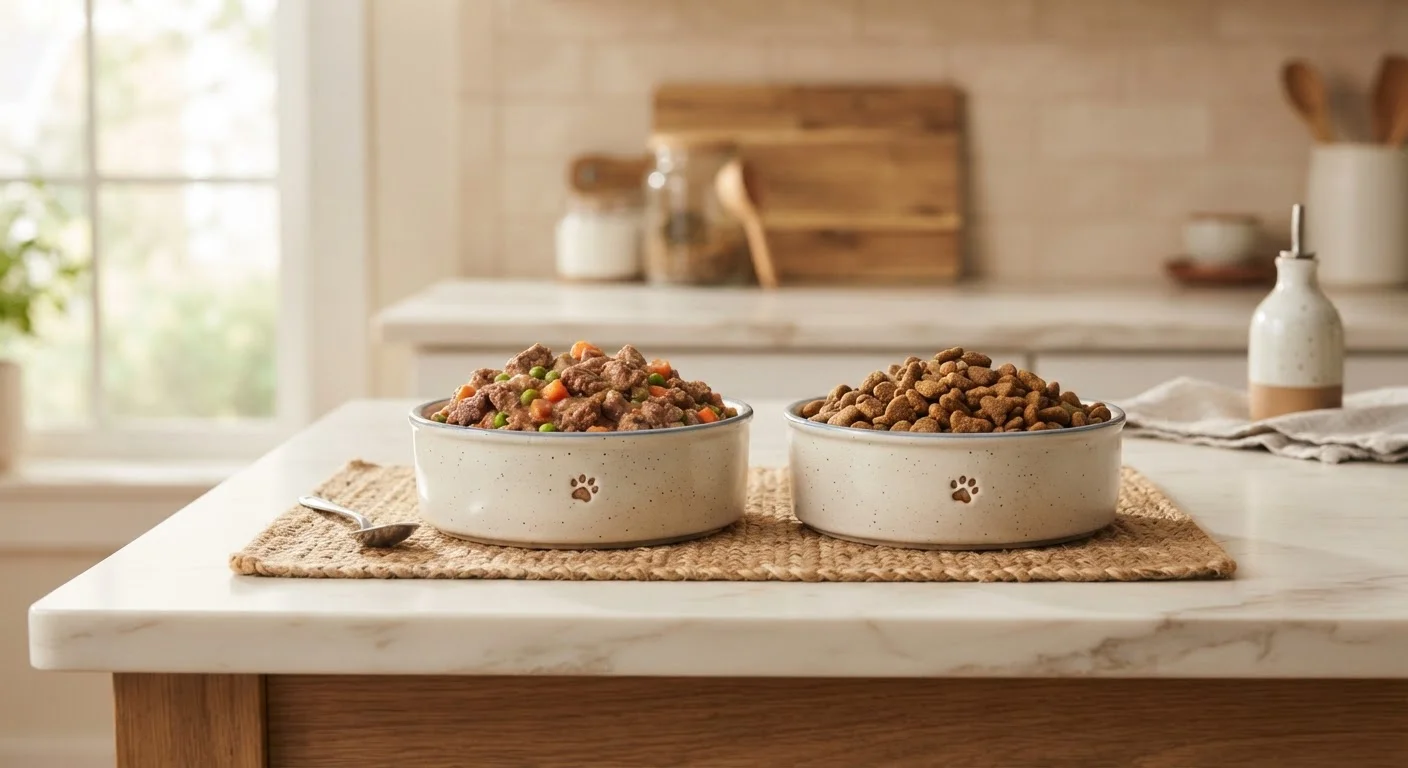
The Core Difference: It Starts With Water
The most fundamental distinction between wet and dry pet food is moisture content. Wet food - whether sold in cans, pouches, or trays - typically contains 70-80% water. Dry kibble, by contrast, contains roughly 6-10% moisture. That gap has real physiological consequences, particularly for cats.
Cats evolved as desert-adapted predators with a naturally low thirst drive. In the wild, they obtained most of their water from prey. A cat eating exclusively dry kibble may chronically consume less water than its kidneys and urinary tract require. This is one reason veterinarians frequently recommend wet food - or at least a mixed approach - for cats, especially those with a history of urinary crystals, lower urinary tract disease, or early kidney disease.
Dogs are generally more willing drinkers and adapt more easily to dry food, though senior dogs and those with certain conditions may also benefit from the added moisture in wet formulas. Understanding your individual pet's health profile is the essential starting point - your veterinarian is the right person to guide that conversation.
| Criterion | Wet Food | Dry Food (Kibble) |
|---|---|---|
| Moisture content | 70-80% | 6-10% |
| Hydration support | High - significant daily contribution | Low - relies on separate water intake |
| Palatability | Generally higher (aroma, texture) | Varies; can be less appealing |
| Dental benefit | Minimal mechanical action | Modest plaque reduction |
| Cost per serving | Higher | Lower |
| Shelf life after opening | 1-2 days (refrigerated) | Weeks (sealed, cool storage) |
| Caloric density | Lower (high water volume) | Higher (concentrated nutrients) |
| Suitability for cats | Strongly recommended by many vets | Adequate if hydration is monitored |
Nutrition: Format Doesn't Determine Quality
A common misconception is that wet food is inherently more nutritious than dry, or vice versa. In reality, nutritional adequacy is determined by the formulation, not the format. Both wet and dry pet foods can meet the complete-and-balanced standards established by the Association of American Feed Control Officials (AAFCO), which sets nutrient profiles for pet food sold in the US. Look for an AAFCO nutritional adequacy statement on the label - it tells you whether a food is formulated for a specific life stage (puppy/kitten, adult, or all life stages). For a deeper look at how to interpret what's on the packaging, see our guide on reading pet nutrition labels.
One nuance worth knowing: when comparing nutrient percentages between wet and dry foods, you must account for moisture. A wet food listing 8% protein contains far more protein per dry-matter gram than that number suggests once water is removed from the equation. This dry-matter basis comparison levels the playing field and reveals the true nutrient density of each food.
70-80%
Moisture in typical canned pet food
Compared to 6-10% in dry kibble, this difference has meaningful implications for feline urinary and kidney health.
~70%
US dogs and cats affected by dental disease by age 3
According to the American Veterinary Medical Association, periodontal disease is among the most commonly diagnosed conditions in companion animals.
2-3x
Higher typical cost of wet food vs. dry per calorie
Cost difference varies by brand and formulation, but wet food consistently carries a higher per-calorie price than equivalent dry food.
Dental Health: Separating Fact From Assumption
Dry kibble is widely believed to clean pets' teeth, and there is a kernel of truth here: the mechanical action of chewing hard kibble can reduce plaque accumulation modestly compared to soft food that clings to tooth surfaces. However, most kibble shatters before it makes meaningful contact with the gum line, where periodontal disease actually begins. The American Veterinary Dental College notes that kibble alone is not sufficient for dental hygiene.
Wet food is not inherently worse for teeth - the relationship is more nuanced than "dry cleans, wet doesn't." What matters most for dental health is active prevention: regular tooth brushing with pet-safe toothpaste, veterinary dental cleanings, and dental-specific products with proven efficacy. For a full breakdown of what actually works, our team's companion article on dental care habits for pets covers the routines veterinarians recommend.
Cost, Convenience, and Practical Feeding
Dry kibble wins on both price and convenience for most households. A pound of dry food costs significantly less than the equivalent caloric content in wet food, and an open bag remains shelf-stable for weeks. Wet food requires refrigeration once opened, should be discarded within a day or two, and generates more packaging waste.
That said, wet food's palatability advantage is real and not trivial. For pets recovering from illness, dealing with nausea, or simply refusing to eat, wet food's stronger scent and softer texture often encourages intake when kibble won't. Many veterinarians endorse a mixed feeding strategy - combining wet and dry meals - to capture the hydration benefits of wet food alongside the cost efficiency of kibble. If you pursue this approach, ask your vet about appropriate portion ratios to avoid unintentional overfeeding.
For guidance on evaluating what's actually in the food you choose - regardless of format - see how to read a pet food label without getting lost in the fine print.
This article is intended for general educational purposes and does not constitute veterinary or medical advice. Always consult a licensed veterinarian before making significant changes to your pet's diet, especially if your pet has an existing health condition.