Two Distances, One Number
Most drivers think of braking as a single action - you hit the pedal, the car stops. In reality, stopping distance is always the sum of two separate events happening back to back.
Reaction distance is how far your car travels while you recognize a hazard and physically move your foot to the brake. Research consistently places the average driver's reaction time between 1.0 and 1.5 seconds under normal conditions. At 60 mph, that's a car length every tenth of a second - so 1.5 seconds of reaction time adds roughly 130 feet of unbraked travel before anything mechanical happens.
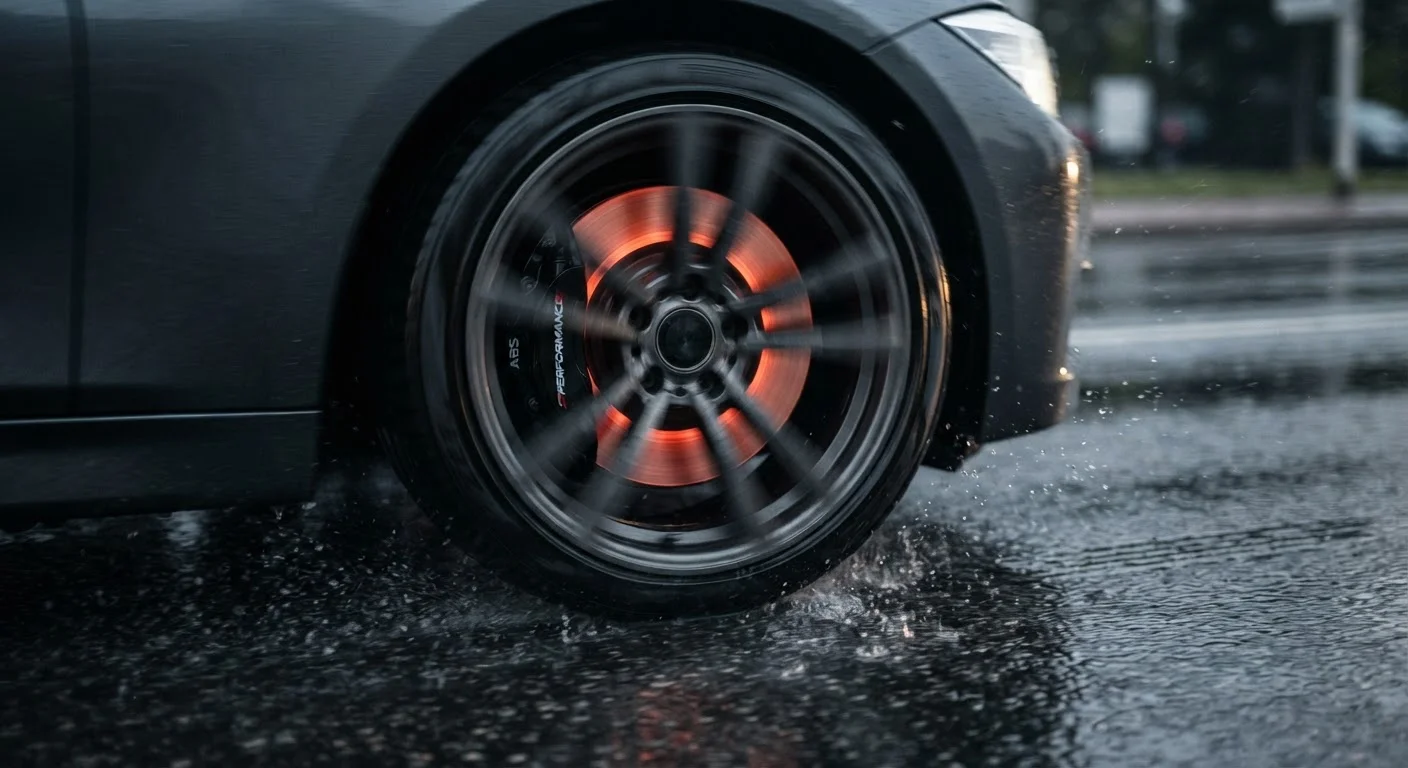
Braking distance is what happens after the brakes engage. Physics takes over: the brakes convert kinetic energy into heat through friction, gradually slowing the vehicle. How quickly that happens depends on how much kinetic energy needs to be shed, how hard the brakes can grip, and how much traction the tires have with the road.
Add those two together and you get total stopping distance - the honest answer to "how much road do I actually need?"
~132 ft
Reaction distance at 60 mph (1.5-sec reaction time)
This distance is traveled before brakes even engage, based on standard reaction time estimates used in traffic safety education.
4×
Braking distance increase when speed doubles
Because kinetic energy scales with the square of speed, doubling vehicle speed roughly quadruples the braking distance required.
50%+
Increase in stopping distance on wet pavement
Wet roads significantly reduce tire-to-road friction; stopping distances commonly increase by half or more compared to dry conditions.
Why Speed Is the Biggest Variable
There's a common assumption that stopping distance scales linearly with speed - go twice as fast, need twice the space. That's wrong, and the gap between assumption and reality is where crashes happen.
Kinetic energy increases with the square of speed. A vehicle going 60 mph carries roughly four times the kinetic energy of the same vehicle going 30 mph. To stop, all of that energy must be absorbed by the brakes and tires. Doubling your speed doesn't double the braking distance - it roughly quadruples it.
This is why a reduction from 70 mph to 60 mph isn't just a minor courtesy adjustment. That single 10-mph drop meaningfully cuts the energy your brakes need to manage. On a highway where closing speeds between vehicles are high, that margin matters enormously - which is why following too closely is genuinely dangerous, not just an annoyance.
Road Conditions and Tire Friction
Your car's ability to brake is limited by the grip between your tires and the road surface. On dry asphalt in good condition, that grip is substantial. Introduce moisture, oil, leaves, ice, or gravel, and it drops fast.
Wet pavement can increase stopping distances by 50% or more compared to dry conditions. Ice is in a different category entirely - stopping distances on black ice can be up to ten times longer than on dry pavement. Even light rain early in a storm can be treacherous because water mixes with accumulated oil on the road surface before it washes away.
Wet and winter road conditions demand a recalibrated following distance, not just more careful steering. If you're using dry-day mental models on a wet road, you're operating with a false margin of safety.
Adjust Your Following Distance for Conditions
The three-second rule is a starting point for dry pavement - increase it to five or six seconds in rain, and much more on snow or ice. Count from when the car ahead passes a fixed point, not from how close you appear to be. More time means more room for your full stopping distance to play out.
The Role Your Vehicle Plays
Two identical-looking cars can have very different stopping distances depending on their mechanical condition. Worn brake pads generate less friction, extending braking distance. Tires with low tread depth lose grip sooner on wet pavement. A vehicle that's heavier - whether from passengers, cargo, or a trailer - carries more kinetic energy and needs more road to shed it.
Modern safety systems like anti-lock brakes (ABS) help by preventing wheel lockup, which maintains steering control and can reduce stopping distance on slippery surfaces. But these systems work within the limits of tire-to-road friction. They can't create grip that isn't there. Keeping brake components in good condition is what gives those systems something to work with.
Understanding stopping distance is ultimately a foundation for defensive driving - adjusting your speed and following distance based on real conditions, not optimistic assumptions.