Why Following Distance Is a Life-Safety Issue
Tailgating might feel like a minor bad habit, but the physics say otherwise. When you follow too closely, you eliminate the one thing you need most in an emergency: time. By the time your brain registers that the car ahead has braked, your foot moves to the pedal, and your vehicle starts slowing, you've already traveled a significant distance - at highway speed, often more than 100 feet before braking even begins.
That's the reality of reaction time, and it doesn't improve with confidence or experience. Skilled drivers react faster, yes - but not fast enough to overcome a one-second gap at 65 mph. Defensive driving is built on the understanding that you can't always control what happens in front of you, only how much time and space you give yourself to respond.
~33%
Crashes involving rear-end collisions
The NHTSA has consistently identified rear-end crashes as one of the most common collision types on US roads, making up roughly one-third of all reported accidents.
1.5 sec
Average driver reaction time
Research from traffic safety organizations estimates average perception-reaction time at around 1.5 seconds - time during which a vehicle continues forward at full speed before braking starts.
240 ft
Stopping distance at 60 mph (dry road)
This estimate, widely cited in driver education materials, combines reaction distance and braking distance for a typical passenger vehicle on dry pavement.
Common Tailgating Mistakes and How to Fix Them
Most drivers don't think of themselves as tailgaters - they think of tailgating as something other, more aggressive drivers do. But the behavior shows up in subtle ways: creeping forward in slow traffic, matching speed too closely on the highway, or unconsciously drafting behind a vehicle on a familiar commute. Below are the most common mistakes, and what to do about each one.
Using only a one-second gap at highway speeds.
Why it happens: Many drivers learned a vague 'car length' rule and apply it at every speed, not realizing that a car length matters far less at 65 mph than at 25 mph.
Assuming a shorter gap is fine because traffic is moving smoothly.
Why it happens: When traffic flows steadily, drivers get a false sense of control and creep closer without realizing it. The risk feels low because nothing has gone wrong yet.
Failing to increase following distance for heavy or large vehicles.
Why it happens: Drivers treat every vehicle the same way, not accounting for the fact that trucks and SUVs block the driver's view of traffic ahead and take longer to stop.
Tailgating as a way to pressure a slow driver to move over.
Why it happens: Frustration with slower traffic can trigger aggressive behavior. Drivers rationalize that closing the gap will communicate their desire to pass, treating it as a signal rather than a hazard.
Ignoring following distance when distracted by a phone or radio.
Why it happens: Divided attention means drivers don't notice they've drifted closer until it's nearly too late. Even a glance away from the road for two seconds at 60 mph covers nearly 180 feet.
Double Your Distance in Bad Weather
Rain, snow, and ice dramatically increase stopping distances. A car traveling at 60 mph on a dry road needs roughly 240 feet to stop; on wet pavement, that figure climbs significantly. If weather is poor, the three-second rule becomes a four- to six-second minimum. Adjust before conditions force you to.
How to Actually Judge a Safe Following Distance
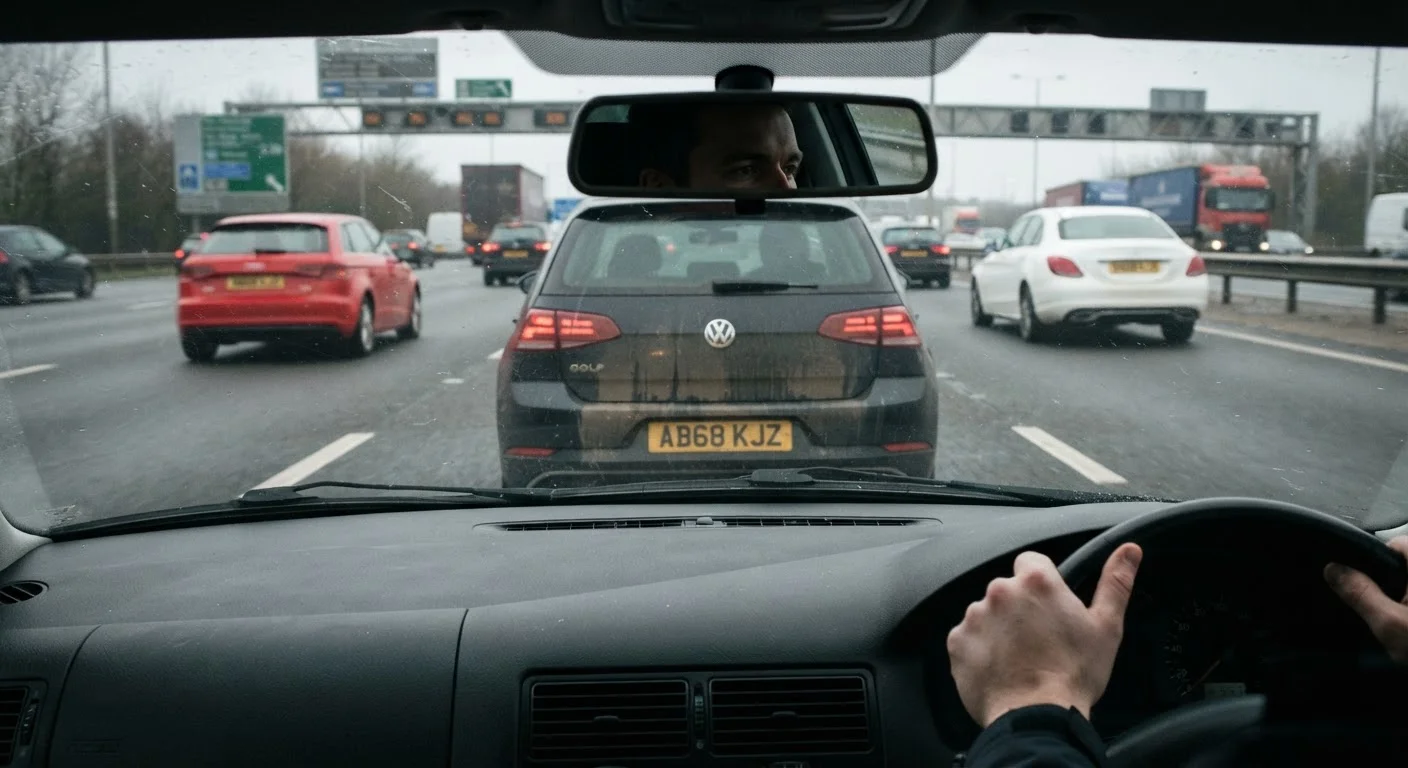
The three-second rule is the most reliable and practical tool most drivers have access to without any equipment. Here's how it works: as the vehicle ahead passes a stationary object - a sign, a shadow line, an overpass - begin counting. If you reach that same object before you count to three, you're following too closely. Open up the gap and try again.
This works at any speed because it scales with velocity automatically. At 30 mph, three seconds equals about 130 feet. At 65 mph, it's closer to 285 feet. The math adjusts for you.
Keep in mind that the three-second rule is a minimum under ideal conditions. Rain or snow, nighttime driving, following large vehicles, towing a trailer, or driving with worn brakes all call for longer gaps. Speed limits vs. safe speeds covers a related point: legal doesn't always mean safe, and the same thinking applies to following distance.
Tailgating Can Be Legally Actionable
Most US states have laws requiring drivers to maintain a 'reasonable and prudent' following distance. Being rear-ended is not automatically the following driver's fault legally, but tailgating often is. If you cause a rear-end collision while following too closely, you can face citations, increased insurance premiums, and civil liability.
Building the Habit So It Sticks
Knowing the three-second rule is easy. Applying it consistently while managing lane changes, merges, and normal driving demands is the harder part. One useful mental shift: stop thinking of the gap ahead as wasted space and start thinking of it as a safety buffer you're actively maintaining. Other drivers may cut into that buffer - when they do, ease back until the gap is restored rather than closing up behind them.
Highway merges are a particularly common pressure point where following distance collapses. Merging onto a highway without a near-miss walks through why gaps get squeezed during merges and how to handle them without creating a chain reaction. The habits reinforce each other: a driver who keeps proper following distance is also better positioned to merge cleanly, change lanes safely, and avoid being caught off guard by the driving myths that lead people to overestimate their stopping ability.
Following distance won't make every emergency survivable, but it gives you the best chance to respond rather than simply react. That gap is the most underused safety feature on any vehicle.