How Each System Actually Works
To understand the difference, it helps to know what a router does at a basic level. If that's new territory, our plain-language breakdown of routers and modems is a useful starting point.
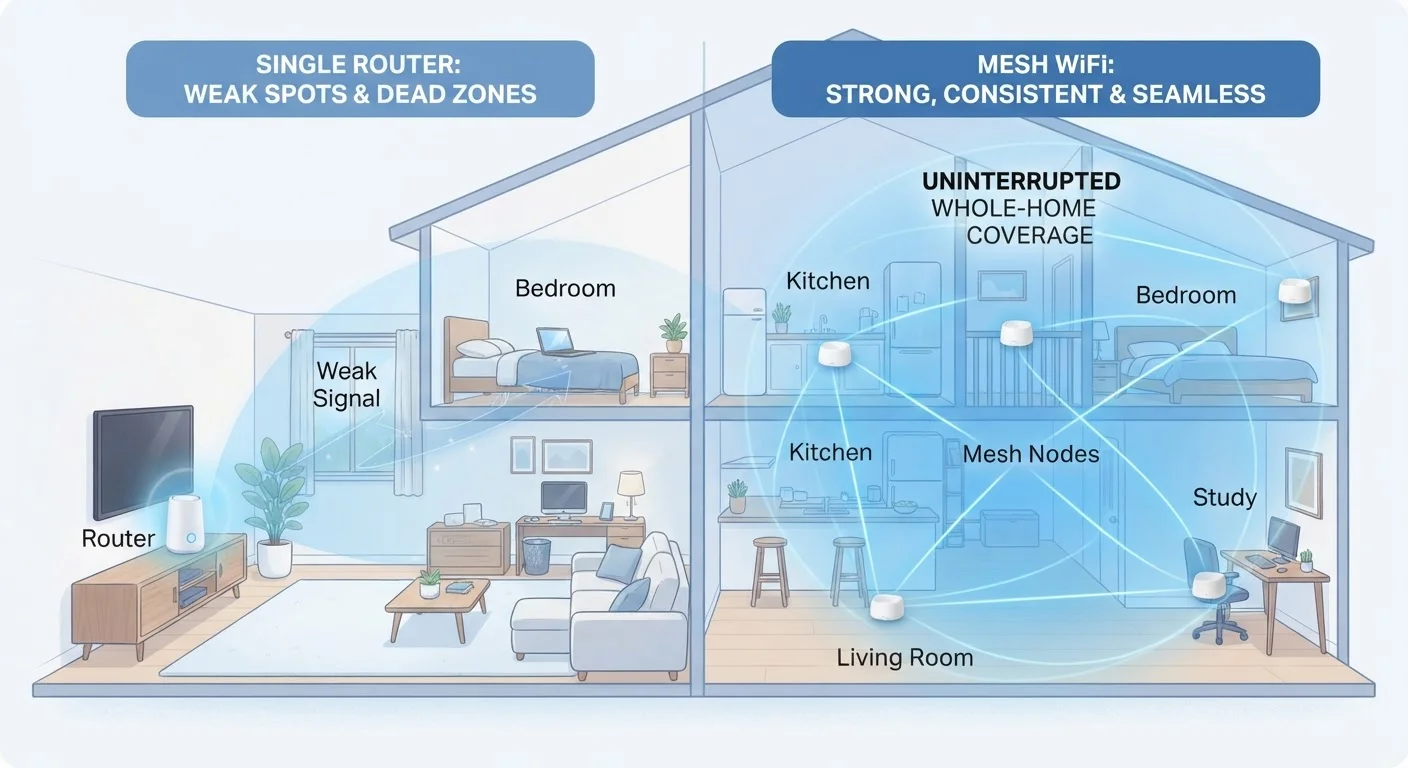
A traditional router is a single device that connects to your modem and broadcasts a Wi-Fi signal in all directions. Its reach is limited by transmit power, antenna design, and physical obstructions like walls and floors. The further a device gets from the router, the weaker the signal - and the slower the effective connection.
A mesh network system replaces that single point of broadcast with a set of nodes - typically two to four units - placed around the home. One node connects to the modem as the primary unit; the others act as satellites. Crucially, these nodes communicate directly with each other, not just with your devices. That coordination is what makes the network feel seamless: your phone or laptop connects to whichever node has the strongest signal, and the handoff happens in the background.
| Criterion | Traditional Router | Mesh Network System |
|---|---|---|
| Coverage area | Single broadcast point; limited range | Multiple nodes; whole-home coverage |
| Roaming between areas | Manual reconnection may be needed | Seamless automatic handoff between nodes |
| Setup complexity | Browser-based admin panel | Guided smartphone app; typically faster |
| Advanced configuration | Full access to granular settings | Simplified; many options abstracted away |
| Upfront cost | Generally lower (one device) | Generally higher (two to four nodes) |
| Backhaul type | Not applicable | Wireless (default) or wired (better performance) |
| Ideal home size | Under ~1,500 sq ft | 1,500 sq ft and above, or multi-story |
Coverage, Speed, and the Limits of Both
Mesh systems genuinely outperform traditional routers on coverage consistency. In a 3,000-square-foot home or a building with thick concrete walls, a single router will almost always leave weak spots. A well-placed mesh system can eliminate those dead zones entirely. For a broader look at coverage options including range extenders and powerline adapters, see our guide on expanding Wi-Fi coverage.
On raw speed, the picture is more nuanced. Neither system increases the internet speed your ISP delivers to your modem - that ceiling is fixed by your plan. What mesh systems can do is ensure more devices reach that ceiling more of the time, rather than being throttled by distance or interference.
One trade-off worth knowing: when mesh nodes communicate wirelessly with each other (called a wireless backhaul), some bandwidth is consumed by that node-to-node traffic. Wired backhaul - running an Ethernet cable between nodes - avoids this penalty but requires more installation effort. Our article on wired vs. wireless connections explains when that cable run is worth the trouble.
~1,500 sq ft
Typical effective range of a single router
Industry estimates suggest most consumer routers provide reliable coverage within roughly 1,000-1,500 square feet under real-world conditions with walls and interference.
30-50%
Bandwidth overhead of wireless backhaul
Networking engineers generally estimate that wireless node-to-node communication in a mesh system can consume 30-50% of available band capacity on the backhaul link.
Setup, Management, and Cost
Traditional routers are set up through a browser-based admin panel - functional, but often unintuitive for non-technical users. Once configured, they run quietly without much ongoing management. Power users can access advanced settings like custom DNS servers, port forwarding, guest network controls, and Quality of Service (QoS) rules that prioritize specific traffic types.
Mesh systems are almost always managed through a dedicated smartphone app. Initial setup typically takes under 15 minutes: plug in the primary node, follow the app prompts, and place satellite nodes where coverage is needed. The trade-off is that the simplified interface hides or removes many of the advanced controls found in traditional routers.
On cost, a capable single router generally runs less than a comparable mesh kit - which makes sense, since you're buying one device instead of two or three. That said, if you've ever resorted to a range extender to cover a dead zone, a mesh system may actually be a cleaner, more effective solution. If you're building your network knowledge from scratch, our Home Wi-Fi From the Ground Up covers the foundational concepts before you invest in any hardware.