Why Tech Myths Persist Even Among Careful Users
Gadget myths spread because they contain a kernel of truth, or because they made sense at some point in the past. A belief that held in 2010 may be completely outdated today, but it travels from person to person as reliable advice. Understanding which of these ideas are still accurate - and which have been overtaken by engineering advances - helps you treat your devices better and spend money more wisely.
The myths below cover some of the most persistent misconceptions about everyday hardware. Each one is grounded in how devices actually work, not in speculation.
Myth
Leaving your phone on the charger overnight ruins the battery.
Fact
Modern smartphones use charge-management circuits that stop drawing full current once the battery reaches 100%, preventing overcharge damage.
Lithium-ion batteries can degrade if repeatedly charged to 100% and held there under heat stress, but contemporary devices handle this intelligently. Many phones now offer features that delay the final charge increment until just before your usual wake time. The real enemies of battery longevity are sustained high heat and repeatedly draining the battery to near zero - not overnight charging itself. Wireless charging, which generates more ambient heat than a cable, can contribute marginally more wear, but the effect of overnight charging alone is modest for most users.
Myth
More megapixels always means a better camera.
Fact
Megapixels measure resolution only; image quality is determined by sensor size, lens optics, aperture, and computational processing.
A 50-megapixel sensor crammed onto a tiny phone module can produce noisier, less detailed images in low light than a well-engineered 12-megapixel sensor with a larger surface area. Each pixel on a larger sensor captures more light, which translates directly to dynamic range and color accuracy. Software processing - including multi-frame noise reduction and computational HDR - now contributes as much to final image quality as the raw hardware. Megapixel count matters mainly when you need to crop heavily or print at very large sizes.
Myth
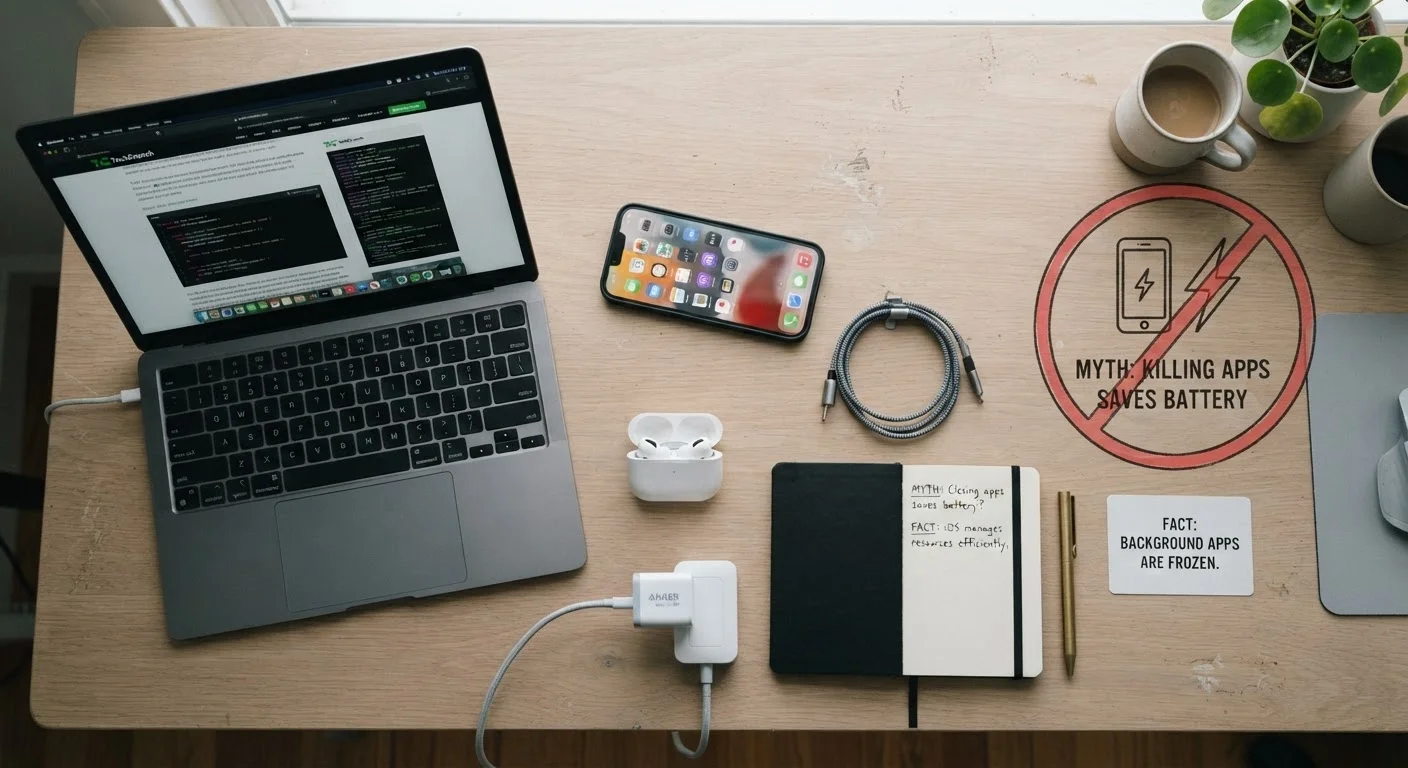
Closing background apps saves battery life and speeds up your phone.
Fact
On modern operating systems, background apps are largely frozen and consume negligible resources; force-closing them can actually increase battery drain.
Both iOS and Android suspend apps when they leave the foreground, meaning those apps are not actively running or consuming CPU cycles. When you force-quit an app and then reopen it, the system must reload it from scratch - using more power and memory than simply resuming a suspended state would require. Habitually swiping away every app is, at best, a neutral action and, at worst, a minor drain on battery and performance.
Myth
More RAM always makes a device faster.
Fact
RAM helps with multitasking, but a device bottlenecked by a slow processor, storage drive, or inefficient software will not become meaningfully faster just by adding memory.
RAM is a holding area for data the processor is actively using. Once a device has enough RAM for its workload, adding more produces no measurable speed benefit for typical tasks like browsing, messaging, or streaming. The performance ceiling is determined by whichever component is the limiting factor - often the storage read/write speed or the processor itself. This is why a device with generous RAM but aging storage can still feel sluggish.
Myth
Incognito mode makes you anonymous on the internet.
Fact
Private browsing prevents local history from being saved, but your network traffic is still visible to your internet service provider, network administrators, and the websites you visit.
Incognito or private mode is a local privacy tool, not a network anonymity tool. It stops your browser from logging visited URLs, cookies, and form data on your device - useful if you share a computer. It does nothing to mask your IP address or encrypt traffic beyond what a standard connection provides. For genuine network-level privacy, a reputable VPN (virtual private network) or the Tor network would be the appropriate tools to research, each with its own trade-offs. For guidance on related software misconceptions, see our Apps & Software coverage.
Myth
A fully drained battery is good for calibration and should be done regularly.
Fact
Lithium-ion batteries do not need calibration cycles, and deep discharges accelerate chemical aging in the battery.
The calibration ritual - running a device to zero before recharging - originated with older nickel-cadmium batteries, which suffered from a 'memory effect' that made periodic full discharges beneficial. Lithium-ion chemistry, which powers virtually every consumer gadget sold today, has no such memory effect. Deep discharges place additional stress on the battery's electrode materials. Most manufacturers recommend keeping lithium-ion batteries between roughly 20% and 80% charge for maximum long-term health, though occasional full charges are not harmful.
Camera and Storage Myths Worth Unlearning
Two areas where confusion runs especially deep are smartphone cameras and device storage. Marketing language - megapixels, gigabytes, processor cores - is designed to be memorable, not always accurate. Once you understand what those numbers actually measure, the picture changes considerably.
~500
Charge cycles before notable lithium-ion capacity loss
Battery manufacturers commonly rate lithium-ion cells for approximately 300-500 full charge cycles before capacity drops to around 80% of original.
~80%
Optimal upper charge threshold for long battery life
Research into lithium-ion degradation consistently finds that avoiding sustained 100% charge states can meaningfully extend total battery lifespan.
For a broader look at what physically wears out in your devices over time, see our guide to what actually wears out first in consumer gadgets. And if you want to put accurate knowledge into practice, habits that genuinely extend hardware life covers evidence-backed routines that make a real difference.
Privacy-related myths deserve equal attention. Many users believe incognito or private browsing mode makes them anonymous online. In reality, it only prevents the browser from saving local history. Your internet service provider, employer network, and the websites you visit can still observe your activity. For a deeper look at software-level misconceptions, our coverage of antivirus software myths addresses related misunderstandings about digital protection.
Incognito Mode Does Not Mean Anonymous
Private browsing protects only your local browsing history on the device itself. Anyone monitoring your network - including your internet provider or a workplace IT system - can still see which sites you visit. Do not rely on incognito mode for sensitive transactions that require true anonymity or encrypted communications.