
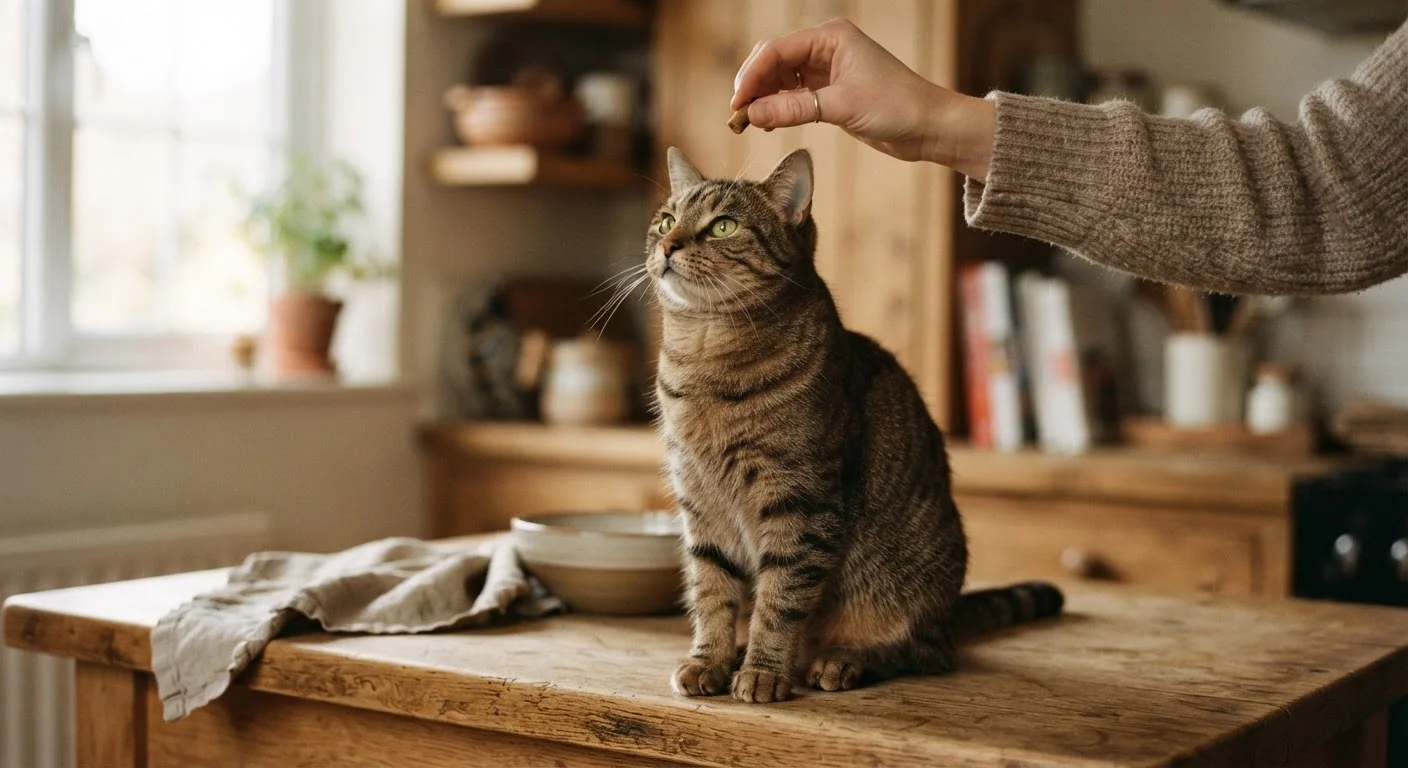
The Truth About Cat Trainability
The idea that cats are untrainable is one of the most persistent misconceptions in pet ownership. Cats are not stubborn by nature - they are simply motivated differently than dogs. As solitary hunters rather than pack animals, they did not evolve to defer to a social hierarchy. This means they respond best when training feels relevant and rewarding to them, not out of a desire to please.
Behavioral science confirms that cats learn through the same core mechanisms as other mammals: association and consequence. When a behavior produces something the cat values, that behavior is more likely to be repeated. This is called positive reinforcement, and it is the foundation of effective cat training. Before starting, it helps to review key training concepts so the terminology makes sense as you go.
Positive reinforcement
Adding something the animal likes immediately after a behavior to make that behavior more likely to happen again. In cat training, this usually means a food treat or other valued reward.
Marker signal
A precise sound or word - often a click or the word 'yes' - used at the exact moment a correct behavior occurs to tell the animal that a reward is coming.
Shaping
Teaching a behavior gradually by rewarding small steps that move closer and closer to the finished behavior, rather than waiting for the complete action from the start.
Cue
A specific word, hand signal, or other prompt that tells the animal a particular behavior is expected and that a reward is available for performing it.
Operant conditioning
A learning process in which behavior is shaped by its consequences - behaviors followed by rewards become more frequent, while those that produce no outcome tend to fade.
Targeting
Training an animal to touch a specific object - often a finger or a stick - with part of its body, typically the nose or paw. It is a foundational skill that can be used to guide more complex behaviors.
What Cats Can Realistically Learn
Cats can learn a wider range of behaviors than most owners expect. Practically achievable goals include: responding to their name, sitting on cue, targeting (touching a finger or stick with their nose), coming when called, using a scratching post instead of furniture, tolerating handling such as nail trims, and entering a carrier voluntarily. These skills have direct quality-of-life benefits - particularly carrier training, which reduces stress during veterinary visits.
What is less realistic is expecting a cat to perform behaviors that conflict strongly with instinct or to sustain attention for long periods. Cats are not wired for prolonged drilling. Two-to-five-minute sessions, two or three times a day, consistently outperform marathon training attempts. For a structured approach to timing and session design, see how to build a training routine that fits feline learning patterns.
Core Tools and Techniques
High-value rewards are the engine of cat training. Identify what your individual cat finds irresistible - this varies widely. Small pieces of cooked chicken, commercially prepared meat treats, or even a lick of a food paste can work. Reserve these rewards exclusively for training to maintain their value.
A marker signal bridges the gap between the behavior and the reward. A clicker produces a precise, consistent sound that cats can learn to associate with incoming reinforcement. A short, distinct verbal marker such as "yes" works equally well as long as it is used uniformly. The marker must come the instant the correct behavior occurs - even a one-second delay reduces its effectiveness.
Shaping is the process of rewarding successive approximations of a behavior rather than waiting for the finished product. To teach a cat to sit, you might first reward any downward hip movement, then reward when hindquarters make contact with the floor. This technique lets owners teach complex behaviors in small, achievable steps.
Train Before Meals, Not After
A slightly hungry cat is a significantly more motivated training partner. Conduct sessions just before scheduled mealtimes to ensure food rewards carry maximum value. Avoid training immediately after a large meal, when your cat's interest in food - and therefore in earning it - will be at its lowest.
Before your first session, review the preparation checklist for new pet training to ensure your environment and expectations are set up for success.
Reading Feline Body Language
Training only works when a cat is in the right state to engage. Learning to read feline body language prevents frustration on both sides. A cat that is ready to work typically holds a relaxed body posture, moves deliberately toward the trainer, and keeps ears facing forward. Slow blinks and a loosely held tail signal comfort.
Stress signals to watch for include: flattened ears, a low or tucked tail, dilated pupils in normal light, excessive grooming between repetitions, or turning away from the handler. Any of these cues is a signal to pause or end the session entirely - pushing through stress teaches the cat that training is unpleasant. Understanding how illness can also affect a cat's behavior and mood is worth noting; cats often mask health changes, so a sudden drop in training engagement may sometimes warrant a vet check.
Common Mistakes and How to Avoid Them
Using punishment. Squirting water, loud noises, or physical corrections do not teach a cat what to do - they teach it that the owner is unpredictable. Veterinary behaviorists consistently advise against aversive methods because they erode trust without addressing the root motivation for the behavior.
Inconsistent cues. Using "come" one day and "here, kitty" the next creates confusion. Choose one word or signal per behavior and stick with it across all household members.
Sessions that run too long. When a cat loses interest, owners sometimes respond by repeating cues more urgently. This degrades the cue's meaning. Stop while the cat is still engaged - always end on success, even a small one.
Skipping species context. Cats process the world differently from dogs or rabbits. Species-specific learning differences matter: what motivates a cat will not necessarily translate from dog training advice, and treating cats as small dogs is one of the fastest ways to stall progress.
Avoid Punishment-Based Methods Entirely
Spraying, startling, or scolding a cat for unwanted behavior does not teach an alternative - it creates fear and avoidance, often directed at the owner. Research in animal behavior consistently shows that aversive methods increase stress and can worsen problem behaviors over time. Redirect, manage the environment, and reward what you want instead.