Understanding What Each Species Actually Needs
Rabbits, guinea pigs, and hamsters are often grouped together as interchangeable "starter pets," but each has meaningfully different spatial, social, and environmental requirements. Getting these fundamentals right before your pet arrives - rather than retrofitting later - is the single most effective welfare decision you can make. For a broader pre-arrival checklist, see our preparation guide for new pet owners.
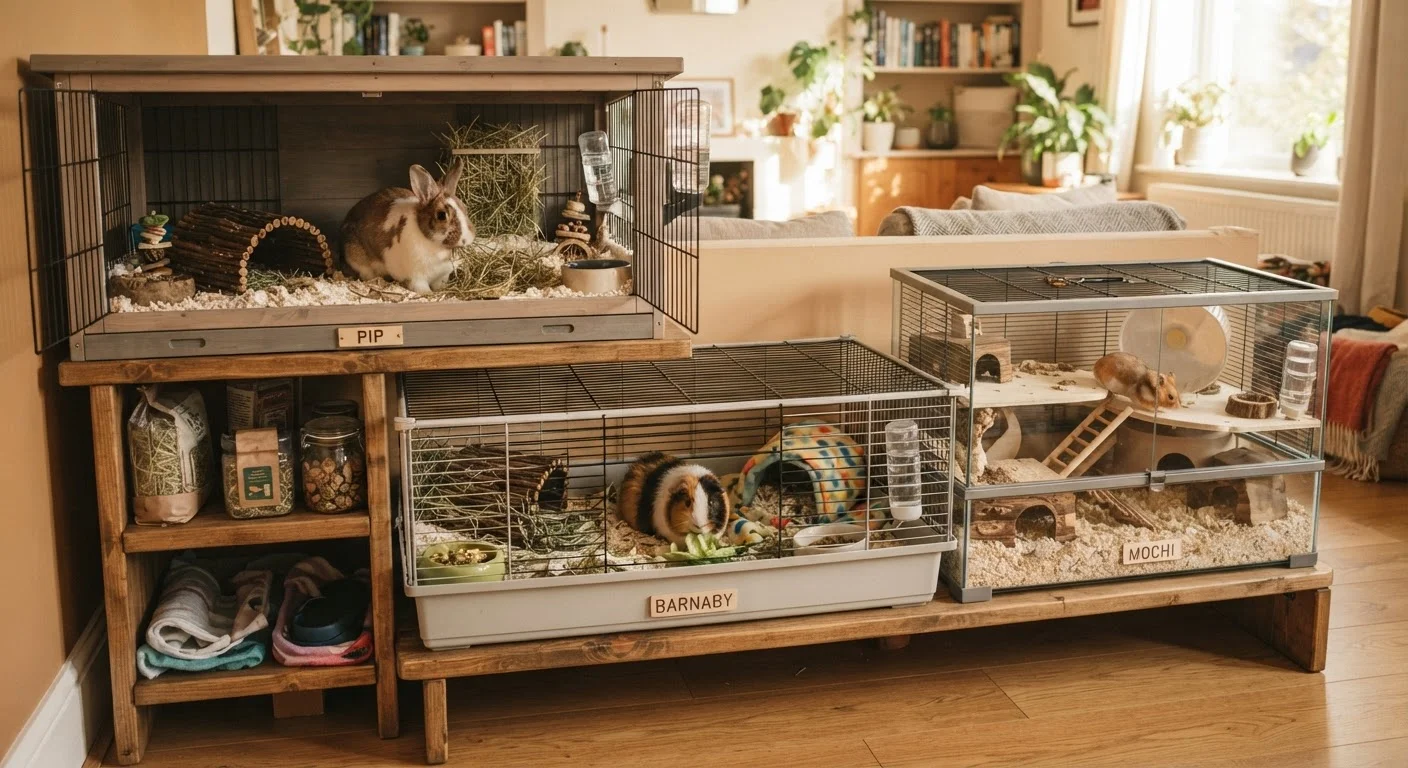
Rabbits are active, intelligent animals that need room to run, jump, and stand fully upright. The House Rabbit Society recommends a minimum of 8 square feet of enclosure space combined with at least 24 square feet of daily supervised exercise area. Rabbits are social - most do better in bonded pairs.
Guinea pigs are highly social herd animals; keeping a single guinea pig is discouraged by many small-animal veterinarians and is restricted or regulated in some countries. The Humane Society recommends at least 7.5 square feet per pair, with more space always preferable. They cannot synthesize their own vitamin C, making dietary variety a genuine health concern - not a preference.
Hamsters are solitary by nature and most species will fight if housed together. Syrian hamsters need a minimum of 450 square inches of floor space (approximately 40 inches × 15 inches); dwarf species need slightly less but still far more than is typical of pet-store caging. A wheel is not enrichment - it is an exercise necessity, sized at least 10 inches for Syrians.
What you will need
Choosing Bedding, Temperature Zones, and Placement
Bedding directly affects respiratory health. For all three species, avoid cedar and pine wood shavings, which release aromatic phenols linked to liver damage and respiratory irritation. Safe options include kiln-dried aspen shavings, paper-based bedding (such as unscented compressed paper products), or timothy hay layered with paper bedding for rabbits and guinea pigs. Hamsters benefit from deep bedding - at least 6 inches - that supports natural burrowing behavior.
Avoid Cedar and Pine Bedding in All Cases
Cedar and pine shavings contain volatile aromatic compounds called phenols that can cause respiratory irritation and liver damage in small mammals. This applies to rabbits, guinea pigs, and hamsters without exception. Always verify bedding is explicitly labeled aspen, paper-based, or otherwise free of pine and cedar oils before use.
Temperature placement matters more than most new owners expect. Guidelines by species:
- Rabbits: Prefer 60-70°F (15-21°C). They are highly susceptible to heat stroke above 85°F.
- Guinea pigs: Comfortable between 65-75°F (18-24°C); avoid humidity above 70%.
- Hamsters: Thrive at 65-75°F (18-24°C); temperatures below 50°F can trigger torpor (a hibernation-like state that indicates dangerous cold stress).
Enclosures should be placed away from windows with direct afternoon sunlight, exterior doors, heating or air conditioning vents, and high-traffic areas with loud noise or vibration. Elevated, predator-secure placement reduces chronic stress in all three species - the consistent presence of a cat, dog, or even a ferret nearby can keep small prey animals in a permanent low-grade stress state that compromises immune function over time.
For strategies on managing multi-species households, our guide on introducing a second pet covers scent management and gradual cohabitation.
Building In Enrichment From Day One
Enrichment is not decoration - it supports cognitive health, reduces stereotypic behaviors (repetitive movements caused by boredom or stress), and allows animals to express natural instincts. Each species has different enrichment priorities:
- Rabbits need cardboard tunnels, untreated wooden chews for dental wear, dig boxes filled with paper strips, and foraging opportunities (scattering pellets in hay rather than bowl-feeding).
- Guinea pigs benefit from multiple hides (one per animal, plus a shared neutral space), tunnels, and safe vegetables tucked into their hay to encourage foraging. They also vocalize and respond to routine - consistent handling and a predictable schedule reduce stress measurably.
- Hamsters require a solid-surface running wheel, multiple hides, burrowing-depth bedding, and scatter-feeding rather than bowl-feeding. Avoid barred wheels - feet and limbs can catch and cause injury.
Rotate enrichment items every few days to maintain novelty without introducing entirely unfamiliar objects that trigger anxiety. For a broader framework on keeping small animals mentally active, see our resource on enrichment strategies for everyday life.
Rotate Enrichment to Maintain Interest
Small pets acclimate quickly to static environments. Swapping one tunnel, chew, or hide for a different version every few days reactivates exploratory behavior without introducing the stress of a complete overhaul. Keep a small rotation of three to five items and cycle them regularly.
Finally, establish care with an exotic or small-mammal veterinarian before any health issue arises. These species mask illness instinctively, and by the time symptoms are obvious, conditions are often advanced. An annual wellness exam - combined with owner education on normal behavior baselines - is the most reliable early-warning system available.
For ongoing pet health and wellness guidance, including nutrition and preventive care, explore our dedicated hub.