Why These Three Services Get Confused
Walk into almost any service center and you'll hear rotation, balancing, and alignment mentioned in the same breath. They all involve your tires, and shops sometimes offer them as a bundle - so it's easy to assume they're variations of the same thing. They're not. Each one addresses a distinct mechanical issue, and knowing the difference helps you make informed decisions about your vehicle rather than just nodding along at the counter.
For a broader look at how these fit into regular upkeep, see our guide on keeping a car roadworthy on a realistic schedule.
~$0.11/mile
Estimated cost of improper tire maintenance
The U.S. Department of Energy has noted that underinflated and poorly maintained tires contribute measurably to fuel waste and increased operating costs per mile.
4-8 weeks
How fast misalignment can visibly damage tires
Alignment professionals commonly note that severe misalignment can produce noticeable uneven tread wear within a few thousand miles of driving.
5,000-7,500 mi
Typical tire rotation interval
Most vehicle owner's manuals and tire manufacturers recommend rotating tires within this mileage range, though the exact interval varies by vehicle and tire type.
Tire Rotation: Evening Out the Wear
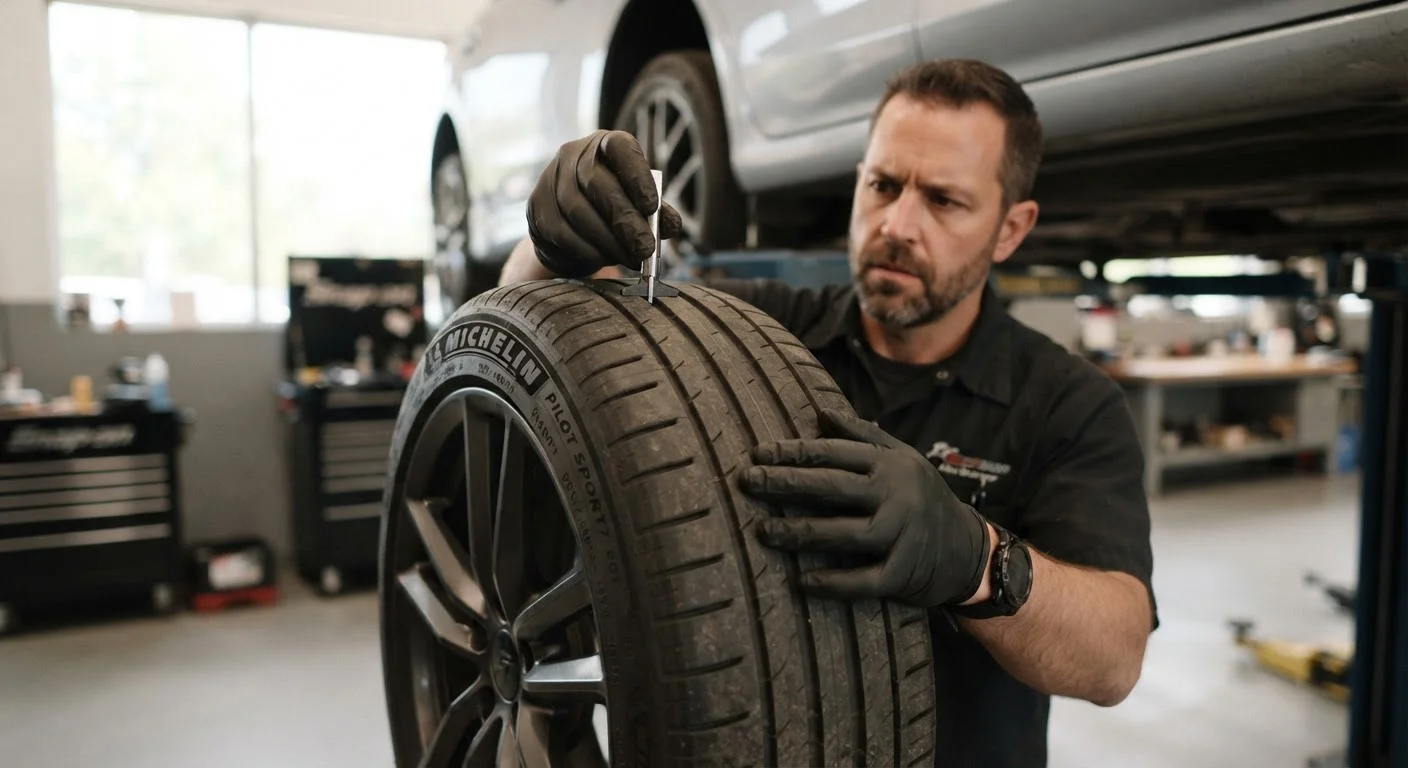
Every tire on your car wears differently depending on its position. On a front-wheel-drive vehicle, the front tires handle steering, acceleration, and most of the braking force - they wear faster. On rear-wheel-drive vehicles, the rear tires bear the brunt of power delivery. Rotation means physically moving the tires to different positions - front to rear, side to side, or in an X-pattern - so no single tire takes all the punishment.
A commonly cited interval is every 5,000 to 7,500 miles, though your owner's manual is the reliable reference for your specific vehicle. Skipping rotations doesn't cause immediate problems, but over time you'll end up replacing two tires while the others still have life left - which costs more in the long run.
Symptoms that rotation is overdue:
- Noticeable difference in tread depth between front and rear tires
- One tire wearing faster on the edges or center than others
- The vehicle pulling slightly in one direction (though this can also signal alignment issues)
Wheel Balancing: Eliminating the Wobble
A tire and wheel assembly is rarely perfectly uniform in weight. Small variations in the rubber, the wheel itself, or the valve stem can create imbalance. When a wheel spins at highway speed with uneven weight distribution, it wobbles - and that wobble travels up through the suspension into the steering wheel or seat as vibration.
Balancing involves mounting the wheel-and-tire assembly on a specialized machine that spins it and identifies where weight is uneven. A technician then attaches small adhesive or clip-on weights to the wheel rim to bring it into balance. It's precise, quick work - and effective.
“Vibration at highway speed is one of the most commonly misdiagnosed tire complaints. Drivers assume it's alignment, but more often the culprit is an out-of-balance wheel - a problem that takes minutes to fix once it's properly diagnosed.”
— Automotive Service Excellence (ASE) Technical Training Materials, Industry reference for certified automotive technicians
When to consider balancing:
- Vibration felt through the steering wheel at 50-70 mph that eases at lower speeds
- After hitting a significant pothole or curb
- When mounting new tires
- If a wheel weight has visibly fallen off
Wheel Alignment: Correcting the Angles
Alignment has nothing to do with tire position or wheel weight - it's about the angles at which your wheels contact the road. Three measurements matter most: camber (the tilt of the tire inward or outward when viewed from the front), toe (whether the fronts of the tires point toward or away from each other), and caster (the angle of the steering axis). When these are off, tires scrub the road rather than rolling cleanly, causing rapid and uneven wear.
Alignment gets knocked out by potholes, hard curb strikes, worn suspension components, or simply accumulating road miles. A shop uses an alignment rack with sensors attached to each wheel to measure current angles and adjust them back to manufacturer specifications.
Signs your alignment may be off:
- The car drifts to one side when you release the steering wheel on a flat road
- The steering wheel is off-center when driving straight
- Tires showing excessive wear on one edge
Proper alignment also affects fuel economy - misaligned tires create drag. If you're planning a long road trip, it's worth checking alignment beforehand. Our pre-trip vehicle check guide covers what else to verify before heading out.
Check Alignment After Suspension Work
Any time a suspension component is replaced - control arms, tie rods, struts - the geometry of your wheels can shift. It's standard practice to perform an alignment check after this kind of repair, even if the car seemed to drive fine beforehand. Skipping this step can lead to premature tire wear despite a successful repair.
How to Keep Track of All Three
The simplest approach: note your mileage each time a service is done and follow the intervals in your owner's manual. Rotation is the most frequent - treat it like an oil change in terms of scheduling regularity. Balancing and alignment are less routine but should be checked any time something changes noticeably about how the car drives.
Where you get these services done is a separate conversation. For a balanced take on your options, see dealer service vs. independent repair shops. What matters most is that the work gets done on time - by someone with the right equipment - rather than where it happens.