
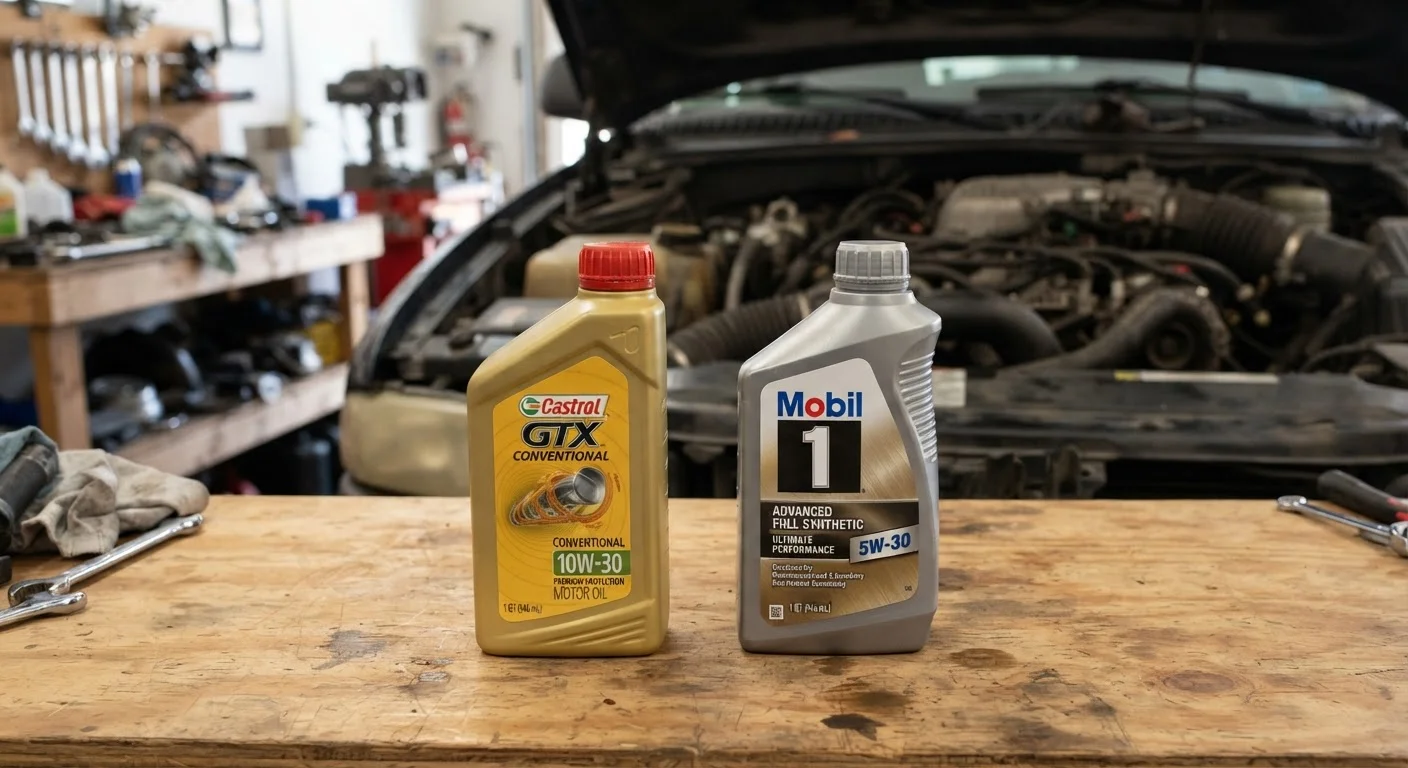
What Actually Makes These Oils Different
Motor oil's job is straightforward: lubricate moving metal parts, carry heat away from the engine, and suspend contaminants until the next oil change. Both synthetic and conventional oil do this - but they start from different places and hold up differently under stress.
Conventional motor oil begins as crude oil that's refined to remove impurities. The base molecules aren't uniform - they vary in size and shape, which makes conventional oil reasonably stable under normal conditions but more prone to oxidation and viscosity breakdown when temperatures climb or miles stack up.
Synthetic motor oil is either fully synthesized from chemical compounds or built from a highly refined base stock. The result is a more uniform molecular structure that resists thermal breakdown, flows better in cold starts, and lasts longer before degrading. That uniformity is the core advantage - not marketing language.
Both types use additive packages - detergents, anti-wear agents, viscosity modifiers - but synthetics tend to retain those additives' effectiveness longer. That's a key reason why synthetic oil typically carries longer recommended change intervals.
| Criterion | Synthetic Motor Oil | Conventional Motor Oil |
|---|---|---|
| Base material | Engineered chemical compounds | Refined crude oil |
| Molecular consistency | Uniform, precisely structured | Variable, less uniform |
| Typical change interval | 7,500-10,000+ miles (varies by vehicle) | 3,000-5,000 miles |
| Cold-weather flow | Flows faster at startup | Thicker until engine warms |
| Heat resistance | Higher thermal stability | More prone to breakdown in heat |
| Cost per quart | Higher | Lower |
| Best suited for | Modern engines, extreme conditions | Older engines, mild conditions |
Change Intervals, Viscosity Grades, and Your Owner's Manual
One of the most persistent myths in routine car care is that all vehicles need an oil change every 3,000 miles. That interval was reasonable decades ago with older conventional oils and older engine tolerances. It's now outdated for most vehicles on the road.
Synthetic oil in a modern engine commonly runs 7,500 to 10,000 miles between changes, and some manufacturer specifications go higher. Conventional oil generally performs best with changes every 3,000 to 5,000 miles depending on driving conditions. The only authoritative source for your vehicle's requirement is the owner's manual - not a sticker on your windshield or a quick-lube recommendation.
Viscosity grades - the numbers on the bottle like 5W-30 or 0W-20 - describe how the oil flows at cold temperatures (the first number) and at operating temperature (the second). Your manual specifies the correct grade. Using a different grade, regardless of oil type, is a bigger issue than the synthetic vs. conventional choice itself.
Keeping up with your maintenance schedule doesn't require guesswork - it just requires reading what your manufacturer actually recommends.
~7,500-10,000 mi
Typical synthetic oil change interval
Many automakers now specify extended synthetic oil change intervals in owner's manuals, replacing the older 3,000-mile conventional guidance.
~3,000-5,000 mi
Typical conventional oil change interval
Conventional oil degrades faster under heat and use, making more frequent changes necessary to maintain adequate engine protection.
0W-20
Common modern engine viscosity grade
Thinner viscosity grades like 0W-20 are increasingly specified for fuel efficiency and are almost exclusively used with full synthetic formulations.
Which Oil Makes Sense for Your Situation
For the majority of drivers with vehicles from roughly 2010 onward, synthetic oil is likely already specified by the manufacturer and will serve the engine well. The higher per-quart cost is real, but longer intervals between changes typically close much of that gap over the course of a year.
For older vehicles, especially those that have been running conventional oil for years, the calculus can shift. High-mileage ownership comes with its own maintenance considerations, and some mechanics note that engines with significant wear may leak slightly more with full synthetic due to its thinner viscosity at operating temperature. There's no universal rule here - your owner's manual and a trusted mechanic's assessment matter.
A concern worth dismissing outright: switching from conventional to synthetic (or back) does not harm your engine. That idea has circulated for years but isn't supported by modern oil chemistry. The oils are compatible, and modern engines handle the transition without issue.
What genuinely harms engines is neglecting changes altogether. Skipping oil changes causes real, expensive damage regardless of which type of oil is in there - the best oil in the world eventually degrades past the point of protecting your engine. Consistency matters more than the label on the bottle.