The System on a Chip: Your Phone's Brain
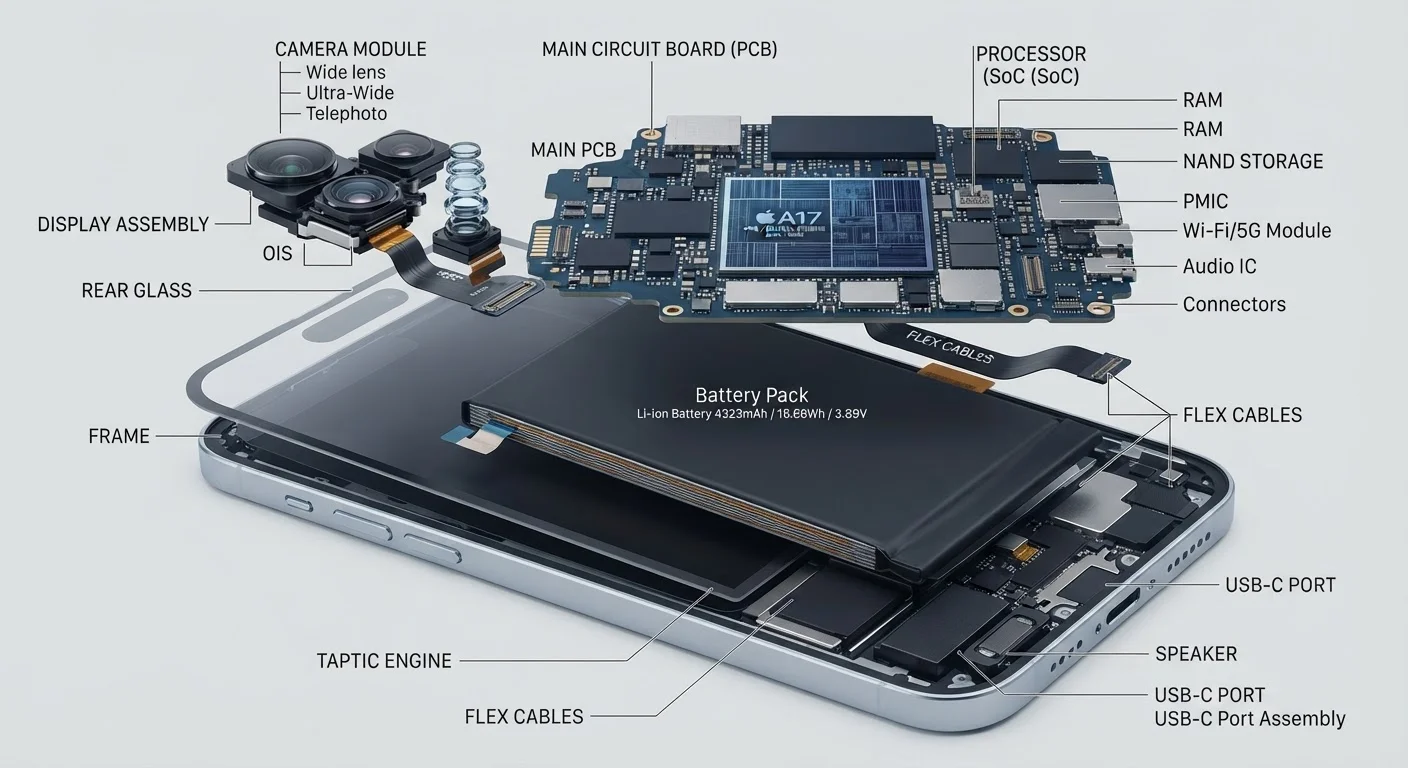
Every smartphone is built around a System on a Chip (SoC) - a single piece of silicon that combines the central processing unit (CPU), graphics processing unit (GPU), modem, and other controllers into one compact package. Think of it as the entire engine room of your phone compressed to roughly the size of a fingernail.
The CPU handles general calculations: opening apps, processing keyboard input, running the operating system. The GPU renders images and video. The modem manages cellular communication. By integrating all of these onto one chip, manufacturers reduce power consumption and physical space compared to using separate components.
SoC performance is often described in terms of the manufacturing process measured in nanometers (nm) - smaller numbers generally mean more transistors packed in, which translates to greater efficiency and speed. When your phone feels snappy launching apps or editing photos, the SoC is doing that work. If you've ever wondered why your phone slows down over time, hardware capability is only part of the picture - software behavior matters too.
When comparing phones, prioritize SoC generation over clock speed numbers alone - a newer architecture at a lower clock speed often outperforms an older chip running faster.
Chip architecture determines efficiency and instruction throughput; raw GHz figures are marketing shorthand that doesn't capture real-world differences between processor generations.
To extend battery longevity, avoid regularly charging to 100% or letting the phone drain to 0% - keeping charge between roughly 20% and 80% reduces cell stress.
Lithium-ion chemistry degrades faster at voltage extremes; partial-cycle charging is a well-documented method for slowing capacity loss over time.
RAM and Storage: Memory That Works Two Ways
Your phone uses two distinct types of memory, and confusing them is one of the most common misunderstandings in consumer tech.
RAM (Random Access Memory) is short-term, active memory. When you open an app, its data loads into RAM so the processor can access it instantly. More RAM means more apps can stay ready in the background without needing to reload. Most current smartphones ship with 6-12 GB of RAM.
Internal storage (often called flash storage or eMMC/UFS) is where everything lives permanently: your photos, downloaded apps, music, and the operating system itself. Storage capacity is measured in gigabytes (GB) and doesn't disappear when the phone powers off - unlike RAM, which clears with every restart.
The practical takeaway: if your phone feels sluggish switching between apps, RAM is the likely bottleneck. If you keep getting "storage full" warnings, that's your internal flash storage running low. Both are fixed at manufacture and cannot be upgraded on most modern smartphones.
The Display: More Than Just a Screen
The display is the component you interact with most, and it's considerably more complex than a sheet of glass. Modern smartphone screens are typically built on one of two panel technologies: LCD (Liquid Crystal Display) or OLED (Organic Light-Emitting Diode).
LCD panels use a backlight that illuminates the entire screen uniformly. OLED panels light each pixel individually, which means pixels showing black simply turn off - producing deeper contrast and saving power on dark-themed interfaces.
Refresh rate, measured in hertz (Hz), describes how many times the screen redraws per second. A 60 Hz display redraws 60 times per second; a 120 Hz display does so twice as fast, making scrolling and animations appear noticeably smoother. Some phones use adaptive refresh rates that scale dynamically to conserve battery.
The digitizer - a transparent layer bonded to the display - is what actually detects your touch. It's a separate component from the visible panel itself, which is why a cracked screen doesn't always prevent touch input from working, and vice versa.
The Camera System: Optics Meets Silicon
Contemporary smartphones often feature multiple rear camera sensors, each serving a distinct optical purpose rather than simply adding redundancy.
- Main (wide) sensor: The largest sensor, used for most everyday photography. Larger sensors capture more light, which is why the main camera typically performs best in low light.
- Ultra-wide sensor: A shorter focal length lens captures a broader field of view - useful for landscapes, architecture, and group shots at close range.
- Telephoto sensor: Provides optical zoom by using a longer focal length lens, preserving image quality at a distance without the software degradation of digital zoom.
The image signal processor (ISP), typically integrated into the SoC, handles computational photography tasks: noise reduction, HDR merging, portrait-mode depth mapping, and video stabilization. Much of what makes a modern smartphone photo impressive is software processing applied milliseconds after the shutter fires. For more on leveraging what your phone can already do, see getting more out of your phone's built-in apps.
Digital Zoom Is Not Optical Zoom
"Digital zoom" is software cropping - it enlarges a portion of the image captured by one sensor and discards surrounding pixels, reducing quality. True optical zoom uses a physically separate telephoto lens to bring subjects closer without quality loss. Check whether a phone's zoom feature is optical or digital before assuming the specification represents equivalent capability.
Sensors: The Hardware You Never See
A modern smartphone contains an array of sensors that most users never consciously think about, yet rely on constantly.
- Accelerometer
- Detects linear acceleration and orientation. Responsible for auto-rotating your screen and counting steps in fitness apps.
- Gyroscope
- Measures rotational movement. Essential for augmented reality apps, image stabilization, and smooth gaming controls.
- Proximity sensor
- Detects when your phone is held near your face, automatically dimming the screen during calls to prevent accidental touches.
- Ambient light sensor
- Reads surrounding light levels and adjusts screen brightness automatically.
- Barometer
- Measures atmospheric pressure. Used by GPS systems to improve altitude accuracy and by weather apps for local forecasts.
- Fingerprint sensor
- Either embedded under the display or housed in a side button; reads unique ridge patterns for biometric authentication.
These sensors interact extensively with apps and software to create experiences that feel seamless - from map navigation to sleep tracking to mobile payments.
The Battery and Charging Circuitry
Smartphone batteries are lithium-ion (Li-ion) or lithium-polymer (LiPo) cells. Capacity is measured in milliamp-hours (mAh) - a higher number means more stored energy, generally translating to longer use between charges. Most current smartphones carry batteries in the 4,000-5,000 mAh range.
The battery doesn't connect directly to the phone's circuits. A dedicated power management integrated circuit (PMIC) regulates voltage, controls charging speed, and protects the battery from overcharging or excessive heat. When you see fast-charging specifications (measured in watts), those figures reflect what the PMIC and charging adapter can negotiate together - both the phone's hardware and the charger must support the same standard for maximum speed.
Lithium cells degrade gradually with each charge cycle. After several hundred full cycles, a battery typically retains around 80% of its original capacity. This degradation is one of the primary reasons phones feel less capable over time - not just software bloat. For a broader view of how hardware ages, the guide on what actually wears out first in consumer gadgets covers this in detail.
Connectivity Hardware: Radios and Antennas
Staying connected requires multiple dedicated radios operating simultaneously, each tuned to different frequency ranges and protocols.
- Cellular modem: Handles voice calls and mobile data across 4G LTE and 5G networks. On most current phones this is integrated into the SoC rather than a discrete chip.
- Wi-Fi radio: Operates on 2.4 GHz and 5 GHz bands (and 6 GHz on Wi-Fi 6E-capable devices). For a deeper look at how these bands differ in range and speed, our connectivity guides break it down clearly.
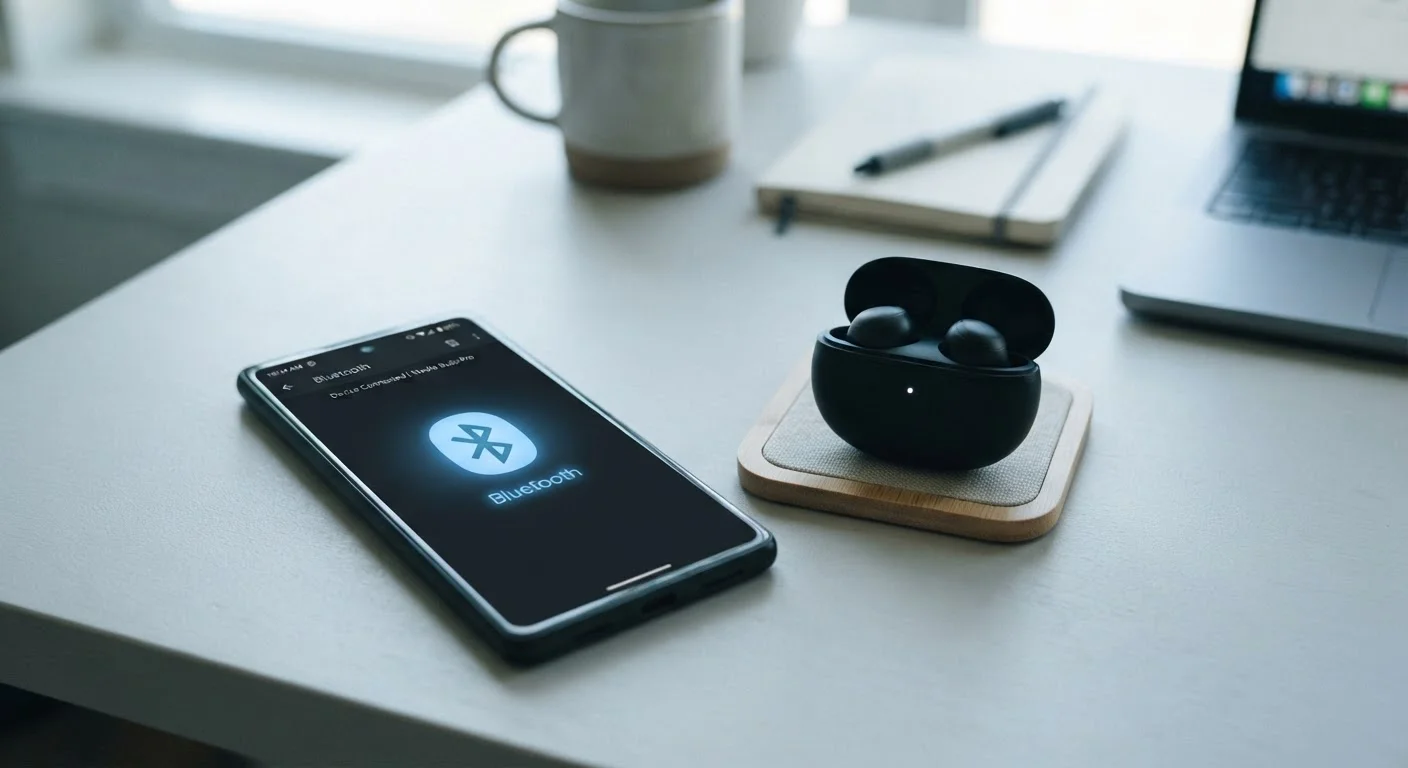
- Bluetooth: A short-range radio for accessories - headphones, speakers, keyboards, and health wearables. Bluetooth version numbers (5.0, 5.3, etc.) reflect improvements in range, speed, and energy efficiency.
- NFC (Near Field Communication): An extremely short-range radio (a few centimeters) enabling tap-to-pay and contactless data exchange. Requires both devices to support the standard.
Antennas for these radios are typically thin conductive traces printed or embedded along the phone's frame and back panel - one reason metal cases can slightly attenuate signal strength compared to plastic or glass. Each radio operates on distinct frequencies, allowing them to function simultaneously without interference.