The Physics Behind the Pad
At its core, wireless charging is an application of electromagnetic induction - a principle demonstrated by physicist Michael Faraday in the 1830s. When an alternating electrical current flows through a wire coil, it generates a fluctuating magnetic field around that coil. If a second coil is placed nearby, that magnetic field induces a new electrical current in the second coil. No physical connection is needed.
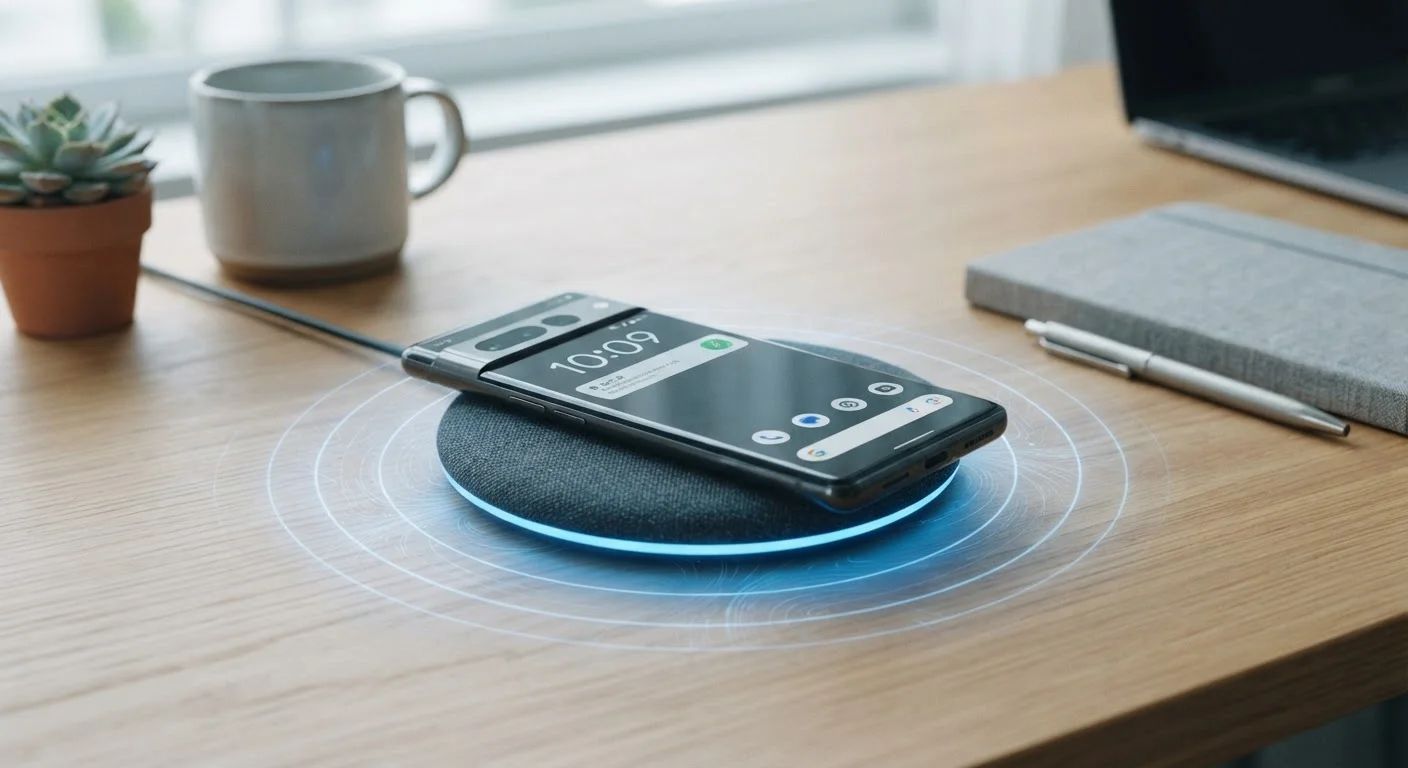
A wireless charging pad contains a transmitter coil connected to your wall outlet. Your phone contains a smaller receiver coil, typically located toward the middle or back of the device. When you place the phone on the pad, the two coils interact across the small gap - usually a few millimeters - and energy flows from the pad to the battery. The Qi standard, now found in hundreds of smartphone models, governs how these coils communicate to regulate the power level safely.
This is fundamentally different from how Wi-Fi or Bluetooth transfers data wirelessly. Those technologies send radio frequency signals carrying information; inductive charging physically moves electrical energy. For a broader look at how wireless signals behave in your home, see our guide to home Wi-Fi from the ground up.
Why Wireless Charging Is Slower - The Energy Loss Equation
Every step of the wireless energy transfer process introduces inefficiency. When electricity moves through the transmitter coil, some energy radiates outward as heat rather than coupling neatly into the receiver coil. The receiver coil then converts the magnetic field back into direct current to charge the battery - another conversion step where heat is generated. By the time energy reaches the battery, a meaningful fraction has been lost to the environment.
Wired charging avoids most of these conversion losses. Electricity travels through a cable directly to the phone's charging circuitry, which manages the final step of conditioning current for the battery. The path is shorter and more direct, so far less energy is wasted. This is why a wired fast-charger can deliver 25W, 45W, or more to a device, while most mainstream wireless chargers cap out at 5-15W under real-world conditions - even if the pad is nominally rated higher.
~80%
Typical wireless charging efficiency rate
Industry measurements generally place Qi wireless charging efficiency at roughly 80% or below, meaning around one-fifth of energy drawn from the outlet is lost before reaching the battery.
~95%
Typical wired charging efficiency rate
Direct cable charging loses far less energy to heat, with many modern wired chargers operating at 93-97% efficiency under controlled conditions.
5-15W
Common real-world wireless charging output
While premium wireless chargers are rated higher, most mainstream devices charge wirelessly at 5-15W depending on coil alignment and pad compatibility.
Coil alignment compounds the issue. If your phone is slightly off-center on the pad, the magnetic coupling weakens, efficiency drops further, and charging slows noticeably. You may also notice your phone and pad both becoming warm - that warmth represents energy that did not reach your battery.
Where Wireless Charging Makes Sense
Understanding the trade-off helps you use wireless charging where it genuinely fits. The technology excels in low-urgency, high-convenience scenarios: keeping a phone topped up on a desk while you work, charging overnight on a bedside pad, or dropping a device down without hunting for a cable in a dark room. In these situations, the slower rate is irrelevant - the phone has hours to charge.
Match the Charging Method to the Situation
Keep a wireless pad at your desk or nightstand for routine, long-duration charging sessions where convenience matters most. Reserve your cable for situations where you need meaningful charge in under 30 minutes. Using both tools for what they do well means you rarely feel the limitation of either.
Where wireless charging struggles is the quick top-up situation: arriving somewhere with 20% battery and needing 50% in 20 minutes. In that scenario, a cable is the straightforwardly better tool. The same principle applies to the broader wired-versus-wireless trade-off across device categories - as explored in our comparison of wired and wireless earbuds, convenience and performance often pull in opposite directions.
It is also worth setting aside the common belief that overnight wireless charging causes serious battery harm. While heat does contribute to gradual battery wear, modern phones manage thermal loads actively. For a closer look at which popular device beliefs hold up, see Gadget Myths That Even Tech-Savvy People Believe.
What Determines the Wattage You Actually Get
Wireless chargers are rated by their maximum output, but several factors determine what your device actually receives. First, both the pad and the phone must support the same wattage tier - a pad capable of 15W will only deliver that to a phone with a compatible receiver. Second, the quality and thickness of any case between the phone and pad affects coupling efficiency. Third, ambient temperature and the phone's current battery level influence how aggressively the charging circuitry accepts power.
Charging slows as the battery approaches full capacity - this is intentional. The final 20% of a charge cycle uses a trickle-charge approach to protect battery chemistry, and this applies to both wired and wireless charging. The difference is that wireless charging starts from a lower effective wattage ceiling, so the entire curve takes longer.
For anyone curious about how the broader wired-versus-wireless choice plays out across home devices - not just phones - our article on choosing wired vs. wireless connections by device covers the practical decision-making involved.