The Core Difference: How Audio Actually Travels
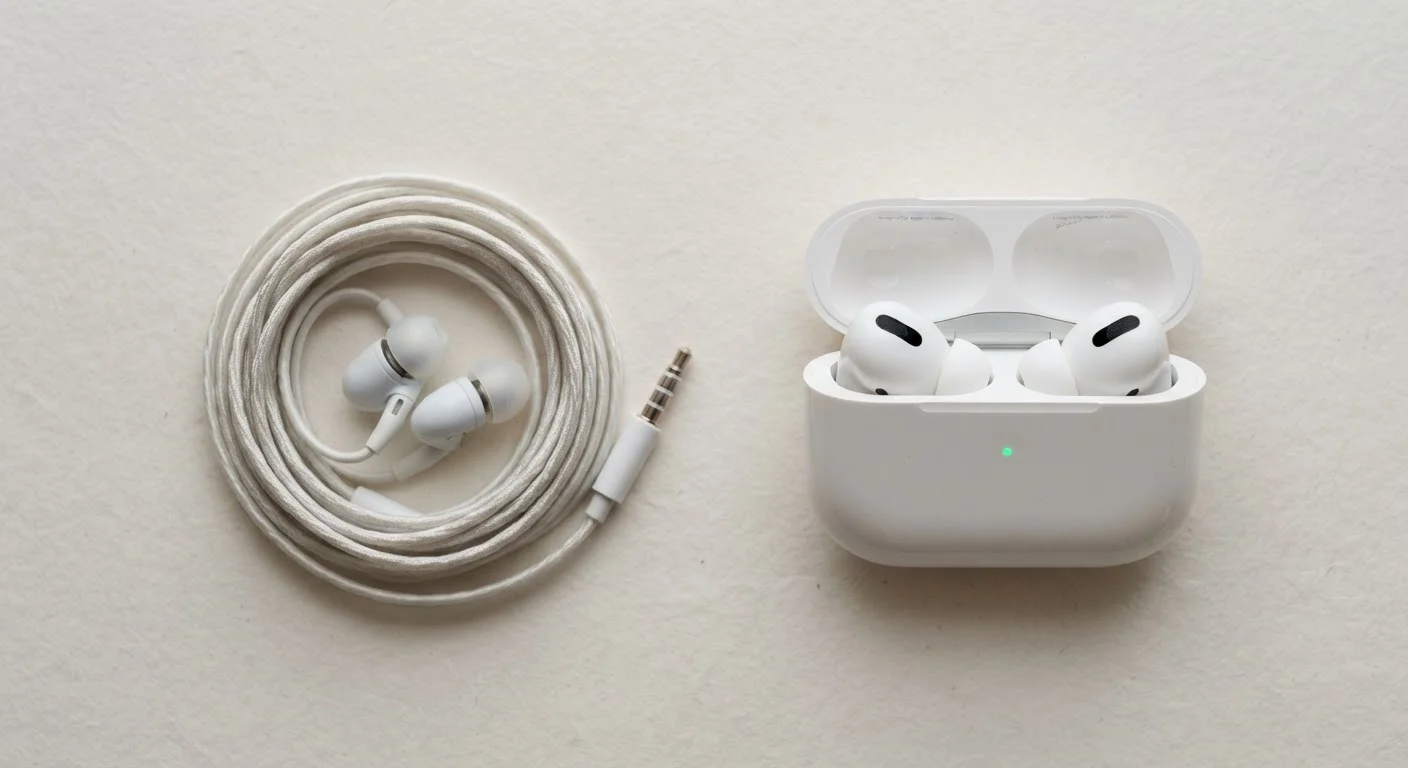
The most fundamental distinction between wired and wireless earbuds is the signal path. With wired earbuds, an analogue audio signal travels directly from your device's audio output through the cable to the driver in each ear - no translation required. With wireless earbuds, that same audio is compressed into a digital Bluetooth signal, transmitted through the air, received by a chip inside the earbud, decoded, and then converted back to sound. That extra chain of steps has real consequences.
Latency - the gap between a sound occurring and you hearing it - is effectively zero with a wired connection. Bluetooth audio introduces a delay typically ranging from around 40 to 200 milliseconds depending on the codec (the compression format used). For music streaming, this is imperceptible. For watching video, it can cause audio to feel slightly out of step with the picture, though many devices and apps now compensate automatically.
| Criterion | Wired Earbuds | Wireless Earbuds |
|---|---|---|
| Signal path | Direct analogue | Bluetooth (encoded/decoded) |
| Latency | Effectively zero | ~40-200 ms (codec-dependent) |
| Audio quality ceiling | Higher (no compression) | Near-equal for typical streaming |
| Battery required | No | Yes (5-8 hrs per charge) |
| Active noise cancellation | Rarely available | Common on many models |
| Cable management | Required | None |
| Interference risk | None | Possible in crowded environments |
| Device compatibility | Requires 3.5 mm jack or adapter | Works with any Bluetooth device |
Audio Quality: Closer Than You Might Think
A persistent belief holds that wired earbuds always sound better. In practice, the gap has narrowed considerably. Early Bluetooth audio relied on lossy compression that stripped out detail. Newer codecs such as aptX, AAC, and LDAC transmit higher-quality audio, and for most everyday listening - podcasts, pop music, streaming services - the difference is not audible without dedicated testing equipment.
Where wired earbuds still have a measurable advantage is in high-resolution audio playback. If your source material is lossless or high-bitrate and your earbuds are built to reproduce fine detail, the analogue path avoids any compression artefacts entirely. Audio enthusiasts who invest specifically in this area tend to prefer wired. For the typical listener using a streaming service at standard quality, the distinction is largely theoretical.
40-200 ms
Typical Bluetooth audio latency range
Latency varies by codec; aptX Low Latency targets under 40 ms while standard SBC can reach 200 ms or more.
5-8 hrs
Average wireless earbud playback time per charge
Most mainstream wireless earbuds offer this range, with charging cases extending total use to 20-30 hours before a wall charge is needed.
990 kbps
Maximum bitrate of the LDAC Bluetooth codec
Sony's LDAC codec, supported on many Android devices, transmits up to 990 kbps - approaching the bandwidth of CD-quality audio.
Battery Life and the Ongoing Trade-Off
Wireless earbuds carry onboard batteries, and that introduces a management responsibility that wired earbuds simply do not have. Most wireless earbuds offer between five and eight hours of playback per charge, with a charging case providing two to four additional charges. That amounts to a full week of moderate daily use between wall-charging sessions for many people - but it requires remembering to return earbuds to their case.
The battery also degrades over time. Lithium-ion cells lose capacity with repeated charge cycles, which means wireless earbuds bought today will deliver fewer hours of playback after a few years of use. Wired earbuds, drawing power from the connected device, experience no such degradation. For listeners who consistently forget to charge devices or who use earbuds in unpredictable bursts throughout the day, this is a practical consideration worth weighing. This dynamic mirrors what happens with other wireless accessories - similar trade-offs are covered in our look at how wireless charging trades speed for convenience.
Features, Fit, and Real-World Reliability
Wireless earbuds carry onboard processors that enable features physically impossible in a passive wired design. Active noise cancellation (ANC) uses microphones to measure ambient sound and generate an inverse signal to suppress it - this requires a chip, software, and power, none of which a wired earbud has. Similarly, transparency modes, touch or gesture controls, automatic play/pause when an earbud is removed, and voice assistant integration all depend on that processor.
Reliability differs in a practical sense too. Wired earbuds can fail where the cable meets the housing - a common stress point - but when working, they work unconditionally. Wireless earbuds can experience Bluetooth interference in crowded environments such as airports or offices with many active devices. Bluetooth 5.0 and newer versions have improved connection stability considerably, but interference remains a real-world variable. For a broader look at how wireless signals behave in different environments, see our guide on choosing the right wired or wireless connection for each device.