
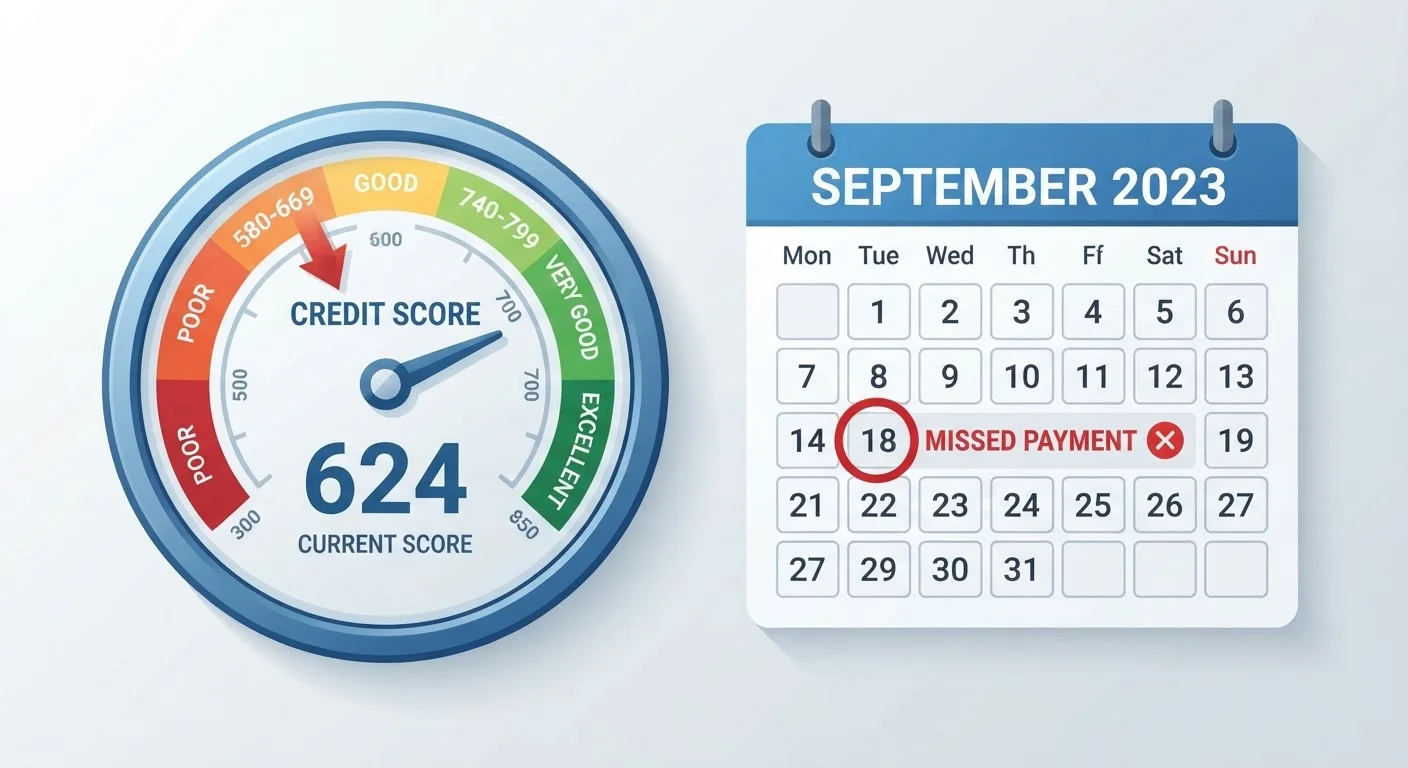
The 30-Day Rule: When a Missed Payment Becomes a Problem
Many people assume that missing a payment by a few days immediately tanks their credit score. That's not how the reporting system works. Under the Fair Credit Reporting Act, lenders cannot report a payment as late to the credit bureaus until it is at least 30 days past due. This means a payment missed on the 1st of the month isn't reportable until after the 30th.
That window matters. If you realize the mistake within those 30 days and pay in full - or at minimum the required minimum payment - the delinquency never appears on your credit report. You may still incur a late fee from the lender, but your credit score remains untouched.
Once the 30-day mark passes and the lender reports the missed payment to Equifax, Experian, or TransUnion, the consequences become more significant and harder to reverse. Understanding this timeline is the first step toward protecting your score.
Act Before the 30-Day Window Closes
If you've missed a payment, check how many days have passed before assuming the worst. Paying within 30 days of the due date - even with a late fee - typically prevents the delinquency from reaching your credit report at all. Setting up autopay for at least the minimum amount is a reliable safeguard against this situation recurring.
How Much Your Score Actually Drops
The score impact of a single missed payment depends heavily on two factors: your current credit score and your overall credit history. Counterintuitively, borrowers with higher scores typically face steeper drops. Someone with an 800 score seeing a first-ever 30-day late can lose between 90 and 110 points, according to FICO's published impact examples. Someone already sitting at 650 might see a drop in the range of 60 to 80 points - less in absolute terms, but damaging at a score level where lenders are already cautious.
This asymmetry exists because scoring models treat a delinquency as more unexpected - and therefore more statistically significant - when your record has been spotless. Your payment history carries roughly 35% of your FICO score's weight, making it the single heaviest factor in the calculation.
~35%
Payment history weight in FICO score
According to FICO, payment history is the single largest factor in calculating your credit score.
90-110 pts
Estimated score drop for high scorers
FICO's published research indicates that borrowers with scores around 780-800 can lose 90 to 110 points from a single 30-day missed payment.
7 years
How long a late payment stays on report
Under the Fair Credit Reporting Act, a reported delinquency can remain on your credit file for up to seven years from the original missed-payment date.
For context on how other factors interact with your score, our explainer on hard vs. soft credit inquiries covers another commonly misunderstood piece of the credit score puzzle.
What Happens If the Missed Payment Goes Unresolved
A 30-day delinquency is harmful. A 60-day delinquency is worse. A 90-day delinquency is where serious long-term damage begins. Each escalation in delinquency stage is separately reportable and adds a new negative mark. After 90 to 180 days of non-payment, many lenders will charge off the account - writing it off as a loss on their books - and potentially sell it to a collections agency.
That collections account then appears on your credit report as a separate negative entry, compounding the damage. Our article on what actually happens when debt goes to collections walks through that chain of events in detail.
For secured debt - like a mortgage or auto loan - the consequences extend beyond credit damage. Lenders can move to repossess collateral or initiate foreclosure proceedings. The distinction between secured and unsecured debt becomes critical here; understanding what changes when collateral is involved can help clarify your exposure.
Not All Accounts Report the Same Way
Some creditors, particularly smaller lenders or buy-now-pay-later providers, may not report payment activity to all three major bureaus - or at all. Conversely, certain accounts like federal student loans may have specific deferment or forbearance provisions that affect when and how delinquencies are reported. Always confirm reporting practices directly with your lender.
Recovery: How Long It Takes and What Helps
A reported late payment stays on your credit report for seven years from the date of the original delinquency. That sounds alarming, but the practical damage diminishes over time. Scoring models place greater weight on recent activity, so a 30-day late payment from five years ago has far less impact than one from six months ago - especially if you've built a clean payment record since.
The most effective recovery strategy is straightforward: pay every future obligation on time, reduce outstanding balances where possible, and avoid applying for unnecessary new credit in the months following the delinquency. Autopay is one of the simplest tools available; setting it to cover at least the minimum payment protects against future missed payments.
If you sometimes find yourself making only minimum payments, it's worth understanding that this approach carries its own long-term costs - our piece on why paying only the minimum costs more than people realize explains the math. And if you're unsure which credit behaviors truly matter, common credit score myths is a useful reality check.
This article is for general informational purposes only and does not constitute personalized financial advice. Consult a qualified financial professional for guidance specific to your situation.