
The Core Difference: What a Lender Can Take
At its most basic, the distinction between secured and unsecured debt comes down to one question: did you pledge an asset to back the loan?
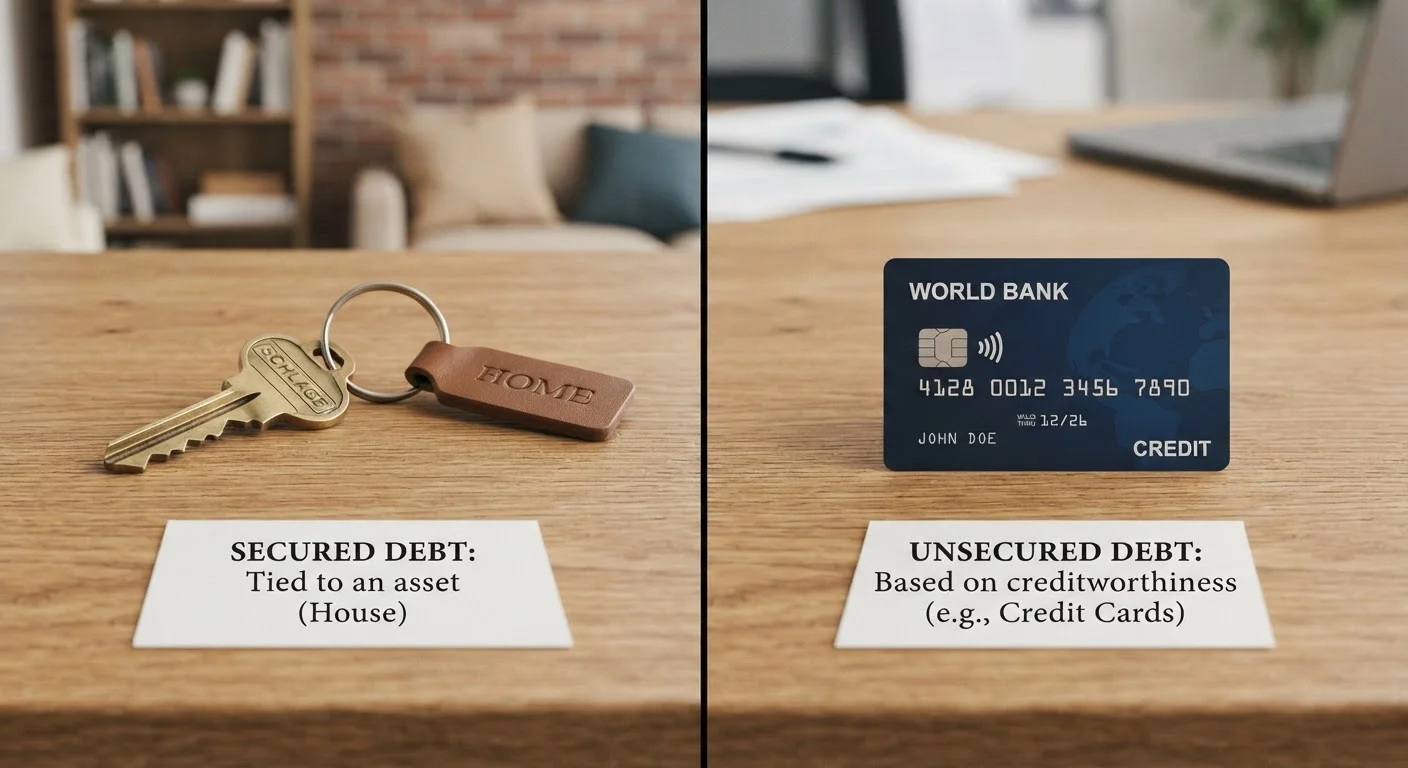
Secured debt is any borrowing tied to collateral - a specific asset the lender has a legal claim on if you stop paying. A mortgage is secured by the home itself. An auto loan is secured by the vehicle. If payments stop, the lender has defined remedies: foreclosure on a property, repossession of a car. The asset secures the lender's position, which is why lenders are generally willing to offer lower rates and larger loan amounts.
Unsecured debt carries no such claim. A credit card, a personal loan, a medical bill - none of these are tied to a specific asset. The lender extended credit based on your creditworthiness: your income, payment history, and debt-to-income ratio. If you default, the lender can't immediately seize property. Their remedies are more indirect: reporting to credit bureaus, hiring collection agencies, or eventually pursuing a court judgment.
For a deeper look at how debt terminology like principal, APR, and charge-off fit into this picture, see our plain-language debt glossary.
How Collateral Changes Rates, Risk, and Approval
The presence or absence of collateral reshapes the entire loan relationship - not just what happens if you default, but how the loan is structured from the start.
| Criterion | Secured Debt | Unsecured Debt |
|---|---|---|
| Collateral required | Yes - specific asset pledged | No - creditworthiness only |
| Typical interest rate | Lower due to reduced lender risk | Higher, reflects greater lender exposure |
| Common examples | Mortgage, auto loan, secured card | Credit card, personal loan, medical debt |
| Consequence of default | Foreclosure or repossession | Collections, credit damage, possible judgment |
| Approval factors | Credit + value of collateral | Credit score, income, debt-to-income ratio |
| Loan amounts | Typically larger | Generally smaller or capped |
Because secured lenders have a fallback - they can recover value by selling the collateral - they face less financial exposure. That reduced risk typically translates to lower annual percentage rates (APRs). A mortgage might carry a rate a fraction of what an unsecured personal loan charges for a similar borrower profile.
Approval standards also differ. Unsecured lenders lean heavily on credit scores and income because there's no asset cushion. Secured lenders still evaluate creditworthiness, but the collateral provides a floor. That's why someone with a limited credit history might qualify for a secured auto loan more easily than an unsecured personal loan of equivalent size.
It's worth noting that not all secured debt involves traditional property. Secured credit cards use a cash deposit as collateral - a useful tool for establishing credit when other options are limited.
A Note on Home Equity Products
Home equity loans and home equity lines of credit (HELOCs) are secured debt - they use your home as collateral even though the funds can be used for almost any purpose. This is an important distinction from unsecured personal loans, which may offer similar flexibility but without placing your home at risk. Understanding which category a loan falls into matters, particularly when evaluating how to handle it in a financial hardship.
What Default Looks Like on Each Type
The stakes of non-payment diverge sharply depending on which type of debt is involved.
With secured debt, the lender's legal right to the collateral is explicit. Miss enough mortgage payments and the lender can initiate foreclosure - a legal process that can result in losing your home. Default on a car loan and repossession is typically the lender's next step, often without court involvement required, depending on state law. The timeline and process vary, but the outcome is the same: the asset you pledged can be taken.
With unsecured debt, there's no asset to seize immediately. Instead, default triggers a different chain of events: late fees, credit score damage, potential charge-off (when the lender writes the debt off as a loss), and sale to a collections agency. The lender may eventually seek a court judgment, which could lead to wage garnishment in some states - but this takes time and legal action. To understand that progression in detail, see what happens when a debt goes to collections.
Both paths damage credit. A single missed payment can move your credit score significantly, regardless of whether the debt is secured or not.
This article is for general informational and educational purposes only and does not constitute personalized financial or legal advice. Consult a qualified financial professional for guidance specific to your situation.