How Each Intersection Type Works
A four-way stop puts the full burden of safety on driver behavior. Each approaching vehicle must stop completely and then take turns in order of arrival - or yield to the vehicle on the right if there's a tie. When everyone follows the rules, it works. When they don't, the results can be serious: right-angle crashes at uncontrolled intersections are among the most violent collision types on public roads.
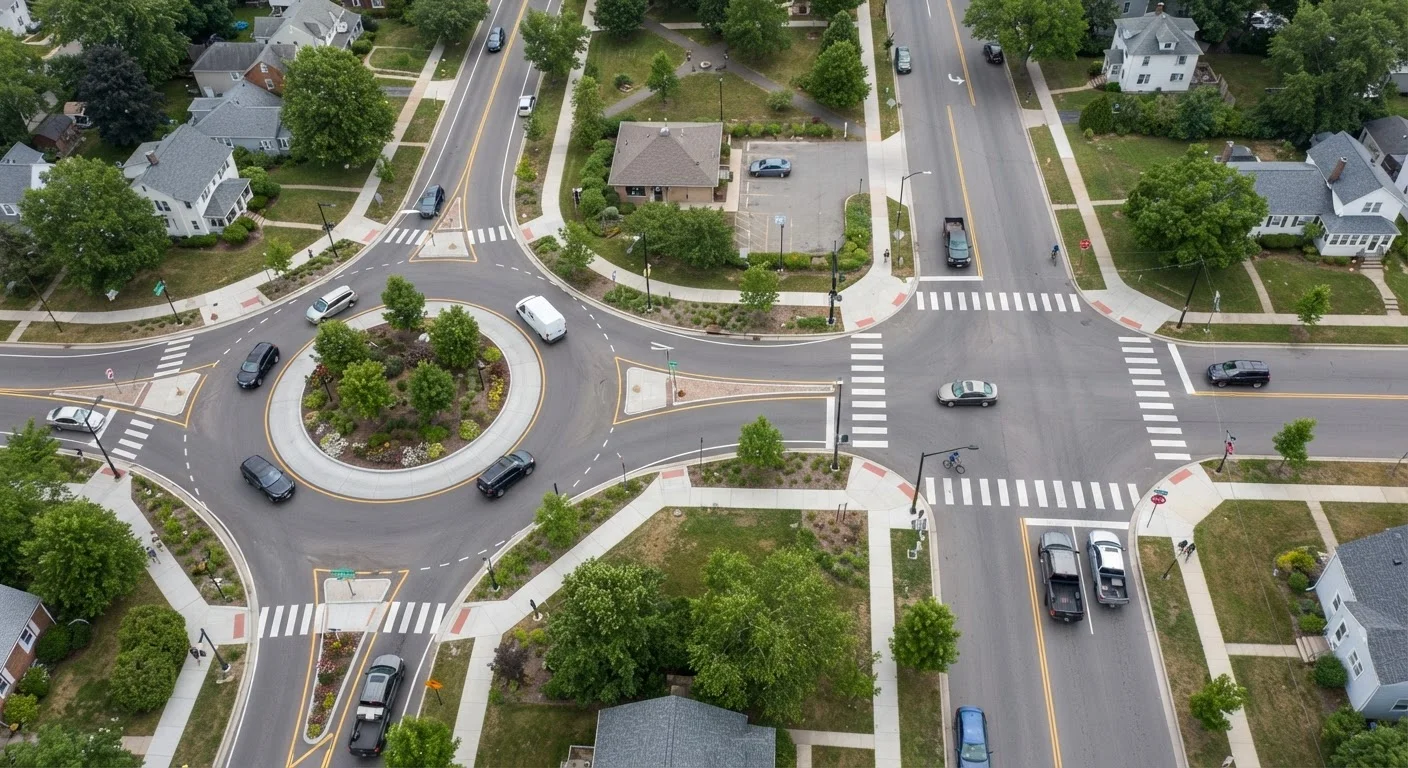
A roundabout uses a central island to redirect traffic into a one-way circular flow. Vehicles entering the roundabout yield to those already circling, then merge in at low speed. There are no signals to run, no ambiguous turn-order disputes, and no opposing traffic streams crossing at 90-degree angles. The geometry itself forces slower speeds and eliminates the most dangerous conflict points.
The Safety Data: What Research Shows
The Federal Highway Administration has studied roundabout safety extensively. Their findings, drawn from before-and-after studies at converted intersections, show roundabouts reduce injury crashes by roughly 75% and fatal crashes by up to 90% compared to the intersections they replaced. These aren't small differences - they reflect a fundamental change in crash physics.
~75%
Reduction in injury crashes at roundabouts
According to Federal Highway Administration research on intersections converted from traditional signals or stops to roundabouts.
Up to 90%
Reduction in fatal crashes at roundabouts
FHWA before-and-after studies show roundabouts dramatically reduce the likelihood of fatal collisions at converted sites.
Why such a dramatic gap? At a four-way stop, if a driver fails to stop - whether distracted, misjudging the situation, or simply running the stop sign - the result is a right-angle collision, also called a T-bone crash, at whatever speed they were traveling. Those are high-energy impacts directed at the weakest parts of a vehicle's structure.
At a roundabout, entry speeds are typically 15-25 mph. Conflicts between vehicles are largely merging-type interactions rather than crossing ones, which means if a collision does occur, it tends to be a low-speed sideswipe - survivable in a way that a broadside impact rarely is. Understanding how speed affects crash outcomes helps explain why this geometric difference matters so much.
Where Four-Way Stops Still Make Sense
Four-way stops aren't going away, and for good reason. They're inexpensive to install, require no land acquisition, and work well in situations where traffic volumes are low enough that the driver-negotiated turn-taking system isn't frequently tested. A quiet residential intersection with a handful of vehicles per hour doesn't need a roundabout.
Approaching a Four-Way Stop Correctly
Come to a complete stop - wheels fully stopped - before the line. Then look left, right, and left again before proceeding. If you and another driver arrive simultaneously, yield to the vehicle on your right. Don't wave others through out of politeness; it creates confusion about who has the right of way and can lead to collisions.
Four-way stops also serve as a useful traffic-calming tool in neighborhoods, because the mandatory full stop slows drivers who might otherwise roll through at speed. Roundabouts, by contrast, allow continuous movement - which is efficient but means there's no forced stop that pedestrians can rely on as a guaranteed gap.
Pedestrian accommodation is genuinely more complicated at multi-lane roundabouts, where walkers must cross multiple lanes of circulating traffic in stages. Single-lane roundabouts handle pedestrians reasonably well, but larger designs require more careful engineering. It's one area where the four-way stop has a legitimate edge in dense urban settings.
Driver Behavior and the Human Factor
Any intersection design is only as good as the drivers navigating it. Four-way stops demand that every driver correctly identify their arrival order, make eye contact or read the situation accurately, and actually stop - not roll through. Research on stop-sign compliance suggests a meaningful share of drivers treat stop signs as yield signs in practice.
Roundabouts have their own learning curve. Many US drivers report uncertainty about yielding rules, lane selection in multi-lane roundabouts, and how to signal exits. Poor decisions inside a roundabout - like stopping in the circle to let someone in - can create rear-end hazards. If you're prone to following too closely in traffic, roundabouts are worth extra attention; tailgating inside a roundabout leaves almost no reaction time when the car ahead slows to exit.
The good news: familiarity matters. Studies show driver comfort and compliance at roundabouts improves significantly after a few months of exposure. The initial unfamiliarity is real, but it's temporary.
| Roundabout | Four-Way Stop | |
|---|---|---|
| Fatal crash reduction | Up to 90% vs. prior intersection | Baseline - depends on compliance |
| Injury crash reduction | ~75% vs. prior intersection | Moderate with full compliance |
| Dominant crash type (when crashes occur) | Low-speed sideswipe | Right-angle (T-bone) collision |
| Pedestrian handling | Complex at multi-lane; manageable single-lane | Clear stop gap; easier for pedestrians |
| Installation cost & space | Higher; requires land and engineering | Low cost; fits existing footprint |
| Traffic flow efficiency | Continuous flow; less idling | Stop-start; can queue at volume |
| Driver familiarity (US) | Lower initially; improves with exposure | High; universally understood |