
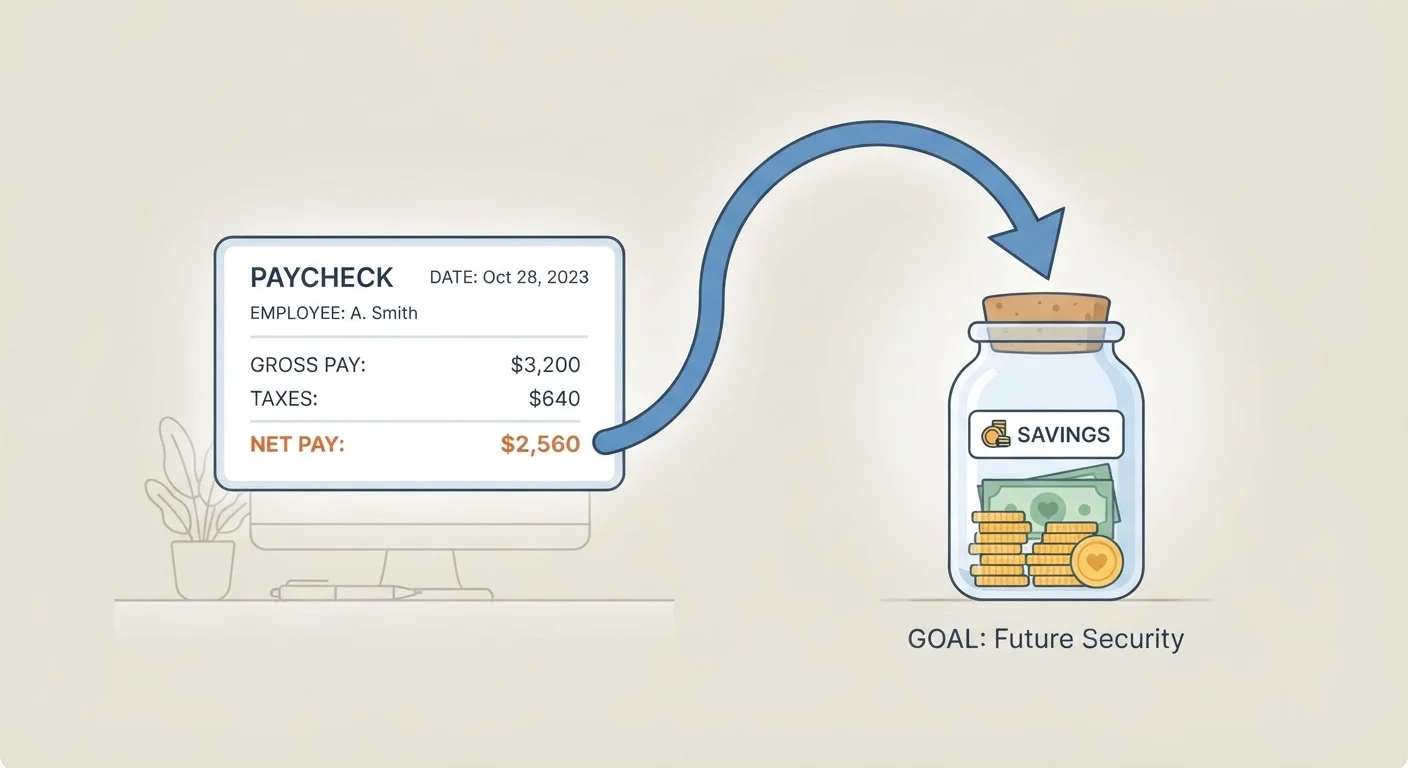
The Core Idea: Flip the Savings Order
Most people save in one direction: income comes in, bills get paid, everyday spending happens, and savings receive whatever survives the month. For many, that remainder is small - or nonexistent. Pay-yourself-first simply reverses that sequence.
Under this approach, a predetermined amount moves into savings the moment income arrives, before any discretionary spending occurs. Everything else - groceries, entertainment, clothing - is funded from what remains. The practical effect is that savings are treated as a fixed cost rather than a flexible one.
This framing matters because it changes the psychological relationship with money. Spending decisions become constrained by what's left after saving, not the other way around. For a broader look at how this compares to other frameworks, see other budgeting approaches that suit different financial situations.
This Is Financial Education, Not Advice
Pay-yourself-first is a general savings concept, not a prescription suited to every financial situation. Individual circumstances - debt levels, income stability, household obligations - vary significantly. Consider speaking with a licensed financial professional before restructuring how you allocate income.
How Automation Makes It Work
Knowing you should save and actually doing it consistently are two different things. Automation closes that gap. When a transfer is scheduled to happen automatically - through an employer's direct deposit split, a bank's recurring transfer, or a retirement plan contribution - saving requires no ongoing decision-making.
This matters because financial research consistently highlights that willpower is an unreliable savings mechanism. Automatic systems reduce the friction between intention and action. Common automation mechanisms include:
- Employer payroll splits: Many employers allow direct deposit to go to two accounts simultaneously - a checking account for spending and a savings account for goals.
- Scheduled bank transfers: Most banks allow recurring transfers set to trigger on a specific date each month, ideally aligned with payday.
- Retirement plan auto-contributions: 401(k) and similar workplace plans deduct contributions before the paycheck reaches you, making them a natural fit for this approach.
The automation element is what separates pay-yourself-first from simply intending to save - it removes the monthly decision entirely. You can explore what research says about durable savings habits for additional context on why consistent behavior matters more than occasional large deposits.
~36%
Americans with no emergency savings
According to Bankrate's annual emergency savings report, a significant share of U.S. adults report having no emergency savings at all, highlighting the gap between savings intentions and actual behavior.
401(k) auto-enrollment
Default enrollment increases participation
Research published by the National Bureau of Economic Research found that automatic enrollment in retirement plans substantially increases participation rates compared to opt-in systems, demonstrating the power of automation defaults.
Practical Limits and Common Pitfalls
Pay-yourself-first is a useful framework, but it is not a universal fix. Its effectiveness depends heavily on how realistically the savings amount is chosen. Set aside too much and you may face overdrafts or shortfalls on essential expenses. Set aside too little and the habit may feel symbolic without building meaningful reserves.
A few considerations worth keeping in mind:
- Fixed obligations come first in practice: Rent, loan payments, and utilities cannot be skipped. The savings transfer should be sized after accounting for non-negotiable expenses, not before.
- Variable income complicates fixed amounts: For freelancers or gig workers, a percentage-based transfer (e.g., 10% of each deposit) often works better than a fixed dollar amount. Our article on saving on a variable income covers this in more detail.
- Where the money goes matters: Accumulating savings in a low-interest account while carrying high-interest debt is a trade-off worth evaluating carefully. This is a decision that depends on individual circumstances - a licensed financial professional can help weigh the specifics.
It is also worth distinguishing where automatic savings should land. An emergency fund and a long-term savings account serve different purposes, even if both receive automatic contributions. See emergency fund vs. savings account for a clear breakdown of that distinction.
Getting Started Without Overcorrecting
The most common mistake when adopting pay-yourself-first is setting the initial savings amount too high, then abandoning the approach when cash flow becomes strained. A small, consistent transfer that you never touch tends to outperform an ambitious one that gets reversed after two weeks.
A practical starting point: review your fixed monthly costs, then look at what reliably remains after those obligations. A fraction of that - even if modest - can be automated into a separate account. Over time, as income grows or expenses decrease, the transfer amount can be adjusted upward.
For a structured way to evaluate where your finances stand before setting an amount, the self-audit checklist for savings and credit offers a methodical starting point. And if you're still deciding which broader budgeting framework to pair this with, the complete personal budgeting reference covers the full range of approaches and how they interact.
This article is for general informational and educational purposes only and does not constitute personalized financial, tax, or investment advice. Readers should consult a qualified financial professional before making decisions based on their individual circumstances.