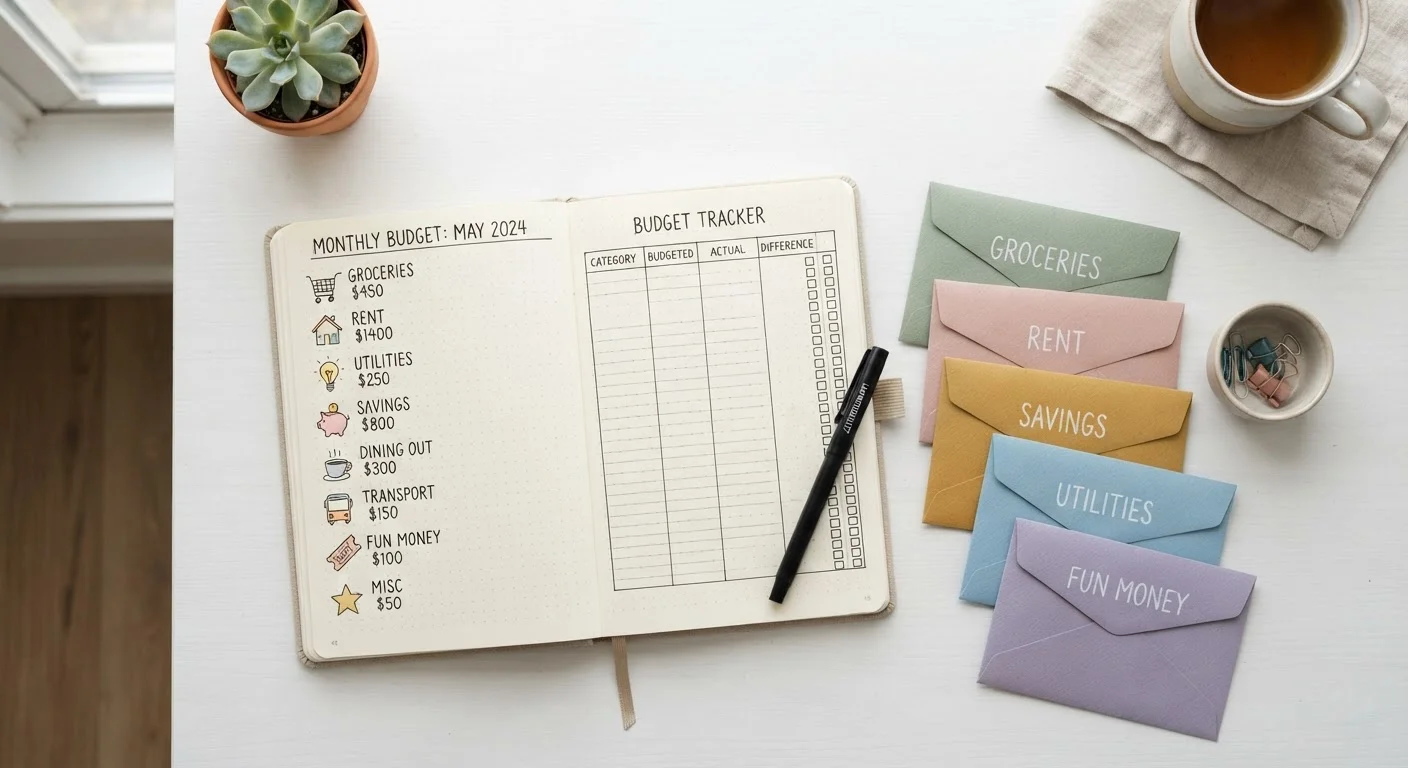

What a Personal Budget Actually Does
A personal budget is simply a written plan for how your money will be spent over a given period - typically a month. It tells your dollars where to go before they arrive, rather than leaving you to wonder where they went after the fact.
That distinction matters more than it sounds. Without a plan, spending tends to fill available income - a pattern behavioral economists call lifestyle inflation. With a plan, you're making deliberate trade-offs: choosing rent, groceries, and savings contributions over less intentional purchases.
Budgeting is often framed as deprivation, but its primary function is clarity. Knowing what you have and where it's going removes financial anxiety because uncertainty - not spending itself - is what erodes confidence. A budget also creates a feedback loop: you can see, month after month, whether your actual behavior matches your stated priorities.
When you're building your first budget, track your actual spending for 30 days before assigning any targets. Real data almost always reveals categories - like subscriptions or convenience food - that feel minor but quietly consume significant income.
Estimates of past spending are notoriously inaccurate; research consistently shows people underestimate discretionary spending by 20-40%. A month of real data eliminates guesswork and makes your initial allocations far more achievable.
Build a 'budget buffer' line - typically 3-5% of your monthly income - to absorb small unexpected expenses without blowing the whole plan. Label it honestly rather than hiding it inside another category.
Budgets that have no margin for error are fragile. A dedicated buffer prevents minor surprises from triggering a full abandonment of the month's plan, which is the leading cause of people giving up on budgets entirely.
This is general financial education. For guidance tailored to your specific situation, consider speaking with a qualified financial professional.
Getting Your Numbers Together
Before you assign a single dollar, you need an honest picture of what's coming in and what's going out. Start with net income - the amount deposited into your account after taxes and deductions, not your gross salary. For variable-income earners (freelancers, hourly workers with shifting hours), use a conservative average based on your three lowest-earning months.
Next, list every expense. Group them into three buckets:
- Fixed essentials: Rent or mortgage, insurance premiums, loan minimums, subscriptions with set amounts.
- Variable essentials: Groceries, utilities, gas, and other necessities whose amounts fluctuate.
- Discretionary spending: Dining out, entertainment, clothing, and other non-essential spending.
The category most people forget: irregular expenses. Annual car registration, holiday gifts, medical co-pays, and home maintenance don't show up every month - but they're predictable if you plan ahead. Divide annual costs by 12 and treat that monthly fraction as a real expense.
A structured financial audit can walk you through pulling together all income sources, bills, and irregular costs before you write your first budget number.
~33%
US adults with a detailed written budget
Gallup polling has consistently found that fewer than one in three American adults maintains a detailed household budget, despite widespread awareness of its benefits.
3-6 months
Recommended emergency fund coverage
Most mainstream financial guidance, including from consumer finance organizations, recommends an emergency fund covering three to six months of essential living expenses.
$1,400+
Average monthly discretionary spending per US consumer unit
According to the U.S. Bureau of Labor Statistics Consumer Expenditure Survey, discretionary categories represent a substantial share of average household outflows each month.
Choosing a Budgeting Method
Once your numbers are on the table, you need a framework for allocating them. Several well-established methods exist, each with different assumptions about how people spend and save:
- 50/30/20
- Allocates 50% of net income to needs, 30% to wants, and 20% to savings and debt repayment. Simple and flexible, but may not fit high cost-of-living areas where housing alone exceeds 50%.
- Zero-based budgeting
- Every dollar is assigned a job until income minus allocations equals zero. Requires more maintenance but gives maximum visibility into spending categories.
- Pay-yourself-first
- Savings contributions come out automatically before you budget anything else. The remainder covers living expenses. Works well for people who struggle to save consistently.
- Envelope method
- Cash (physical or digital) is divided into labeled categories. When an envelope is empty, spending in that category stops. Effective for discretionary overspending.
For a deeper comparison of these frameworks - including which assumptions each one makes and who tends to find them useful - see budgeting approaches worth knowing before you pick one.
Common Pitfalls and How to Avoid Them
Even well-intentioned budgets stall out. These are the patterns that derail most first-time budgeters:
- Setting unrealistic targets. Cutting spending by 40% overnight almost never sticks. Start with a 5-10% reduction and build from there.
- Ignoring irregular expenses. A $600 car repair feels like a budget failure - but it's just an expense you didn't plan for. Pre-fund a "sinking fund" for known irregular costs.
- Treating savings as optional. If savings aren't in the budget as a fixed line item, they rarely happen. Automate transfers on payday so savings aren't competing with discretionary spending.
- Not reviewing monthly. A budget written once and never revisited becomes irrelevant within two or three months as bills change and habits shift.
- Conflating net worth with cash flow. Having assets doesn't mean you have healthy monthly cash flow. A budget tracks income and spending, not balance sheet items.
Avoid Building a Budget Around Best-Case Income
Using your highest possible paycheck - including bonuses, overtime, or irregular freelance income - as your baseline is one of the most common early budgeting mistakes. If that income doesn't materialize, every category is suddenly underfunded. Always budget from your reliable, recurring net income, and treat variable windfalls as a separate decision about allocation.
Adapting Your Budget as Life Changes
A budget built for your life at 24 won't fit your life at 34 - and it shouldn't. Major life events that typically require a budget revision include: a new job or income change, a move, marriage or divorce, a child, a significant debt payoff, or a shift in health status or insurance coverage.
The rule of thumb: revisit your budget whenever your income, fixed expenses, or financial goals change by more than 10%. For everyone else, a monthly check-in and a more thorough quarterly review are sufficient.
Think of your budget as a living document. The categories and allocations that work during a year of aggressive debt payoff will look different once that debt is gone. Redirect freed-up payments toward the next priority - whether that's an emergency fund, retirement contributions, or a specific savings goal.
For practical habits that help you stay consistent through these transitions, making a budget stick outlines evidence-backed routines that support long-term follow-through.
Connecting Your Budget to Long-Term Goals
A monthly budget and long-term financial goals aren't separate systems - one funds the other. The clearest way to see this connection is to work backward: if you want to have $10,000 in an emergency fund within two years, that's roughly $417 per month. Your budget needs to accommodate that line item explicitly, or the goal will stay abstract.
Common long-term goals that belong in a budget:
- Emergency fund (typically 3-6 months of essential expenses)
- Retirement contributions (even small, early amounts benefit from compounding over time)
- Debt payoff acceleration beyond minimum payments
- Down payment savings for a home or vehicle
- Education or career development expenses
Saving and credit behavior are deeply linked to budgeting outcomes. Understanding how credit utilization, payment history, and savings habits interact can sharpen your financial decisions - the Saving & Credit hub covers those foundational concepts.
The goal isn't a perfect budget. It's a budget that's honest, reviewed regularly, and aligned with what you're actually working toward. That combination - realistic numbers, consistent habits, and clear priorities - is what turns a spreadsheet into a financial plan.
This article is for general informational and educational purposes only and does not constitute personalized financial, tax, or investment advice. Consult a qualified financial professional for guidance specific to your situation.