
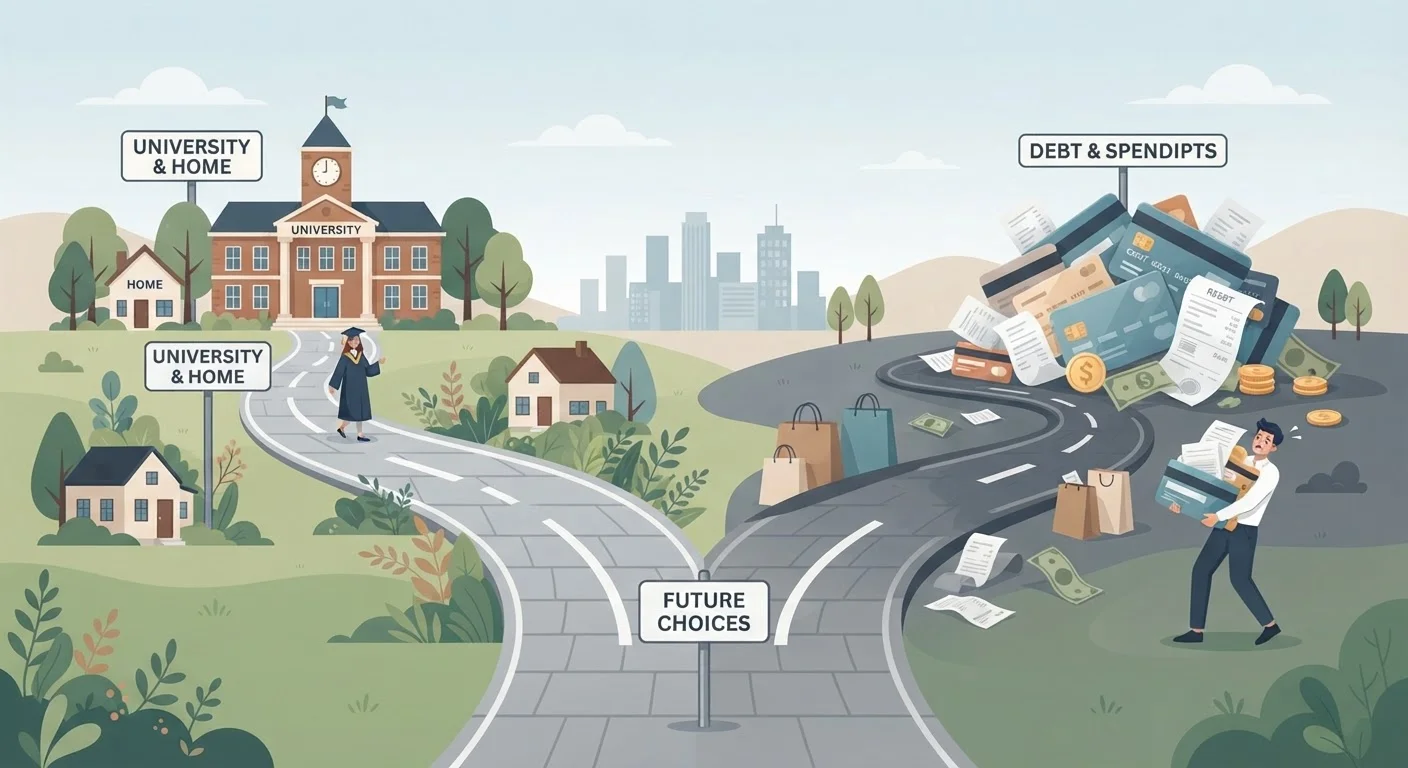
Where the "Good Debt, Bad Debt" Framework Comes From
The distinction between good and bad debt is a concept rooted in personal finance education, not a formal economic classification. It emerged as a teaching tool to help people think more critically about why they're borrowing and what that borrowing actually costs them over time.
At its core, the framework asks two questions: What is the debt financing? And what is the cost relative to the likely return? Borrowing that funds something expected to increase in value or earning power - and that carries a manageable interest rate - is generally considered productive. Borrowing that funds consumption with high interest charges attached is generally considered costly and unproductive.
Before exploring examples, it helps to understand key terms like APR and principal. See our plain-language guide to common debt terms if any of the borrowing terminology in this article is unfamiliar.
What Typically Gets Called Good Debt
Two types of borrowing are most commonly placed in the "good debt" category: mortgages and student loans.
A mortgage funds the purchase of real property, which historically has tended to appreciate over long time horizons, though this is not guaranteed. Mortgage interest rates are typically lower than most other consumer borrowing, and the loan is secured by the asset itself. For more on how secured debt differs structurally from unsecured debt, see our article on secured vs. unsecured debt.
Student loans are commonly described as an investment in human capital - the idea being that a degree can increase lifetime earning potential enough to justify the cost of borrowing. This logic holds more clearly in some fields than others, and the calculus changes significantly depending on total debt load, interest rate, and post-graduation income.
Both types carry real risk. Property markets decline. Not all degrees translate to higher income. Calling these debts "good" is a general tendency, not a guarantee.
~$1.13T
Total US credit card debt outstanding
According to the Federal Reserve Bank of New York's Q4 2023 Household Debt and Credit Report, Americans collectively held over $1.1 trillion in credit card balances.
20%+
Average credit card interest rate
The Federal Reserve reported that average credit card interest rates rose above 20% APR in 2023, a multi-decade high, amplifying the cost of carrying balances.
$1.77T
Total US student loan debt
The Federal Reserve estimated total outstanding student loan debt in the United States at approximately $1.77 trillion as of 2023, underscoring the scale of this borrowing category.
What Typically Gets Called Bad Debt
High-interest consumer debt is the clearest example of what financial educators call bad debt - most commonly, credit card balances carried month to month. When a card's APR runs into the double digits and only minimum payments are made, interest compounds rapidly. The consumer often ends up paying far more than the original purchase price, for items that have already been used up or depreciated in value.
Payday loans and certain personal loans with steep origination fees or high rates can fall into the same category. The borrowed amount may be small, but the effective cost of credit is disproportionately high.
Auto loans occupy a middle ground. A vehicle is often a practical necessity, but it depreciates quickly. A manageable rate on a reliable vehicle can be reasonable; financing a vehicle at a high rate with a long repayment term often results in paying significantly more than the car is ultimately worth.
How to Evaluate Debt Beyond the Labels
The good/bad framework is useful as a starting point, but it oversimplifies. A more practical approach is to evaluate any borrowing decision along a few specific dimensions:
- Interest rate: What is the actual APR, and how does it compare to the expected benefit of what you're financing?
- Loan term: Longer repayment periods reduce monthly payments but often mean significantly more paid in interest overall.
- Purpose: Is the debt funding something that holds or grows in value, or is it financing current consumption?
- Cash flow impact: Can the monthly obligation be absorbed without straining your budget or eliminating your emergency cushion?
If you already carry debt across multiple accounts, understanding how to approach repayment is the logical next step. Our article on the debt snowball and debt avalanche methods explains how each strategy works so you can evaluate which approach might fit your situation.
This article is for general informational purposes only and does not constitute financial, investment, tax, or legal advice. Consult a qualified, licensed financial professional for guidance specific to your circumstances.