
The Core Mechanic Behind Both Methods
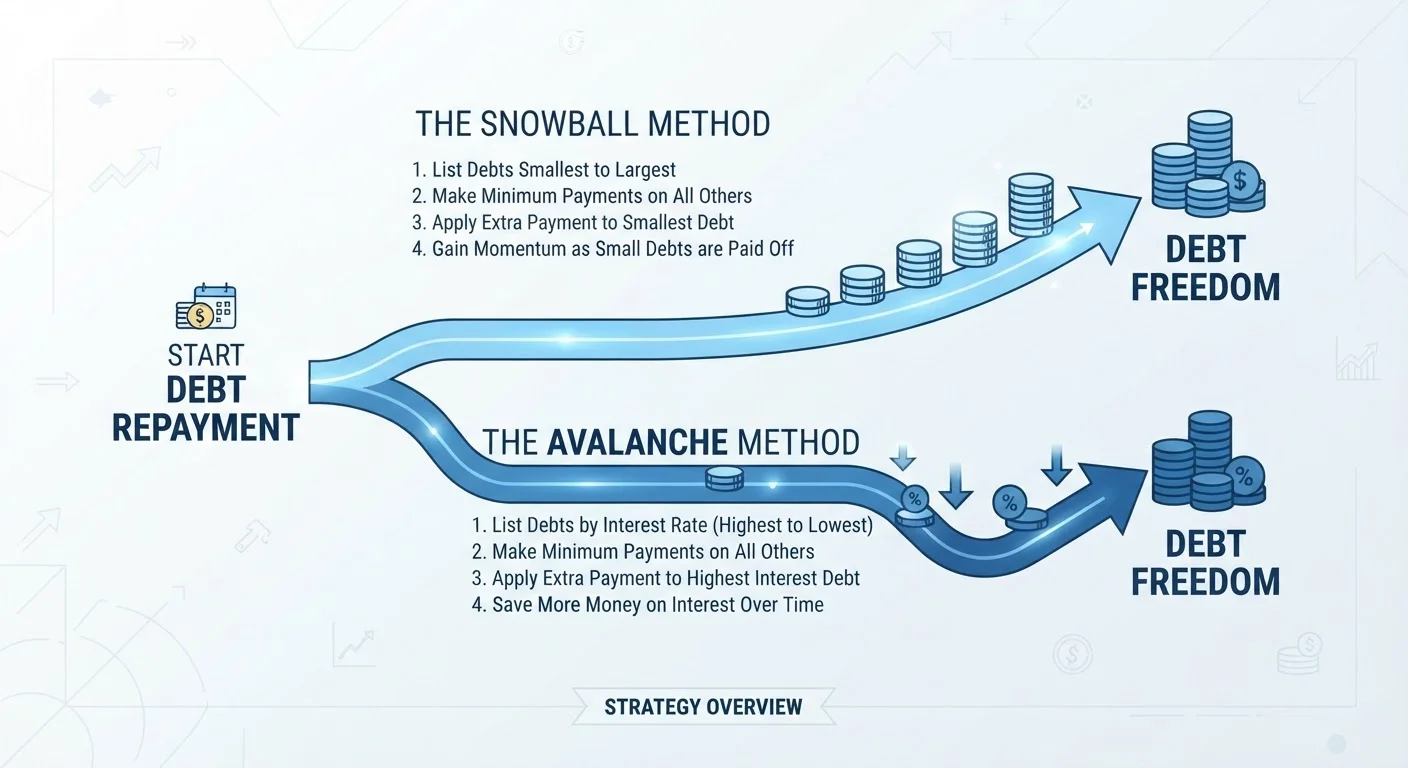
Both strategies share the same foundational structure: you continue making minimum payments on every debt you carry, then direct any additional funds toward one specific target account. What separates them is which debt gets that extra attention.
This targeting approach prevents scattered payments that extend the life of every balance simultaneously without making meaningful progress on any of them. By concentrating extra dollars, you eliminate accounts one at a time - and when one account is paid off, its minimum payment gets rolled into the next target. That compounding momentum is sometimes called a "debt roll-up."
For anyone weighing whether to consolidate first, see our overview of how debt consolidation works - it's a different mechanism worth understanding separately.
How the Debt Snowball Works
The snowball method, popularized by personal finance educators, orders your debts from smallest balance to largest, ignoring interest rates entirely. You attack the smallest balance first with every extra dollar available. Once that account is cleared, you take its freed-up payment and add it to what you're paying on the next-smallest balance - and so on down the list.
The psychological appeal is straightforward: you reach your first payoff milestone relatively quickly. Research in behavioral economics suggests that these early wins can reinforce the habit of continued repayment, which matters because staying motivated through a multi-year payoff plan is genuinely difficult for many people.
The trade-off is mathematical. If your smallest balance also carries a low interest rate, you may be leaving a high-rate debt sitting longer - accumulating more interest in the background - than strictly necessary.
Track Your Balances and Rates Before Choosing
Before committing to either strategy, list every debt you carry along with its current balance, minimum payment, and interest rate. This inventory makes the ordering decision concrete rather than abstract. It also helps you calculate roughly how long each approach might take, which can inform which method feels realistic for your situation.
How the Debt Avalanche Works
The avalanche method orders debts by interest rate, from highest to lowest. You direct extra payments toward the account charging you the most - typically a high-APR credit card - while maintaining minimums elsewhere. Once that highest-rate debt is eliminated, you move to the next highest, and so forth.
Mathematically, this is the more efficient path. You're reducing the balance that compounds the fastest, which means less total interest accrues across the life of your debt. Depending on balances and rates involved, the savings can be meaningful - though results vary widely based on individual circumstances.
The potential downside is patience. If your highest-rate debt also carries a large balance, it may take a long time before you see a single account reach zero. Some people find that discouraging, and a plan abandoned early produces worse outcomes than a less efficient plan followed consistently.
| Debt Snowball | Debt Avalanche | |
|---|---|---|
| Primary ordering logic | Smallest balance first | Highest interest rate first |
| Total interest paid | Typically higher over time | Typically lower over time |
| Speed to first payoff | Faster (targets small balances) | Slower if high-rate debt is large |
| Psychological motivation | High - early wins are frequent | Moderate - progress may feel slower |
| Mathematical efficiency | Lower | Higher |
| Best suited for | Motivation-driven payoff plans | Cost-minimization focus |
Choosing the Approach That Works for You
There is no universally correct answer here - both strategies have genuine merit. A few practical considerations can help clarify which fits a given situation:
- If your highest-rate debt is also your smallest balance, both methods point to the same account. Start there - no trade-off exists.
- If you've struggled to stick with payoff plans before, the snowball's early wins may offer the reinforcement needed to stay on track.
- If the interest rate gap between debts is large, the avalanche's cost savings become more significant and harder to ignore.
- If your debts are similar in size and rate, the difference between strategies shrinks considerably.
Some people also use a hybrid: pay off one or two small balances first for the psychological boost, then switch to avalanche ordering. This isn't a formal method, but it reflects the reality that financial behavior is part math and part psychology.
It's also worth knowing what happens if debts go unmanaged - our explainer on what happens when debt goes to collections walks through those consequences clearly.
This article is for general informational purposes only and does not constitute personalized financial advice. Consult a qualified financial professional for guidance specific to your situation.