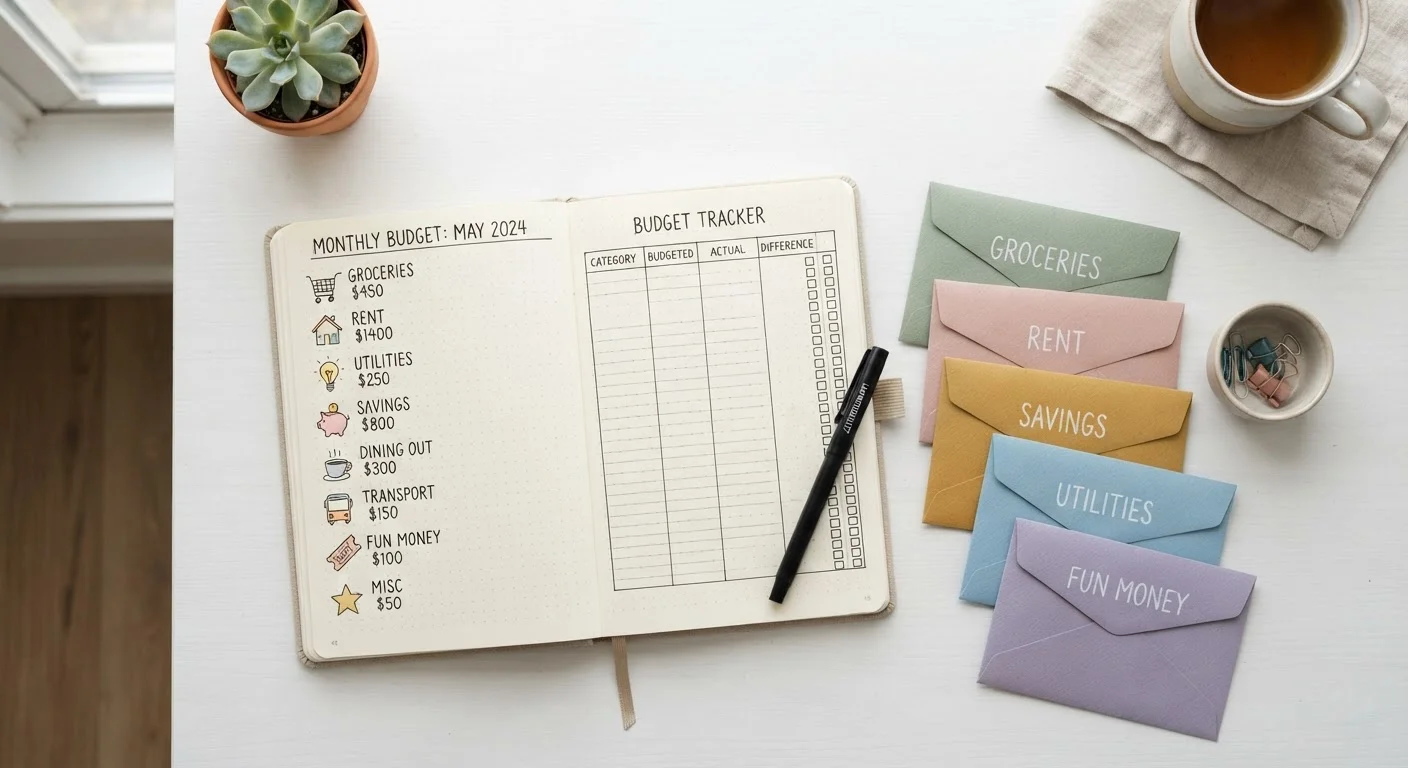

Why Budgets Fail Before They Start
Most people who abandon a budget don't fail because of math - they fail because of habits. A budget is a plan on paper; habits are what make it real. If you've built a budget before and watched it collapse by week three, you're in good company. The problem is rarely the numbers.
Research in behavioral economics consistently shows that financial follow-through depends more on environment design and routine than on motivation or discipline. Motivation fades. Routines don't require it. That's the core insight behind every habit listed here.
If you're still building your first budget, see our step-by-step first budget guide before diving into these practices. And if you've talked yourself out of budgeting before, it's worth reading about common budgeting myths that may be holding you back.
The Practices That Actually Stick
These aren't abstract principles - each one is something you can put in place this week. Taken together, they form the behavioral scaffolding that turns a written budget into a working financial system.
Schedule a fixed weekly money check-in - even just 10 minutes.
Regular review keeps small problems from becoming big ones and reinforces the habit of awareness. Without a scheduled touchpoint, it's easy to drift for weeks without realizing you've blown past a category limit.
Automate savings and fixed transfers on payday.
When money moves automatically before you see it in your checking account, you're not relying on willpower to save - the system does it for you. This is one of the most well-supported strategies in personal finance research.
Tie each budget category to a specific, named goal.
Abstract categories like 'savings' are easy to raid or ignore. Goals with names and amounts - 'emergency fund: $1,500' or 'vacation fund: $600' - create a concrete reason to protect that money.
Review and reset your budget every month, not just once.
A budget written once and never updated quickly becomes irrelevant. Expenses change, income shifts, and priorities evolve. A monthly reset keeps your plan aligned with your actual life.
Use friction to slow discretionary spending.
Adding small obstacles to spending decisions - removing saved card details, using a 24-hour waiting rule on non-essential purchases - reduces impulse decisions without requiring you to never spend.
Track spending in real time, not at the end of the month.
End-of-month tracking is a post-mortem - it tells you what went wrong after the damage is done. Real-time tracking lets you course-correct while you still have options.
Quick Actions You Can Take Today
Some of the most effective changes to your budget routine take less than 20 minutes to set up. Here are the highest-impact moves you can make immediately.
For a broader look at where your finances stand, the self-audit checklist for savings and credit is a useful companion tool.
Building Flexibility Into the System
One of the fastest ways to derail a budget is to build it with no room for error. Life doesn't follow a spreadsheet. Car repairs, medical co-pays, and irregular expenses will happen - the question is whether your budget can absorb them or whether they blow it up entirely.
Sinking funds are one of the most practical tools for handling this: you set aside small amounts each month for anticipated irregular costs, so the expense doesn't feel like a crisis when it arrives. A planned buffer isn't giving up on your budget - it's what makes the budget survivable.
No Budget Survives Contact With Real Life Perfectly
Even well-designed budgets need adjustment. Financial educators broadly agree that a flexible budget - one built to bend rather than break - is more durable than a rigid one. If you find yourself consistently overspending in one category, that may be a signal that your allocation was unrealistic to begin with, not that you lack discipline. Adjust the numbers to reflect your actual spending patterns, then hold the new line.
The same logic applies to how you respond when you overspend in a category. A rigid system treats any deviation as failure. A durable system treats it as data. When you go over budget in one area, note why, adjust the next period if needed, and keep going. Consistency over perfection is the actual goal.
This article provides general financial information for educational purposes only and is not personalized financial advice. Consult a qualified financial professional for guidance specific to your situation.