The Physics Behind the Pain
Every time you drive, you and your vehicle are sharing the same kinetic energy - the energy of motion. When the car stops suddenly, that energy doesn't vanish. It transfers. Your body, following Newton's First Law, wants to keep moving at whatever speed you were travelling before the brakes hit or the impact occurred.
Think of it this way: at 30 mph, you're moving at roughly 44 feet per second. Bring the car to a halt in a fraction of a second, and your body still has that momentum. Something has to absorb or redirect it - and in a well-designed modern vehicle, that something is a carefully engineered system of seatbelts, crumple zones, and airbags.
Kinetic energy also scales dramatically with speed. Because the formula involves velocity squared, a vehicle travelling at 60 mph carries four times the kinetic energy of the same vehicle at 30 mph. That difference matters enormously when your body has to absorb the deceleration.
30 ms
Time for an airbag to fully deploy
Automotive safety engineers design airbag systems to deploy in approximately 30 milliseconds - faster than the blink of an eye.
4×
Energy increase when speed doubles
Because kinetic energy scales with velocity squared, doubling your speed quadruples the energy involved in any collision or sudden stop.
~45%
Reduction in crash fatality risk with seatbelts
According to the National Highway Traffic Safety Administration (NHTSA), seatbelts reduce the risk of death in passenger car crashes by approximately 45%.
What Your Body Actually Goes Through
During a sudden stop, your body experiences a rapid sequence of events. The seatbelt engages and applies force across your chest, shoulder, and pelvis - the body's strongest structures. Modern pretensioner belts remove slack within milliseconds, keeping you firmly in place. Your torso decelerates with the vehicle. Your head and neck, however, have more freedom of movement.
That lag is where whiplash originates. The head, unsupported, continues forward as the torso is restrained. In a rear-end collision the sequence reverses - the torso is pushed forward first, and the head snaps backward, then forward. Even at speeds under 10 mph, the soft tissues of the neck can be strained.
Internally, organs don't slow down immediately either. The heart, lungs, and abdominal organs can shift within the body cavity, pressing against ribs, the sternum, or the spine. High-speed crashes can cause internal bleeding even when no external injuries are visible, which is why medical evaluation after any significant collision matters regardless of how you feel.
“The human body is not designed to withstand the forces of a high-speed collision, but restraint systems are specifically engineered to spread and reduce those forces so the body has a fighting chance.”
— NHTSA Vehicle Safety Research Division, U.S. National Highway Traffic Safety Administration
Why Restraint Systems Are Non-Negotiable
An unbelted occupant in a sudden stop becomes a projectile moving at the vehicle's pre-impact speed. In a 35 mph crash, that means your body hits the steering wheel, windshield, or dashboard with roughly the same force as falling from a three-story building. Unrestrained rear-seat passengers also become a hazard to front-seat occupants - an unbelted adult in the back seat can exert hundreds of pounds of force on the driver's seat during a frontal crash.
Seatbelts work by extending the time over which deceleration occurs across a wider, sturdier area of your body. Airbags complement this by cushioning the head and face from the rigid surfaces directly in front of you. Neither system is effective without the other - sitting too close to the steering wheel, for example, can make airbag deployment itself injurious.
Headrests - properly positioned at ear level - reduce the whiplash arc during rear impacts. They aren't head rests in the lounging sense; they're head restraints in the safety engineering sense.
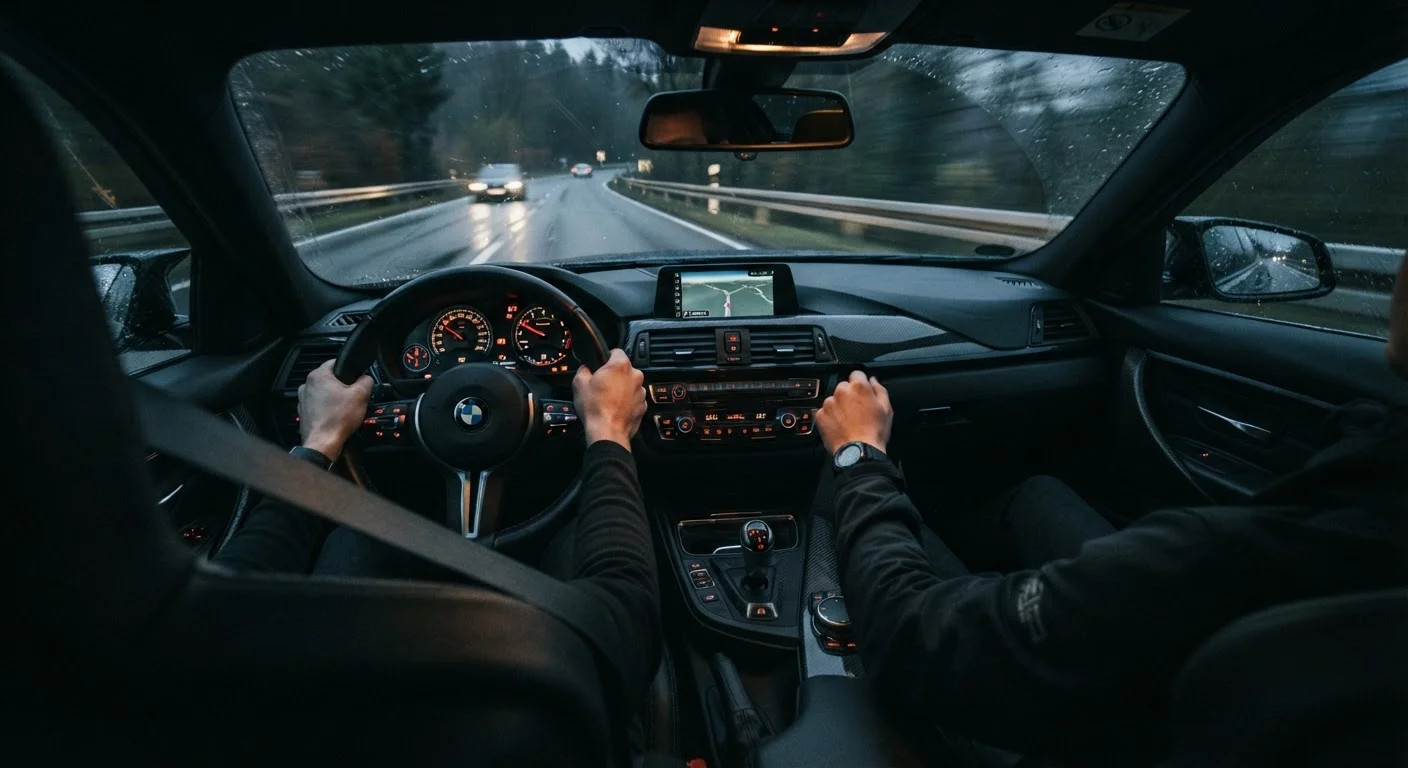
Road conditions magnify all of these effects. On wet or icy pavement, stopping distances increase significantly, which means more time in deceleration - but also more potential for losing control entirely. See how surface conditions affect vehicle handling in our guide to driving on wet and winter roads.
What You Can Control Before the Stop Happens
Defensive driving isn't about assuming the worst - it's about giving physics more room to work in your favor. Maintaining adequate following distance at highway speed gives you the time and space to decelerate gradually rather than slamming brakes. Even an extra second of reaction time can reduce stopping speed significantly before the vehicle even begins to slow.
Proper seating position matters too. Sit at a distance from the steering wheel that allows your arms to rest naturally on it - roughly 10-12 inches from the wheel to your chest - so the airbag has room to fully deploy before it reaches you. Keep the seatbelt snug and positioned across the collarbone, not the neck.
Speed management is the single biggest variable you control. Because kinetic energy rises with the square of speed, reducing your speed by even 10 mph in a crash-prone situation dramatically reduces the forces your body will face. Physics doesn't negotiate - but you can stack the odds in your favor before a sudden stop ever happens.