What You're Actually Comparing
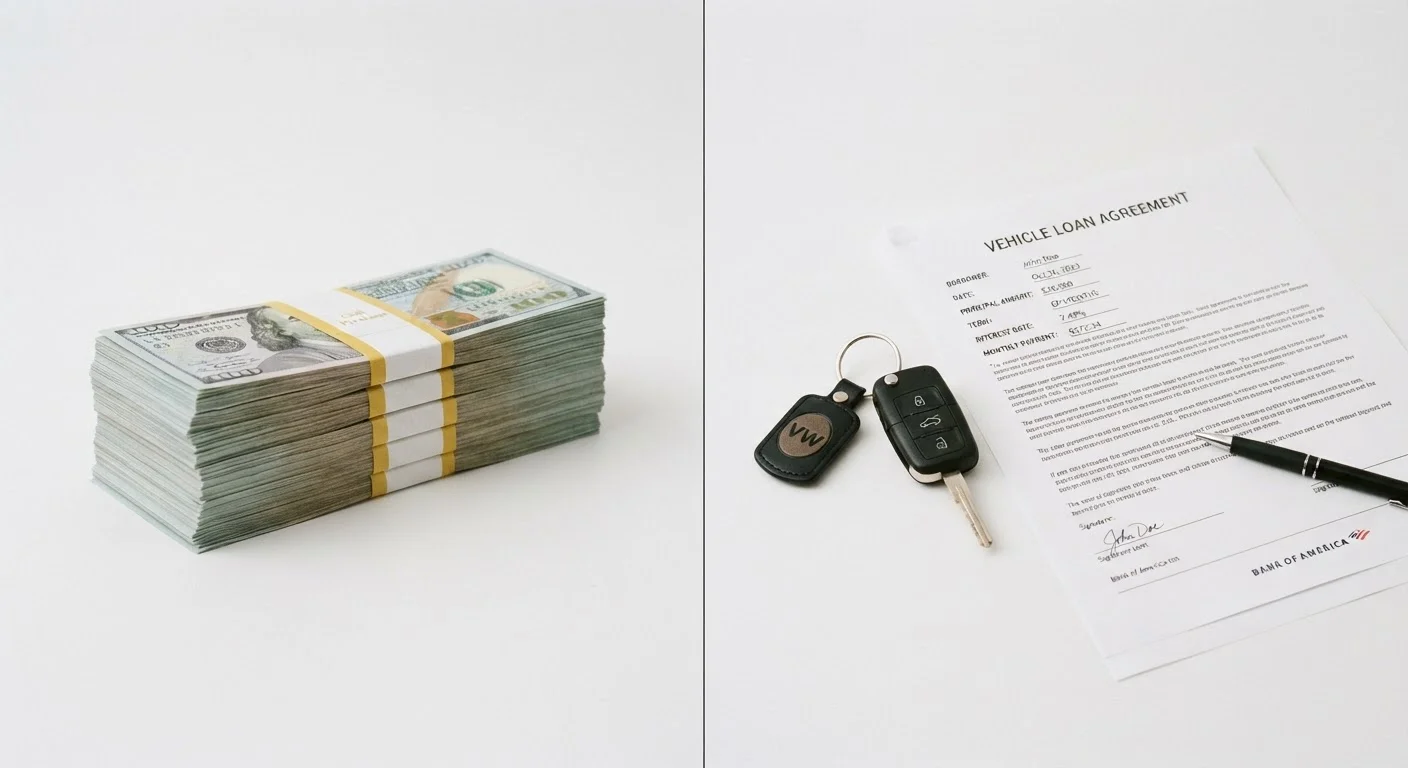
When you finance a car, a lender - typically a bank, credit union, or the dealership's financing arm - pays the seller on your behalf. You then repay the lender in monthly installments, plus interest, over an agreed term, usually anywhere from 24 to 84 months. The interest rate you qualify for depends largely on your credit score and the lender's terms.
A cash purchase is straightforward: you pay the full vehicle price upfront from your own funds and own the car outright from day one. There's no loan, no monthly payment, and no interest charges.
The core trade-off is simple: financing costs more in total due to interest, but it lets you keep your savings intact. Cash costs less overall, but it requires a large sum available at once. Everything else - your credit goals, your emergency fund, your income stability - shapes which trade-off makes sense for your situation. For a broader look at what vehicle ownership actually costs beyond the purchase price, see the true annual cost of owning a car.
How the Numbers Compare
Interest is the defining financial difference. On a $30,000 vehicle financed over 60 months at a 7% annual percentage rate (APR), you'd pay roughly $5,500 in interest over the life of the loan - meaning the car effectively costs closer to $35,500. The longer the term, the more total interest you pay, even if the monthly payment feels more manageable.
Cash buyers pay exactly what the vehicle is priced at - no more. That's a meaningful difference, particularly on higher-priced vehicles or longer loan terms.
| Criterion | Auto Loan (Financing) | Cash Purchase |
|---|---|---|
| Total cost | Vehicle price plus interest | Vehicle price only |
| Monthly payment | Required for loan term | None |
| Upfront cash needed | Down payment only | Full vehicle price |
| Effect on credit | Builds credit history if paid on time | No impact on credit |
| Savings preserved | Yes - most cash stays on hand | No - large sum paid out |
| Ownership status | Lender holds title until paid off | Full ownership from day one |
| Negotiating position | May involve financing contingency | Often simpler for seller |
There's another financial angle worth considering: opportunity cost. If you pay cash, that money is no longer available for other uses - an emergency, an investment, or simply a buffer against an unexpected expense. Whether holding cash offers better "value" than avoiding loan interest depends on your personal financial picture and priorities. That's a question best explored with a qualified financial adviser rather than treated as a universal rule.
~85%
New car buyers who finance
According to Experian's State of the Automotive Finance Market report, the majority of new vehicle purchases in the US involve some form of financing.
60-84 mo.
Common auto loan terms today
Longer loan terms have become increasingly common, which lowers monthly payments but increases total interest paid over the life of the loan.
~$7,000+
Average interest paid on 72-month loan
On a $35,000 vehicle financed at around 7% APR over 72 months, total interest charges can exceed $7,000 - a significant addition to the vehicle's base price.
Credit, Flexibility, and Practical Trade-Offs
One practical benefit of financing is its effect on credit. An auto loan, when repaid consistently and on time, adds a positive installment account to your credit history. For someone with a thin or recovering credit profile, this can be a meaningful side benefit. Cash purchases, by contrast, don't appear on your credit report at all - you own the car outright, but the transaction does nothing for your credit standing.
Cash buyers often have a cleaner negotiating position, since there's no financing contingency and the transaction is simpler for the seller. That said, dealers sometimes offer manufacturer-backed financing incentives - such as low promotional APR rates - that can narrow the cost gap. Always weigh any promotional offer against the actual terms before deciding.
If you're considering a first-time auto loan, understanding how auto loans work before you sit down with a lender is time well spent. And if you carry other debt alongside a potential car loan, it's worth thinking about how you'd manage repayment - approaches like those covered in debt repayment strategies can help you think through prioritization.
This article is for general informational purposes only and does not constitute financial or investment advice. Consult a qualified financial professional before making decisions about large purchases or debt obligations.