Why TV Specs Can Be Confusing
Walk into any electronics department or browse an online listing, and you'll encounter a wall of abbreviations: 4K, OLED, HDR10+, 120Hz, 1000 nits. Manufacturers use these terms as shorthand for real engineering distinctions - but without context, they read more like marketing noise than useful information.
This glossary translates the most common TV display specifications into plain English. Each definition explains what the spec measures, why it matters to everyday viewing, and what level of performance is generally considered adequate versus strong. Think of it as a reference card you can return to whenever you're evaluating a display.
If you find yourself in need of a similar decoder ring for your home network, the Language of Home Networking glossary applies the same approach to router and Wi-Fi terminology.
| Standard HD Resolution | 1,920 × 1,080 pixels (approx. 2 million total) (ITU-R BT.709 broadcast standard) |
| 4K UHD Resolution | 3,840 × 2,160 pixels (approx. 8.3 million total) (CEA / Consumer Technology Association definition) |
| Typical SDR Brightness Target | 100 nits (ITU-R BT.709 mastering standard) |
| HDR Peak Brightness (entry-level) | 400-600 nits (DisplayHDR 400/600 tier specifications) |
| Common native refresh rates | 60Hz and 120Hz (Industry standard consumer TV specifications) |
| Low input lag threshold (gaming) | Under 20 milliseconds (Widely cited by display testing publications) |
Resolution, Refresh Rate, and Brightness Explained
The three specs that most directly affect what you see on screen are resolution, refresh rate, and brightness. Understanding each one individually makes the rest of the spec sheet much easier to interpret.
Resolution
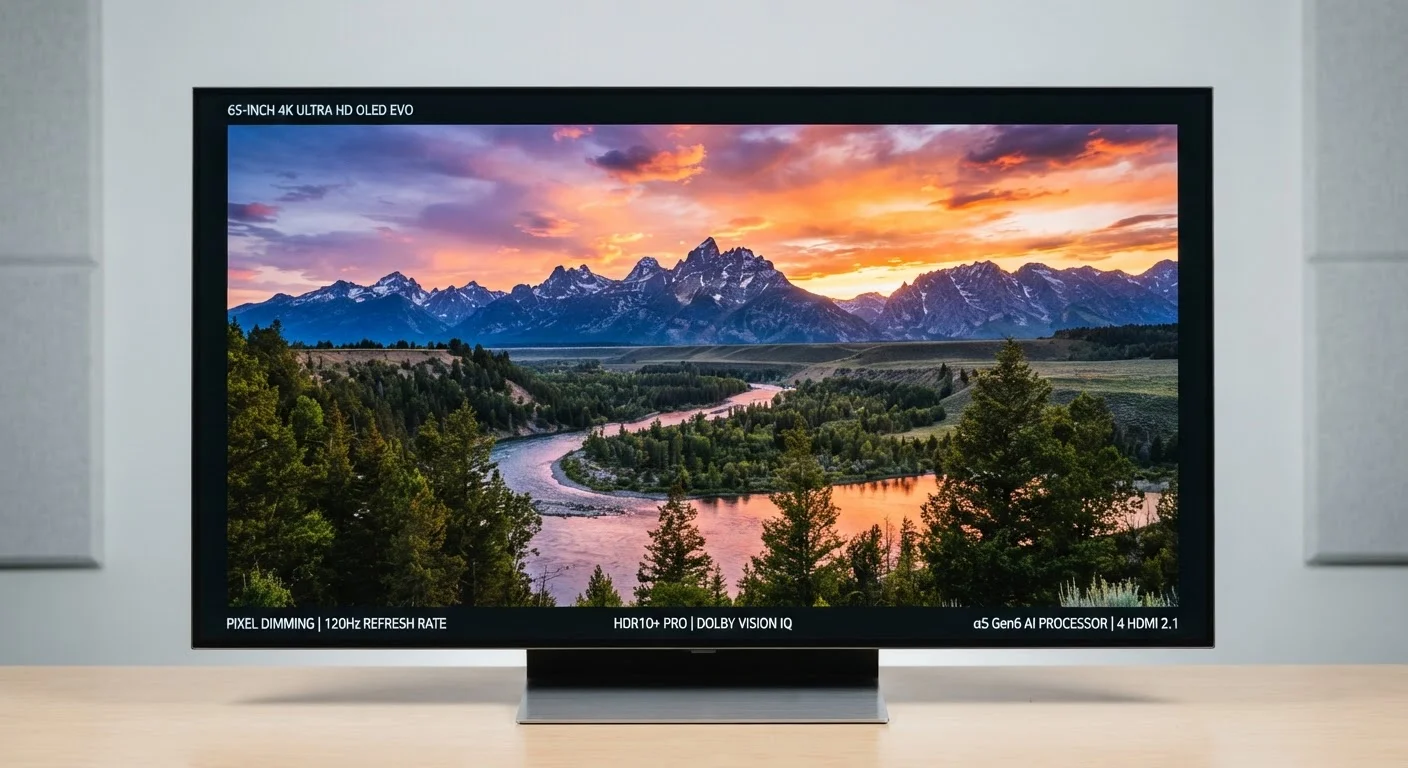
Resolution describes how many individual pixels make up the picture, expressed as a width-by-height count. A 1080p (Full HD) set has roughly 2 million pixels arranged in 1,920 columns and 1,080 rows. A 4K (Ultra HD) set quadruples that to about 8.3 million pixels at 3,840 × 2,160. More pixels means finer detail - but the benefit is most noticeable on larger screens (55 inches and up) viewed at typical living-room distances.
Refresh Rate
Measured in hertz (Hz), refresh rate is how many times per second the screen redraws the image. A 60Hz panel updates 60 times a second; a 120Hz panel updates 120 times. Higher rates reduce motion blur during fast-moving content like sports or action films. Be aware that some manufacturers advertise "effective" or "motion-enhanced" rates that are processed rather than native - checking the native refresh rate specification gives a more accurate picture.
Brightness and HDR
Brightness is measured in nits (candelas per square meter). It determines how vivid highlights appear and how well the picture holds up in a bright room. Standard dynamic range (SDR) content was mastered for displays around 100 nits. High Dynamic Range (HDR) content is mastered for much higher peaks - typically 1,000 nits or more - and requires a capable display to render those highlights correctly. HDR formats include HDR10, Dolby Vision, and HLG; each uses a slightly different method for encoding brightness and color data.
Resolution
The total number of pixels on a screen, expressed as width × height (e.g., 3,840 × 2,160 for 4K). Higher resolution means finer detail, especially on large screens.
4K / Ultra HD
A resolution standard of approximately 8.3 million pixels (3,840 × 2,160). It offers four times the pixel count of 1080p Full HD, delivering sharper images on large displays.
Refresh Rate (Hz)
The number of times per second a screen redraws its image. A 120Hz panel refreshes twice as often as a 60Hz panel, reducing motion blur in fast-moving content.
Nits
The unit used to measure a display's peak brightness (technically candelas per square meter). Higher nit counts allow brighter highlights and better performance in lit rooms.
HDR (High Dynamic Range)
A display and content standard that expands the range between the darkest blacks and the brightest highlights. HDR content requires both a compatible source and a capable display to render correctly.
HDR10 / Dolby Vision / HLG
Three common HDR formats. HDR10 is an open standard; Dolby Vision uses scene-by-scene dynamic metadata for more precise tone mapping; HLG is used in broadcast television.
OLED
Organic Light-Emitting Diode - a panel technology where each pixel produces its own light and can switch off completely, enabling perfect blacks and exceptional contrast ratios.
Local Dimming
A backlight feature on LCD TVs that dims specific zones independently to improve contrast. More dimming zones generally means more precise control over bright and dark areas of the image.
Color Gamut
The range of colors a display can reproduce, often expressed as a percentage of a reference standard such as DCI-P3. A wider gamut produces more vivid, lifelike colors.
Input Lag
The delay in milliseconds between a signal being received and displayed on screen. Low input lag (under 20ms) is important for responsive gaming; it is less relevant for passive viewing.
Bit Depth
The number of distinct shades available per color channel. 10-bit panels support over a billion color combinations, reducing visible banding in gradients compared to 8-bit panels.
Quantum Dot (QLED)
A layer of nanocrystal particles added to LCD panels that converts backlight into purer, more saturated colors, improving both color volume and peak brightness.
Panel Technology and Color
Beyond the headline numbers, the underlying display technology and color capabilities shape the overall viewing experience.
Panel Types
LCD/LED panels use a backlight shining through liquid crystals. They are common, affordable, and bright, but struggle with deep blacks because the backlight cannot be fully extinguished. QLED adds a quantum dot layer to an LCD panel to expand color range and brightness. OLED panels produce light at the pixel level - each pixel turns off completely for true black - resulting in exceptional contrast, though peak brightness is generally lower than premium LCD sets. Mini-LED is a newer LCD variant that uses thousands of smaller backlighting zones for more precise local dimming.
Color Gamut and Bit Depth
Color gamut describes the range of colors a display can reproduce, typically expressed as a percentage of a standard color space such as DCI-P3 or Rec. 2020. Bit depth (8-bit, 10-bit, 12-bit) controls how many distinct shades of each color are available; higher bit depth reduces banding - the visible stepping between shades in gradients like sunsets or skies.
Native vs. Advertised Refresh Rate
Some TV manufacturers list an "effective" or "motion rate" figure that is higher than the panel's actual native refresh rate. For example, a set may be marketed at 240Hz motion rate while the native panel runs at 60Hz. When comparing sets, look specifically for the native refresh rate in the technical specifications - it gives the most accurate picture of real-world motion performance.
Input lag - the delay between a signal being sent and appearing on screen - is a separate spec that matters primarily to gamers. It is measured in milliseconds (ms) and is distinct from refresh rate, though the two are often discussed together.