
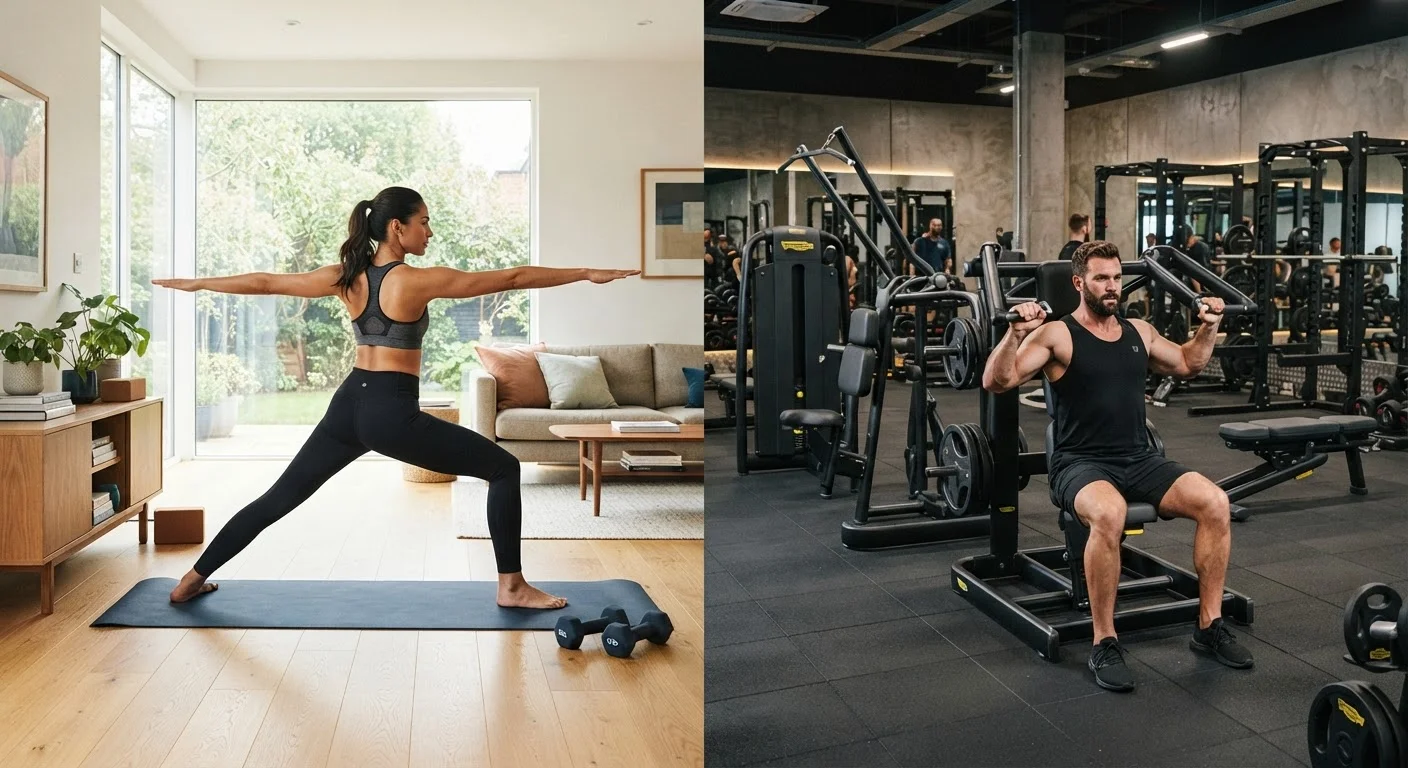
The Core Trade-Off: Access vs. Resources
The debate between home workouts and gym training rarely has a clean winner. Both environments can drive meaningful improvements in strength, cardiovascular health, and body composition. What differs are the conditions under which each works best - and for whom.
Research on exercise adherence consistently points to one overriding variable: whether someone actually shows up. A state-of-the-art gym that requires a 30-minute round trip, a parking fee, and a rigid schedule will lose to a modest home setup used five days a week. That reality should anchor any honest comparison. For a deeper look at how different exercise types affect your body, see how cardio and strength training compare.
| Home Workouts | Gym Training | |
|---|---|---|
| Cost | Low to none after initial setup | Ongoing monthly membership fees |
| Convenience | No commute, flexible hours | Commute required, set operating hours |
| Equipment variety | Limited without investment | Broad range of machines and free weights |
| Social motivation | Minimal unless virtual | High - peers, classes, coaches available |
| Privacy | Full privacy at all times | Shared public environment |
| Long-term strength ceiling | Lower without significant equipment | Higher with access to progressive loads |
| Beginner-friendliness | High - low pressure environment | Moderate - can feel intimidating |
What Home Workouts Do Well
Home training removes friction. There is no commute, no wait for equipment, no membership fee, and no operating hours. For parents, shift workers, or anyone managing an unpredictable schedule, these are genuine advantages - not consolation prizes.
Effective home programs exist across virtually every fitness goal. Bodyweight exercises - push-ups, squats, lunges, planks, and their progressions - can build meaningful muscle and cardiovascular fitness with zero equipment. A small investment in resistance bands or a pair of adjustable dumbbells expands the range considerably. If you are considering setting up a dedicated space, building a home workout space that you will actually use offers practical, low-cost guidance.
The limitation home workouts face is a ceiling on resistance. Progressive overload - the gradual increase in training stress that drives long-term strength gains - becomes harder to achieve once you exhaust the load options available at home. This matters more for advanced lifters than for beginners, who have substantial room to progress on bodyweight alone.
Start With What You Will Actually Do
The most effective workout is the one you repeat consistently over weeks and months. If commuting to a gym feels like a barrier, start with a structured home routine and reassess as the habit solidifies. Habit formation research suggests that reducing friction in the early stages significantly improves follow-through. Once exercise is a stable part of your routine, adding equipment or a gym membership is a much easier upgrade.
What Gym Training Offers
A well-equipped gym provides access to barbells, cable machines, free weights, and cardio equipment that most home setups cannot replicate. For people pursuing strength goals beyond intermediate level, or training for specific sports, that equipment diversity is genuinely important rather than a luxury.
Gyms also provide a social environment that many exercisers find motivating. Exercising around others can increase effort and duration - a documented phenomenon sometimes called social facilitation. Group classes, personal trainers, and coaching staff offer real-time feedback that is difficult to replicate at home, particularly for newer exercisers learning movement patterns. Group fitness classes represent a middle ground worth considering if structured social motivation appeals to you.
The trade-offs are cost and logistical friction. Average US gym memberships range from modest monthly fees at budget chains to considerably more at full-service facilities. Peak-hour crowding, commute time, and scheduling constraints all represent real barriers to consistency.
Making the Choice - or Combining Both
Several practical questions can clarify which environment suits you better. How close is a gym to your home or workplace? Do you respond well to external structure and social energy, or do you prefer privacy and autonomy? What is your current fitness level, and what are your primary goals?
Beginners, in particular, often do well starting at home. The fundamentals of movement - squatting, hinging, pushing, pulling - can be learned and practiced without a gym, and building the habit of regular exercise matters far more at this stage than optimizing equipment. Strength training for people who have never lifted a weight offers a practical starting point for those new to resistance work.
A hybrid approach is increasingly common and practical: bodyweight or dumbbell work at home on busy days, gym sessions when time allows. This model reduces the stakes of any single workout environment and supports the consistency that underlies long-term results. As the evidence shows, frequency of effort tends to matter more than peak intensity over time.
This article is for general informational and educational purposes only and is not a substitute for professional medical advice. Consult a qualified healthcare provider before beginning any new exercise program, particularly if you have an existing health condition or injury.