
Why the Setup Actually Matters
Most people who abandon home workouts don't quit because of motivation - they quit because friction accumulates. Having to move furniture, hunt for equipment, or squeeze between clutter creates enough resistance that skipping becomes the easier choice. A thoughtfully arranged space removes that friction before it becomes an obstacle.
Behavioral research on habit formation consistently points to environment design as a major driver of consistency. The physical setup of your space acts as a cue - when your mat is visible and your equipment is ready, your brain registers "this is where exercise happens." Over time, entering the space itself can become a trigger for beginning. For a deeper look at how environment shapes long-term exercise behavior, see principles that support workout consistency.
Consult a Professional Before Starting
This article provides general fitness information, not personalized medical advice. If you have an existing health condition, injury, or have been inactive for an extended period, speak with a qualified healthcare professional before beginning any new exercise program. They can help you identify any movements or equipment that may not be appropriate for your situation.
What You Need (and What You Don't)
The home fitness industry markets heavily, and it's easy to overestimate what's required. The honest answer for most beginners is: a mat and your own bodyweight. Bodyweight training - push-ups, squats, lunges, planks, hip bridges - covers the major movement patterns and can be progressed significantly before additional equipment becomes meaningful.
If you want to add tools, start with resistance bands. They're compact, affordable, and remarkably versatile across strength, mobility, and rehabilitation-style movements. After bands, a single pair of moderate-weight dumbbells opens up a wide range of exercises. If strength training is a priority and you'd like a clearer foundation first, strength training for complete beginners is a practical starting point.
Exercise mat
Provides cushioning for floor work, yoga, stretching, and bodyweight exercises; also defines your workout zone visually.
Resistance bands (set)
Enables a wide range of strength and mobility exercises with minimal storage footprint.
Adjustable dumbbells or a light fixed-weight pair
Adds progressive resistance for upper- and lower-body strength training.
Pull-up bar (door-frame mounted)
Provides an upper-body pulling movement that bodyweight alone cannot easily replicate.
Foam roller
Supports post-workout recovery and myofascial release between sessions.
Wall-mounted mirror or large mirror
Allows you to check your form during exercises, reducing injury risk.
Don't Over-Invest Before You've Started
Spending heavily on equipment before establishing a consistent habit is one of the most common home gym mistakes. Research on behavior change consistently shows that motivation follows action - not the other way around. Start with the essentials, build the habit first, then expand your setup based on what you actually use.
Setting Up for Long-Term Use
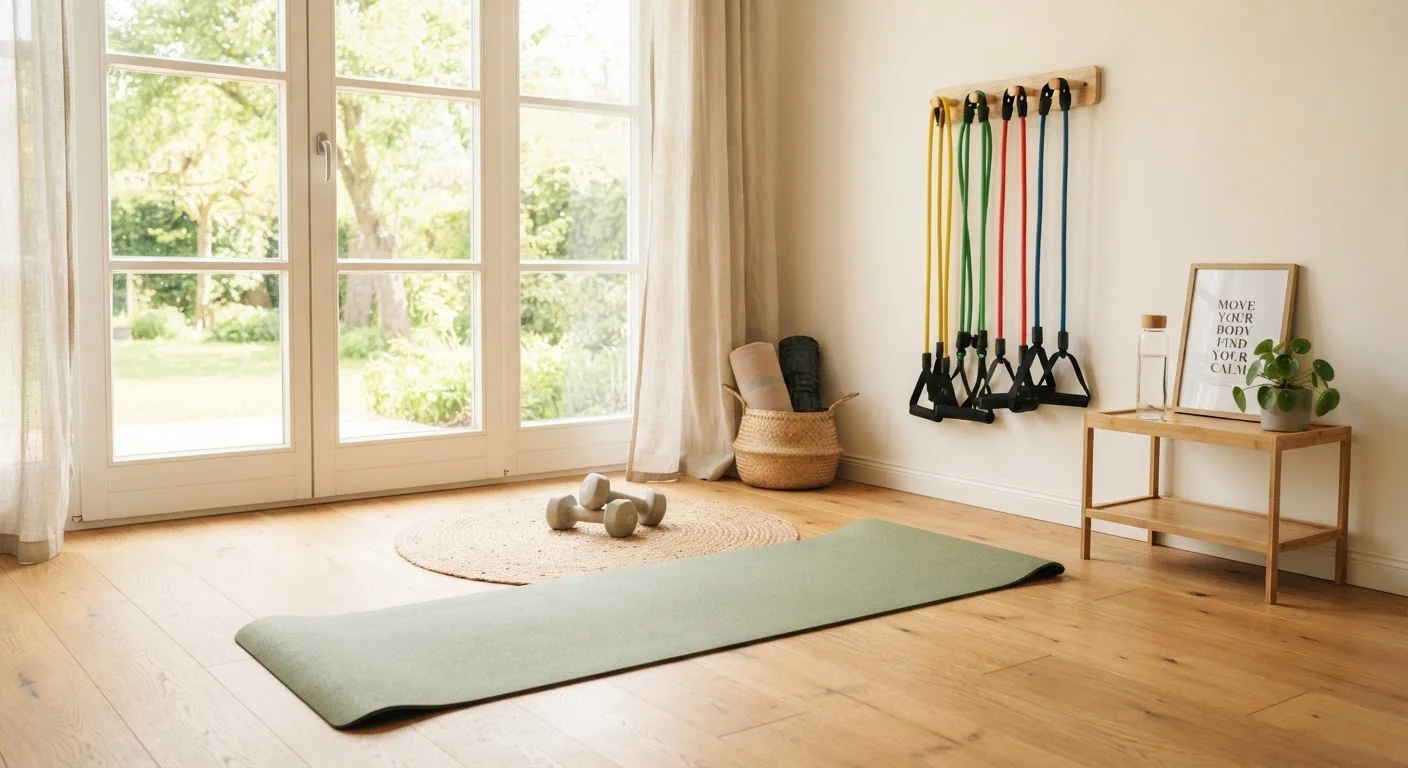
The spaces people actually use long-term share a few qualities: they're tidy, they require minimal setup, and they feel distinct from the rest of the home. None of these require a large budget or a dedicated room. A corner of a bedroom with a mat, a hook for bands, and a small shelf is sufficient.
Think about your morning or after-work routine and where a workout fits most naturally. Place your space along that path if you can - adjacent to where you already start or end your day. Proximity is a powerful consistency driver.
Choose and commit to a specific location
Pick a spot in your home and designate it exclusively - or primarily - for exercise. A spare bedroom, garage corner, basement area, or even a cleared living room section all work. What matters most is that the space is consistent and mentally associated with movement.
Aim for enough floor area to lie down fully with your arms extended - roughly 6×8 feet is a practical minimum. Check that the ceiling height allows for jumping or overhead movements if you plan to include them.
Address the floor surface
Hard floors (hardwood, tile, concrete) are workable but benefit from a quality exercise mat or interlocking foam tiles for joint comfort and noise reduction. Carpet is acceptable for low-impact work but can feel unstable for strength exercises. Foam or rubber flooring tiles are inexpensive, easy to install, and don't require permanent changes to the room.
Optimize lighting and airflow
Poor lighting makes a workout space feel uninviting. If natural light is limited, add a bright overhead bulb or a standing lamp. Adequate airflow prevents the space from feeling stuffy - a small fan is inexpensive and makes a real difference during cardio or strength sessions. Both factors influence how willing you are to enter the space, which matters more than they might seem.
Select your starting equipment - and only that
Resist the impulse to replicate a commercial gym. For most people, a quality exercise mat and a set of resistance bands are enough to begin a well-rounded routine. If you want to add resistance training, a pair of light dumbbells or adjustable dumbbells extends your options considerably without requiring much storage space.
If you're new to exercise altogether, our guide for beginners starting a workout routine covers how to structure your first weeks before you've decided what equipment is right for you.
Set up storage so equipment is visible and accessible
Equipment you have to dig out rarely gets used. Store your mat rolled up nearby (or leave it flat), hang resistance bands on a hook, and keep dumbbells on a small shelf at arm's reach. A single wall shelf or a compact storage basket is often all you need at the beginner stage.
The goal is a zero-setup experience - you walk in, everything is ready, and you start moving within 60 seconds.
Reduce distractions in the space
A home workout area competes with every other activity in your home. Minimize obvious distractions: move non-exercise clutter out of eyeline, consider a dedicated playlist or audio setup, and if possible avoid placing the space directly in front of a television used for passive watching. You don't need a monastery - just a space that feels set apart from leisure or work.
Plan what you'll actually do in the space
A room full of equipment doesn't produce fitness - a plan does. Before your first session, decide which types of workouts you'll do and when. Even a rough weekly framework - two bodyweight strength sessions, one flexibility session - gives your setup a purpose and helps you avoid decision fatigue each day.
For help structuring a realistic schedule, see building a weekly exercise routine around a busy schedule.
Make It Easy to Start, Hard to Quit
Leave your yoga mat unrolled and your resistance bands on a hook you can see from the door. The less you have to set up before a session, the lower the barrier to beginning. Environmental design - making the right choice the easy choice - is one of the strongest levers for long-term consistency. For more on that principle, see workout consistency principles that support lasting habits.
Once your routine is established - typically after several weeks of regular sessions - you'll have a much clearer sense of which additional equipment, if any, would genuinely serve your training. That's the right time to expand, not before.
This article is for general informational and educational purposes only and does not constitute medical or fitness advice tailored to your individual circumstances. Consult a qualified healthcare professional before beginning any new exercise program.