Why Skin Type Is the Starting Point for Any Routine
Walk into any beauty aisle and you'll find products claiming to brighten, balance, hydrate, or control shine. The problem is that a formula designed for one skin type can actively make another worse. A rich, occlusive moisturizer that soothes dry skin may clog pores for someone who produces a lot of sebum. A mattifying toner that benefits oily skin can strip the moisture barrier of someone who's already dry.
This is why identifying your skin type isn't a cosmetic formality - it's the functional first step that makes every subsequent decision more accurate. Once you know your type, ingredient labels and product descriptions start to make sense in a practical, personal way.
If you're building a routine from scratch, our beginner's guide to skincare covers type identification alongside routine building in one place.
~50%
Adults who self-report combination skin
Combination skin is consistently cited in dermatology literature as the most commonly reported skin type among adults seeking skincare guidance.
60-70%
People with self-reported sensitive skin
Studies across multiple countries suggest that a majority of adults describe their skin as sensitive or reactive to some degree, making it one of the most broadly acknowledged skin characteristics.
3-4 layers
Skin barrier thickness affected by skin type
The outermost skin barrier - the stratum corneum - functions differently across skin types, with dry skin showing reduced lipid levels that impair moisture retention compared to oily or normal skin.
The Four Main Skin Types Explained
Oily Skin
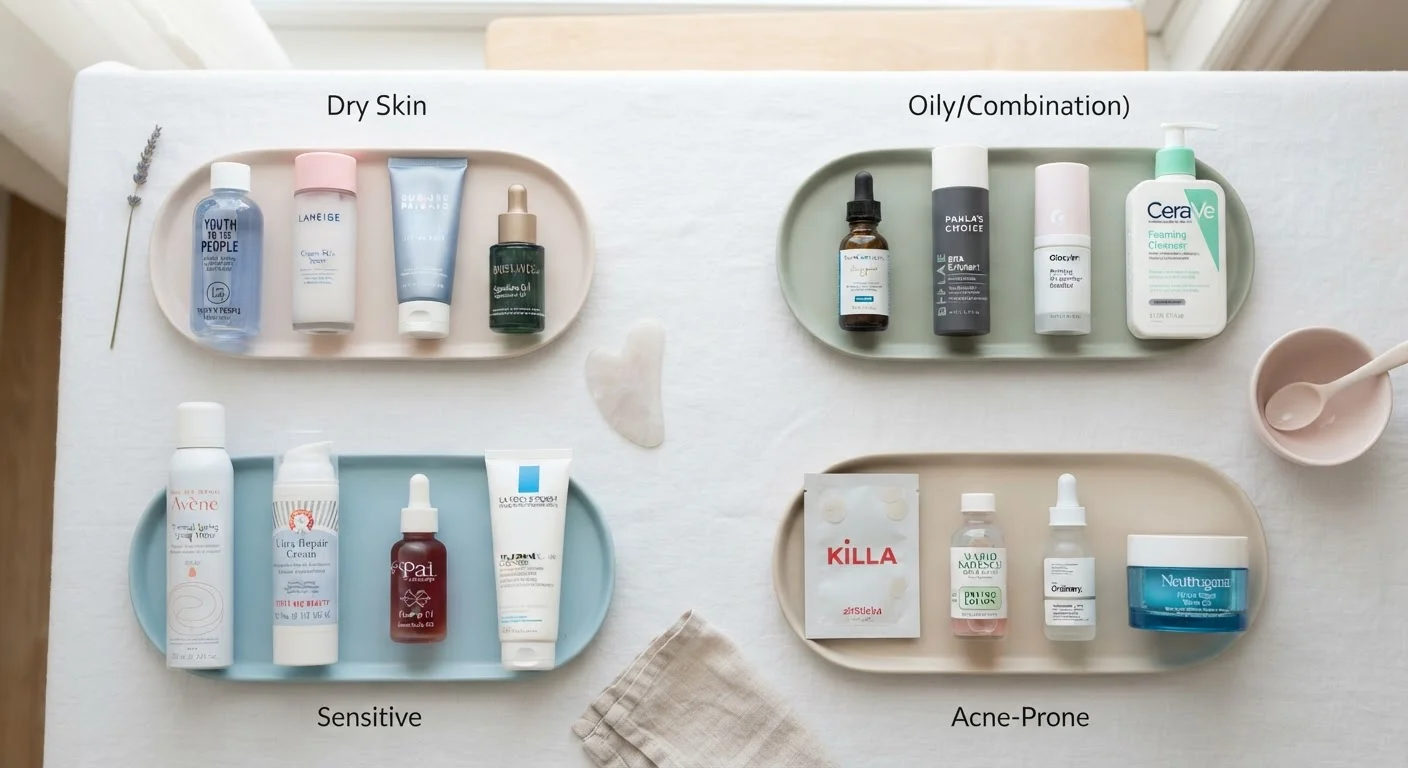
Oily skin produces excess sebum throughout the day, leaving a visible shine - particularly across the forehead, nose, and chin. Pores tend to appear larger, and this type is more prone to blackheads and breakouts. The goal with oily skin is not to eliminate oil entirely (the skin needs some sebum to stay healthy) but to manage excess production without stripping the skin.
Lightweight, non-comedogenic (won't clog pores) moisturizers and gel-based cleansers tend to work well. Skipping moisturizer entirely often backfires - when the skin feels stripped, it can overproduce oil to compensate.
Dry Skin
Dry skin produces less sebum than average, which means it struggles to retain moisture and maintain a healthy barrier. It often feels tight after cleansing, may appear dull or flaky, and is more prone to fine lines showing up early due to a compromised moisture layer.
Cream-based cleansers, richer moisturizers containing ingredients like ceramides or hyaluronic acid, and minimal use of stripping actives (like high-percentage alcohol or strong exfoliants) support this skin type best.
Combination Skin
Combination skin features both oily and dry zones on the same face - typically oiliness through the T-zone (forehead, nose, chin) and dryness or normal behavior on the cheeks. This type requires a degree of nuance: either using different products on different areas, or choosing balanced formulas that don't overcorrect in either direction.
Sensitive Skin
Sensitive skin reacts more readily to products, temperature changes, and environmental stressors. Reactions might include redness, stinging, itching, or a feeling of tightness. Fragrance-free, minimal-ingredient formulas with a lower risk of irritation are generally better tolerated. Sensitive skin can coexist with any of the other three types.
How to Identify Your Skin Type Accurately
The most reliable low-tech method is the bare-face test. Cleanse your face with a gentle, unfragranced wash, pat it dry, and leave it completely bare for 45 to 60 minutes. Then assess:
- Shine across most of the face: likely oily
- Tightness, flaking, or dullness: likely dry
- Shine only in the T-zone, dryness elsewhere: likely combination
- Redness, stinging, or discomfort during or after washing: may indicate sensitivity
Keep in mind that skin can behave differently in summer versus winter, or during hormonal shifts. What you observe on a hot, humid day may differ from what you see in dry winter air. A single observation is useful, but patterns noticed over time are more reliable.
Reassess Your Skin Type Each Season
Skin behavior shifts with humidity, temperature, and lifestyle changes. If your routine stops working as well as it once did, consider whether your skin type has temporarily shifted rather than immediately switching products. A new bare-face assessment during a different season can save you from unnecessary product changes.
Once you have a clear picture of your type, understanding what each step in your routine is doing becomes much easier. Our breakdown of what each skincare step actually does is a natural next read.
Common Mistakes That Come From Misreading Your Skin Type
Many skincare frustrations trace back to a mismatch between product and skin type. A few patterns come up repeatedly:
- Treating dehydration as dryness: Oily skin that feels tight after cleansing may be dehydrated (lacking water), not dry (lacking oil). Reaching for a heavy cream isn't the right fix - a hydrating serum with humectants works better.
- Over-cleansing oily skin: Washing more than twice a day in an attempt to control shine often strips the skin barrier, triggering more oil production - the opposite of the intended effect.
- Skipping moisturizer on oily skin: Oil production and moisture are separate systems. Oily skin still needs hydration; the texture of the product matters more than whether to use one.
- Using heavy products on combination skin: Applying a rich cream across the whole face when only the cheeks need it leads to congestion in the already-oily T-zone.
These kinds of well-meaning missteps are explored in more depth in our article on routine habits that backfire.
“Understanding your skin type is not about labeling yourself permanently - it's about giving yourself a more useful framework for making decisions. That framework should be revisited as your skin changes.”
— Dermatology Education Resource, General dermatology educational guidance