
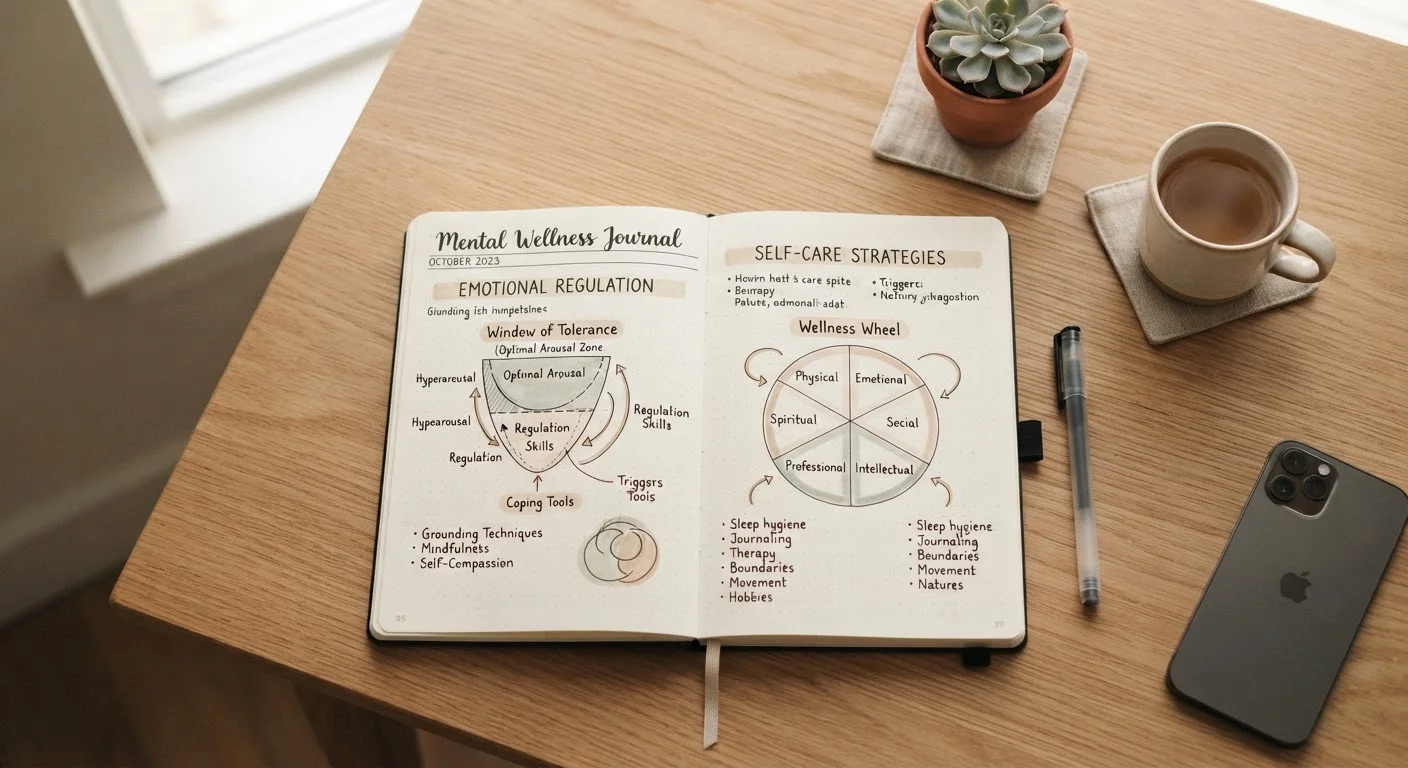
Why Mental Health Vocabulary Matters
Understanding mental health terminology isn't just for clinicians - it equips everyday people to advocate for themselves, communicate clearly with healthcare providers, and reduce the stigma that often surrounds psychological care. When terms like dysregulation, cognitive distortion, or comorbidity appear in a discharge summary or a therapist's intake form, unfamiliarity can create unnecessary anxiety.
This reference glossary defines the most commonly encountered mental health terms in plain language. It is general health information and education, not a substitute for professional diagnosis or treatment. If you are experiencing distressing symptoms, consult a qualified mental health professional.
For a deeper look at one key area this vocabulary unlocks, see our introduction to emotional regulation - a concept that comes up across nearly every mental health discipline.
Anxiety Disorder
A category of mental health conditions characterized by persistent, excessive worry or fear that interferes with daily functioning. Common types include generalized anxiety disorder (GAD), panic disorder, and social anxiety disorder. Anxiety disorders are among the most prevalent mental health conditions in the United States.
Cognitive Behavioral Therapy (CBT)
A structured, evidence-based form of psychotherapy that examines the relationship between thoughts, feelings, and behaviors. CBT helps individuals identify and challenge unhelpful thinking patterns and develop more adaptive responses. It is one of the most extensively researched psychological treatments available.
Cognitive Distortion
An inaccurate or exaggerated thought pattern that can contribute to negative emotions and maladaptive behavior. Common examples include catastrophizing (assuming the worst outcome) and all-or-nothing thinking. Identifying cognitive distortions is a core skill taught in CBT.
Comorbidity
The presence of two or more mental health conditions (or a mental health condition alongside a physical health condition) in the same person at the same time. For example, depression and anxiety disorders frequently co-occur. Comorbidity often influences treatment planning.
Dysregulation
Difficulty managing emotional responses in a way that matches the situation - responses may be more intense, longer-lasting, or harder to recover from than expected. Emotional dysregulation is associated with several mental health conditions, including borderline personality disorder and ADHD.
Nervous System Regulation
The process by which the autonomic nervous system returns to a baseline state of calm after a stress response. Practices such as deep breathing, grounding exercises, and social connection can support regulation. This concept is central to trauma-informed care and polyvagal theory.
Psychotherapy
A broad term for structured, evidence-based talk-based treatments delivered by a licensed mental health professional. It encompasses many approaches, including CBT, dialectical behavior therapy (DBT), and psychodynamic therapy. Goals vary by approach and individual need.
Trauma
A response to an event or series of events that overwhelms an individual's capacity to cope, often leaving lasting effects on emotional, psychological, or physical functioning. Trauma is not defined solely by the event itself but by how the nervous system processes it.
Resilience
The capacity to adapt, recover, or grow following adversity, stress, or significant challenges. Resilience is not a fixed trait - it can be strengthened through supportive relationships, coping skills, and targeted interventions.
Psychiatric Medication
Medications prescribed by a licensed clinician (such as a psychiatrist or primary care physician) to help manage symptoms of mental health conditions. Types include antidepressants, anti-anxiety agents, mood stabilizers, and antipsychotics. Medication decisions require individualized clinical evaluation.
Mindfulness
The intentional, nonjudgmental awareness of present-moment experience - including thoughts, emotions, and physical sensations. Originally rooted in contemplative traditions, mindfulness has been incorporated into several evidence-based treatments, including Mindfulness-Based Stress Reduction (MBSR) and DBT.
Stigma
Negative attitudes, stereotypes, or discrimination directed at people with mental health conditions. Stigma can be social (from others) or internalized (from oneself) and is a significant barrier to help-seeking. Public education and open conversation are among the primary tools for reducing stigma.
Key Terms at a Glance
The following quick-reference card summarizes essential facts about mental health terminology and care access in the United States.
| Prevalence of mental illness in the US | Approximately 1 in 5 adults (National Institute of Mental Health (NIMH)) |
| Most common mental health conditions | Anxiety disorders and major depressive disorder (NIMH) |
| CBT evidence base | Supported by hundreds of randomized controlled trials (American Psychological Association) |
| Treatment gap | Fewer than half of adults with mental illness receive treatment (SAMHSA National Survey on Drug Use and Health) |
| Stigma as a barrier | Stigma cited among the most common reasons people avoid seeking care (Mental Health America) |
Mental health conditions are common, treatable, and well-studied. The terminology used in clinical settings reflects decades of behavioral science research. Many of these terms also appear in conversations about treatment approaches - if you're curious how two leading evidence-based methods compare, our article on CBT vs. Mindfulness-Based Stress Reduction breaks down the differences in accessible detail.
Misconceptions about what therapy involves can discourage people from seeking help. Our piece on common therapy myths addresses the most persistent barriers head-on.
This article is for informational and educational purposes only. It is not medical advice and should not be used to self-diagnose or replace consultation with a licensed mental health professional.