
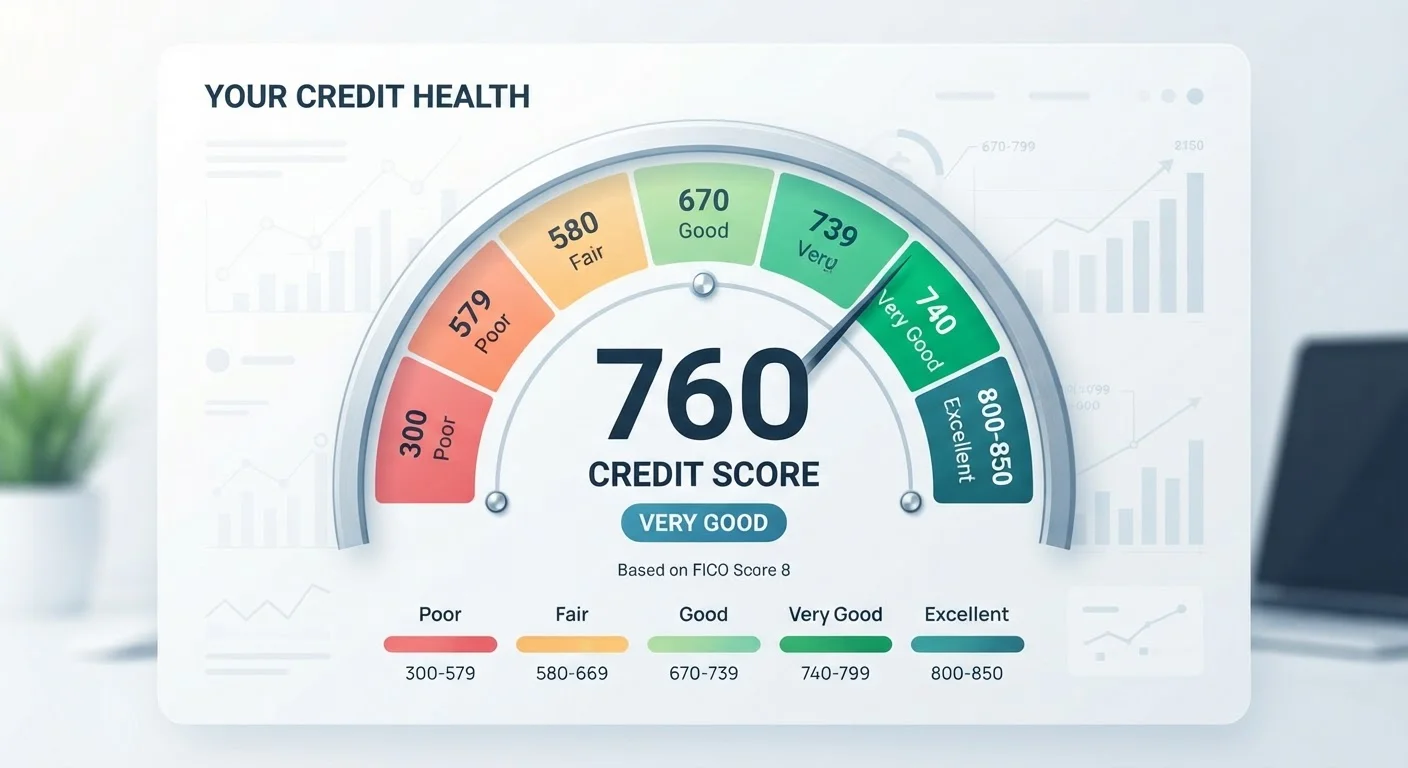
The Five Score Ranges and What They Signal
Under the FICO model - the most widely used by lenders - scores are grouped into five general bands. Understanding what each band means to a lender helps demystify why the number matters beyond just feeling like a grade.
- Exceptional (800-850): Borrowers in this range receive the most favorable rates and easiest approvals. Lenders view them as very low risk.
- Very Good (740-799): This range still unlocks competitive offers. Most prime lending products are fully accessible here.
- Good (670-739): Considered near or at the national median. Most standard credit products are available, though rates may not be the sharpest.
- Fair (580-669): Borrowers may face higher interest rates, stricter terms, or limited product options. Some lenders classify this as subprime.
- Poor (300-579): Approval for unsecured credit is difficult. Secured cards or credit-builder loans are often the tools used to rebuild from here.
These bands are guidelines, not hard cutoffs. Individual lenders set their own thresholds, and some institutions apply overlays - additional criteria beyond the score itself.
716
Average US FICO Score
According to Experian's annual State of Credit report, the average FICO Score in the US has hovered around 716 in recent years, placing most Americans in the 'good' range.
~35%
Weight of Payment History in FICO
FICO publicly states that payment history is the single largest factor in its score calculation, accounting for approximately 35% of a score.
~30%
Weight of Amounts Owed (Utilization)
Credit utilization - how much of your available credit you're using - makes up roughly 30% of a FICO Score, making it the second most influential factor.
Why the Difference Between 670 and 740 Actually Costs You Money
It's tempting to treat a 'good' score as good enough - and for most credit cards or smaller loans, it is. But on larger products like mortgages or auto loans, the gap between score bands translates directly into dollars.
Consider a 30-year mortgage: a borrower with a 680 score might be quoted a rate meaningfully higher than a borrower with a 750 score. On a $300,000 loan, even a 0.5 percentage point difference in rate can add tens of thousands of dollars in total interest over the life of the loan. The score itself doesn't move the needle - it's what the score signals to lenders about repayment probability that drives those pricing decisions.
Two factors carry the most weight in most models: payment history (whether you pay on time) and credit utilization - the ratio of balances to credit limits. Together, these typically account for more than half of a score's calculation. Addressing both is where most improvement potential lies.
What Your Score Doesn't Tell Lenders
A credit score is a compressed signal - useful but incomplete. Lenders typically look at additional factors alongside a score when making final decisions.
Your income, employment history, and debt-to-income ratio are evaluated separately. A strong score with a high existing debt load may still result in a declined application because the lender's model accounts for whether you realistically have room to take on more debt. Conversely, a score in the fair range paired with a substantial down payment and low existing obligations may be enough for approval on certain loan types.
To understand what's driving your score, you need to look at your full credit report - not just the number. A plain-language walkthrough of every section of your credit report shows what lenders actually see when they pull your file. And if you're trying to separate fact from inherited wisdom, common credit score myths that circulate widely can lead people to actively harm their scores with well-intentioned moves.
This article is for general informational purposes only and does not constitute personalized financial or credit advice. For guidance specific to your situation, consider consulting a qualified financial professional.