
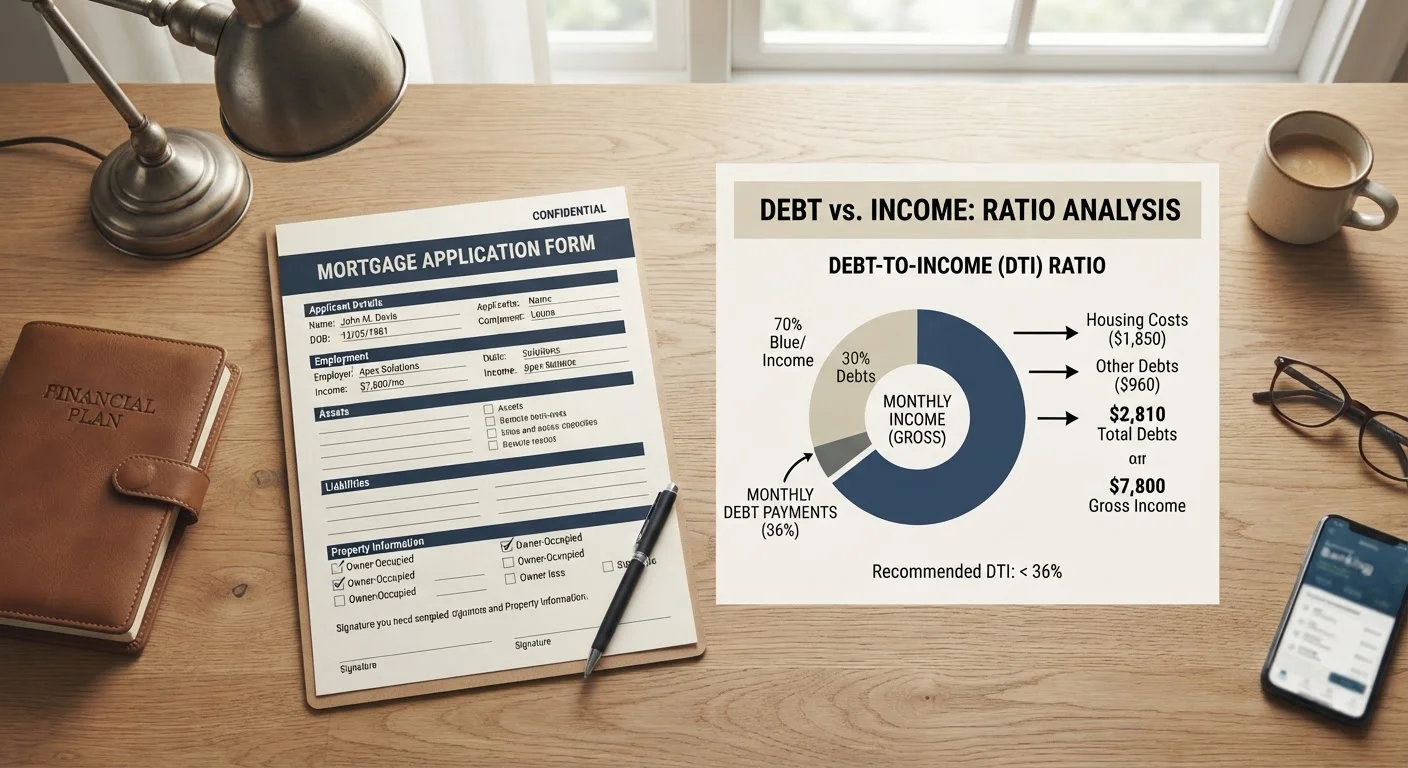
How DTI Is Calculated
The formula is straightforward: add up all of your minimum monthly debt payments, then divide that total by your gross monthly income, and multiply by 100 to get a percentage.
Example: If you have $500 in monthly debt payments (car loan, student loan, credit card minimums) and earn $5,000 per month before taxes, your DTI is 10% ÷ = ($500 ÷ $5,000) × 100 = 10%. Add a proposed mortgage payment of $1,200 and your back-end DTI rises to ($1,700 ÷ $5,000) × 100 = 34%.
Lenders calculate two versions of this ratio. The front-end ratio covers only housing costs - principal, interest, property taxes, homeowner's insurance, and HOA fees where applicable. The back-end ratio adds all other recurring debt obligations. Most underwriters focus on the back-end figure when making approval decisions. For a broader look at the debt terminology you'll encounter throughout this process, see common debt terms every borrower should recognize.
43%
Common back-end DTI ceiling for conventional mortgages
Fannie Mae and Freddie Mac guidelines generally cap the back-end DTI at 45-50%, but many lenders apply a practical benchmark of 43% for standard approvals.
~28%
Typical front-end DTI guideline for housing costs
Many lenders prefer that housing expenses alone - mortgage payment, taxes, and insurance - not exceed roughly 28% of a borrower's gross monthly income.
50%
Maximum DTI allowed under some FHA loan guidelines
The FHA may permit back-end DTIs up to 50% for borrowers who meet additional compensating criteria such as significant cash reserves or strong credit scores.
Why Lenders Weight DTI So Heavily
A mortgage is typically the largest financial obligation a household carries, and lenders need assurance that a borrower won't become overextended. DTI provides a standardized, objective snapshot of that risk. Unlike a credit score, which reflects payment history and credit behavior, DTI directly measures current cash-flow capacity.
Conventional loans backed by Fannie Mae and Freddie Mac set a general ceiling of 45-50% DTI, though 43% is the threshold many lenders treat as a practical benchmark. Government-backed programs have different tolerances - FHA loans can go higher in some cases, while VA loans emphasize residual income as an additional qualifier. To understand how DTI interacts with each loan structure, the article on mortgage types including FHA and VA options provides useful context.
“The debt-to-income ratio is one of the most telling indicators of a borrower's ability to sustain mortgage payments over time. It captures the relationship between what someone owes and what they earn in a way that credit scores alone cannot.”
— Consumer Financial Protection Bureau, U.S. federal agency overseeing mortgage lending standards
Strategies to Improve Your DTI Before Applying
There are only two levers: reduce monthly debt obligations or increase gross monthly income. Both take time, which is why financial preparation well before applying matters.
- Pay down revolving balances: Credit card minimum payments count toward DTI even when balances are small. Eliminating or significantly reducing balances lowers your required monthly payment. This also tends to improve your credit utilization ratio, benefiting your overall credit profile simultaneously.
- Avoid taking on new debt: A new car loan or personal loan in the months before applying can meaningfully raise your DTI and raise red flags for underwriters.
- Consolidate strategically: In some cases, debt consolidation can reduce total minimum payments by extending a term - but this trade-off deserves careful analysis since it may increase total interest paid over time.
- Document all income sources: If you have freelance income, rental income, or other documented earnings, work with your lender to ensure these are properly accounted for in your gross income figure.
Check Your DTI Before You Start Shopping
Calculate your own back-end DTI using your most recent pay stubs and credit report before speaking with a lender. This gives you a clear picture of where you stand and how much room you have for a mortgage payment. If your DTI is above 43%, identifying which debts to address first can make a significant difference in the loan amount you qualify for.
DTI in the Context of Mortgage Pre-Approval
When you apply for mortgage pre-approval, DTI is one of the first calculations an underwriter performs. Lenders pull your credit report to identify all reported monthly obligations, verify your income documents, and run both the front-end and back-end ratios against their guidelines. A DTI that falls outside acceptable ranges can result in a lower loan amount offer or a denial.
Understanding your DTI before you begin house hunting gives you a realistic price ceiling and reduces the chance of surprises during underwriting. For a full breakdown of what lenders review at that stage, see what a mortgage pre-approval actually involves.
This article is for general informational and educational purposes only and does not constitute financial, legal, or mortgage advice. Lending standards vary by institution and loan program. Consult a licensed mortgage professional for guidance specific to your financial situation.